
In the late 1960s, Israel believed it was close to acquiring one of Europe’s most advanced battle tanks. Its crews and engineers tested Britain’s Chieftain and proposed changes for desert warfare. Then London cancelled the arrangement, leaving Israel without the fleet it expected to buy.
That decision changed Israeli planning. Rather than keep searching for another foreign tank, Israel accelerated its own programme. The result was the Merkava, shaped by needs imported platforms could not fully answer. Now, as Europe rebuilds armoured forces, the tank born from an export refusal is attracting new attention.
The British decision that changed Israeli planning
Britain and Israel explored close Chieftain cooperation during the 1960s. Two tanks were sent for trials, and Israeli specialists assessed mobility, heat and maintenance. Israel expected this work to lead to a major purchase, possibly with local production.
After the 1967 war, London reassessed relations with Arab states and ended the proposed sale. For Israeli planners, the lesson was severe: a foreign supplier could close the door even after years of technical cooperation.
Israel still bought components and cooperated with allies, but it no longer wanted the survival of its armoured force to depend entirely on an export licence. In 1970, the government backed a domestic tank programme led by General Israel Tal. The first Merkava entered service near the end of that decade.
A tank built around a different priority
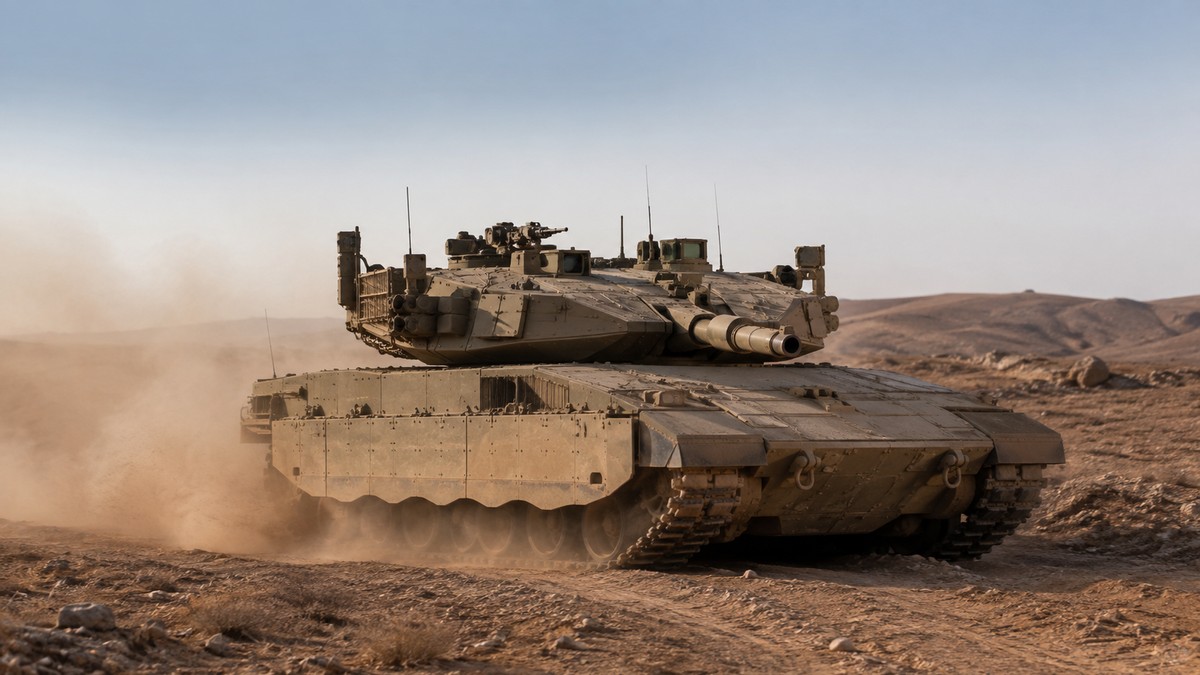
The Merkava did not simply copy the Chieftain. Its most recognisable choice was to place the engine at the front, adding another layer between incoming fire and the crew. A rear door made it easier to evacuate wounded soldiers, resupply ammunition or carry a small infantry team in exceptional circumstances.
Those decisions reflected Israel’s limited manpower and expectation of fighting close to home. Protecting trained crews mattered as much as preserving the vehicle. Later Merkavas gained modular armour, digital networking and the Trophy active protection system against certain incoming anti-tank threats.
The latest Merkava 4 Barak brings sensors and information together for the commander more quickly than earlier versions. Yet the concept remains familiar: a heavily protected tank tailored to Israeli terrain, doctrine and logistics rather than a universal machine intended from the outset for export.
Why European interest is significant
For decades, the Merkava was rarely a realistic foreign purchase. Israel needed production for its own forces, while European armies operated Leopard, Challenger or Leclerc fleets. That calculation is shifting as governments seek tanks faster than factories can deliver new ones.
Cyprus has repeatedly been linked to talks over surplus Merkava 3 vehicles, while reports describe other European enquiries. The distinction matters: interest, negotiation and a signed acquisition are not the same thing. No broad wave of confirmed orders has been announced.
Some armies are also buying Israeli technology developed around the tank rather than the entire vehicle. Trophy has been selected for modern Western platforms, giving the Merkava programme an influence far beyond the number of complete tanks Israel might export. Europe may adopt parts of the Israeli solution before it adopts the tank itself.
Independence never meant isolation
The Merkava is often presented as proof that Israel achieved complete industrial independence after Britain walked away. The reality is more nuanced. Different versions have relied on foreign engines, transmissions and other components, while cooperation with the United States and European suppliers remains important.
Israel gained control over the design and development of its principal tank. It could decide where to place protection, how to respond after combat and which capabilities required investment. Strategic autonomy meant retaining the final engineering choice, not manufacturing every bolt at home.
That distinction resonates in Europe. The war in Ukraine exposed thin stockpiles, slow production and fragile supply chains. A combat-tested platform from surplus stocks can look attractive even if it requires new training, ammunition and maintenance.
Britain’s cancelled sale did not guarantee that the Merkava would succeed. Israel still had to finance, design and refine the tank through decades of difficult service. But the refusal forced a decision that an easier procurement path might have postponed. A vehicle born from dependence became an instrument of choice.
If a European army eventually fields the Merkava, the symbolism will be unmistakable. A tank created because Israel could not rely on a European supplier may return as an Israeli export. The case for controlling a critical weapon system now looks less like isolation and more like foresight.
