
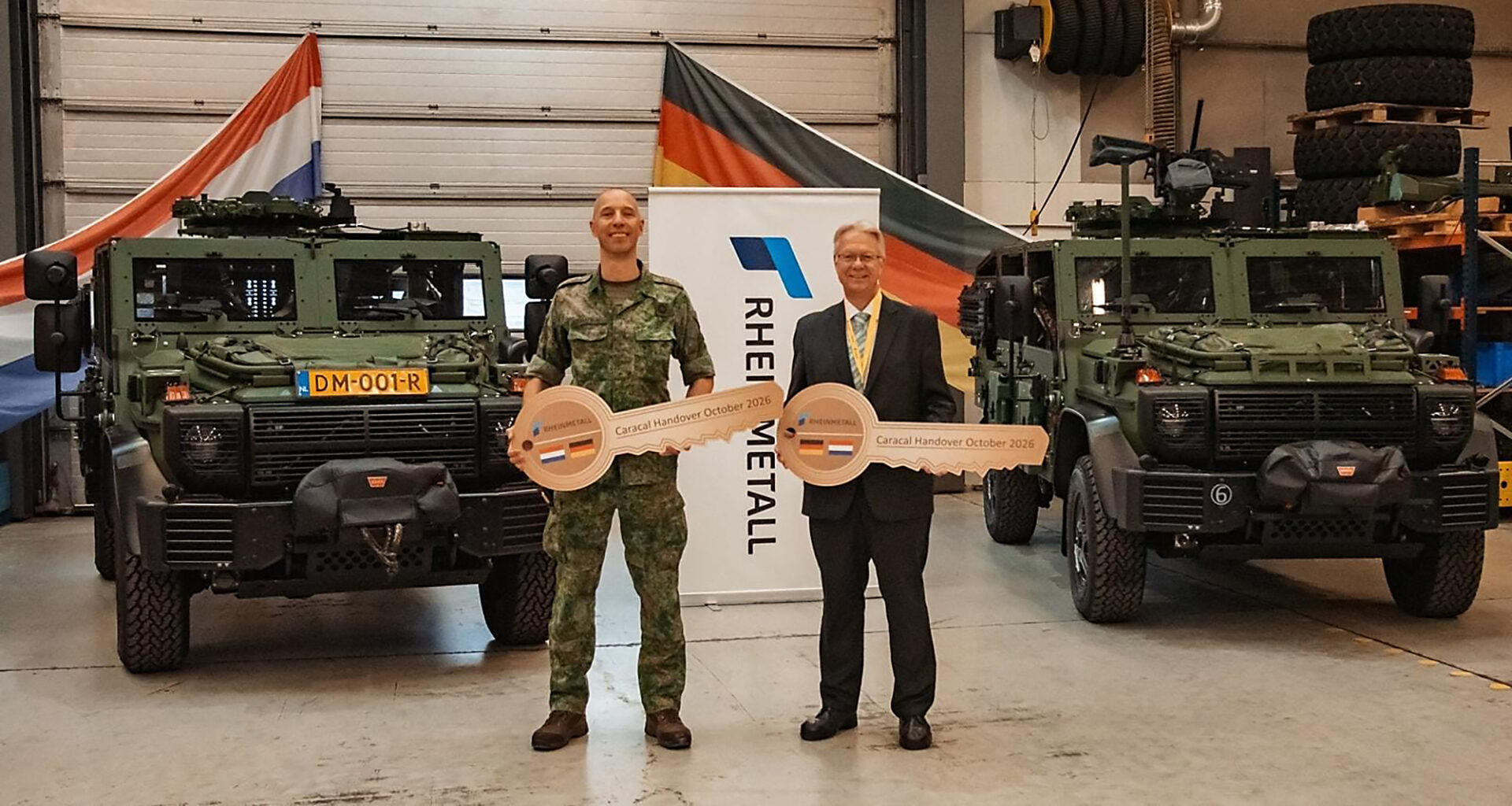
The Bundeswehr yesterday took delivery of the first serial vehicles of the new airborne vehicle CARACAL. Rheinmetall Landsysteme and Rheinmetall Defence Nederland handed over the vehicles yesterday at the production site in Ede, the Netherlands, to the Bundesamt für Ausrüstung, Informationstechnik und Nutzung der Bundeswehr (BAAINBw) as well as the Dutch Defence Material and IT Command (COMMIT). By 2030, more than 1,000 CARACAL are to be delivered to the Bundeswehr.
Airborne Platform CARACAL
With the CARACAL, the German and Dutch airborne forces receive a common vehicle platform specifically developed for air-mobile operations. The Bundeswehr will initially receive two variants: a personnel and equipment transporter and a medical vehicle, with the initial deliveries limited to the personnel/equipment transporter.
The vehicles are intended to replace, among others, the airborne variants of the Wolf and older Mungo-type vehicles used by the German and Dutch forces. The broadly identical equipment not only eases joint training and operations but also simplifies spares provisioning and maintenance. And as the project lead at the BAAINBw emphasizes: “With the CARACAL, the airborne forces and specialized troops of the Bundeswehr receive a multifunctional and highly mobile mission vehicle.”
Base: Mercedes-Benz G-Class
The CARACAL is a joint development by Rheinmetall, Mercedes-Benz and ACS Armoured Car Systems. Mercedes-Benz provides the vehicle platform based on the G-Class model 464, which also underpins the Wolf 2 already fielded by the Bundeswehr. ACS developed the modular cab layout, while Rheinmetall, as overall contractor, handles the integration of the different vehicle variants and final assembly.
Powered by a three-liter six-cylinder diesel engine delivering 183 kW (249 hp). Maximum torque 600 Nm. Through a nine-speed gearbox and permanent all-wheel drive, power is transmitted to the wheels. Top speed up to 140 km/h.
With a length of about 4.35 m, a width of 1.81 m and a height of 1.85 m, the CARACAL is relatively compact. Its off-road capability includes climbing gradients of up to 60 percent. Its ability to climb over obstacles reaches 33 centimeters, and its trench-crossing capability is 50 centimeters.
The robustness of the G-Class is combined with a military-dedicated body developed by ACS. A key feature is the rail system integrated by ACS. Through slot nuts, threads and fasteners, various equipment elements and kits can be mounted on the vehicle. Consequently, the CARACAL can be adapted for different tasks without the need to develop a completely new vehicle platform each time.
Air Transport with CH-47 Chinook
One of the most important requirements for the CARACAL is its air-transportability. The vehicle has therefore been designed so that it can be transported by the Bundeswehr’s future heavy-lift helicopter, the CH-47 Chinook, which has already been adopted by the Dutch forces as well for both internal and external loads.
To provide the necessary balance of payload, off-road capability and protection, the CARACAL achieves this through its modular construction. Its protection level can be extended as needed with additional ballistic and mine protection elements. According to the manufacturer, protection to STANAG 4569 Level 1 is possible.
From Transport Vehicle to Weapons Carrier
However, the CARACAL is much more than a pure transport vehicle. Its modular construction enables different military configurations. In addition to personnel and material transport and medical support, armed variants are planned. The platform can be equipped with heavy machine guns or Spike anti-tank guided missiles. This allows the CARACAL to function as a highly mobile weapons carrier.
For the airborne forces, this means they do not have to resort to a different vehicle type for each task. On a common platform, different capabilities can be provided, from resupply to casualty transport to fire support. The modularity also offers the ability to adjust the vehicles during their service life to changing requirements. In light of rapid technological developments, for example in drones and unmanned systems, this capability is becoming increasingly important.
German-Dutch Procurement Project
The CARACAL procurement stems from a joint decision by Germany and the Netherlands in 2022. Given the very close integration of the two army units, joint procurements are highly sensible.
In July 2023, Rheinmetall finally received the contract to manufacture and deliver the new airborne platform. The framework contract covers up to 3,058 vehicles, of which up to 2,054 are for Germany and 1,004 for the Netherlands. The potential total contract value amounts to around 1.9 billion euros. In a first step, 1,508 vehicles were definitively ordered at a value of around 870 million euros. Germany will receive 1,004 vehicles and the Netherlands 504.
The final assembly takes place in the Netherlands, including at the Rheinmetall site in Ede. The handover of the first serial vehicles on 29 October marks another step in the joint modernization of the German and Dutch airborne forces.
CARACAL Vehicle Family with 6×6
Parallel to the introduction of the CARACAL with 4×4 drive, Rheinmetall is already working on a larger three-axle variant. The CARACAL 6×6 was presented for the first time in June 2026 at the Eurosatory defense exhibition in Paris as a testbed. The additional axle is intended mainly to enable a higher payload. For the 6×6 variant, a permissible gross vehicle weight of 6.5 tons and a payload of up to 3.3 tons are planned. It could thus serve, among other roles, as a personnel carrier for ten people or as a material transporter, and could replace older Mungo vehicles.
The serial readiness of this heavier variant is not expected until 2028. The vehicles now delivered to the Bundeswehr belong to the already ordered CARACAL vehicle family with 4×4 drive.
With the handover of the first serial vehicles, the Bundeswehr now begins the next step in modernizing its air-mobile forces. The crucial factor will be how quickly the new vehicles can be integrated into units and how many variants will be available in sufficient numbers. By 2030, more than 1,000 CARACAL are to be delivered to the Bundeswehr.
Author: Dorothee Frank, Online Editor-in-Chief
