
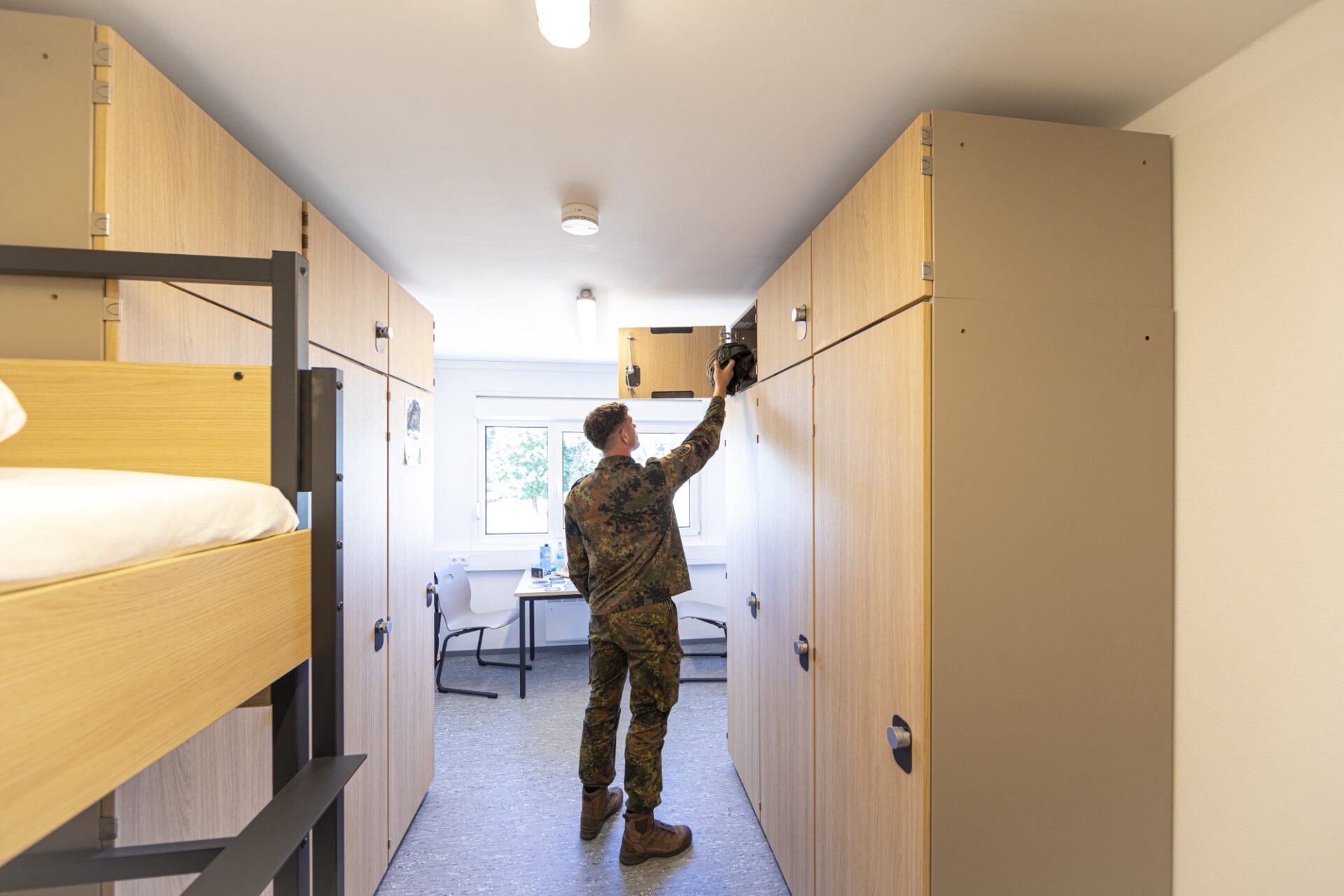
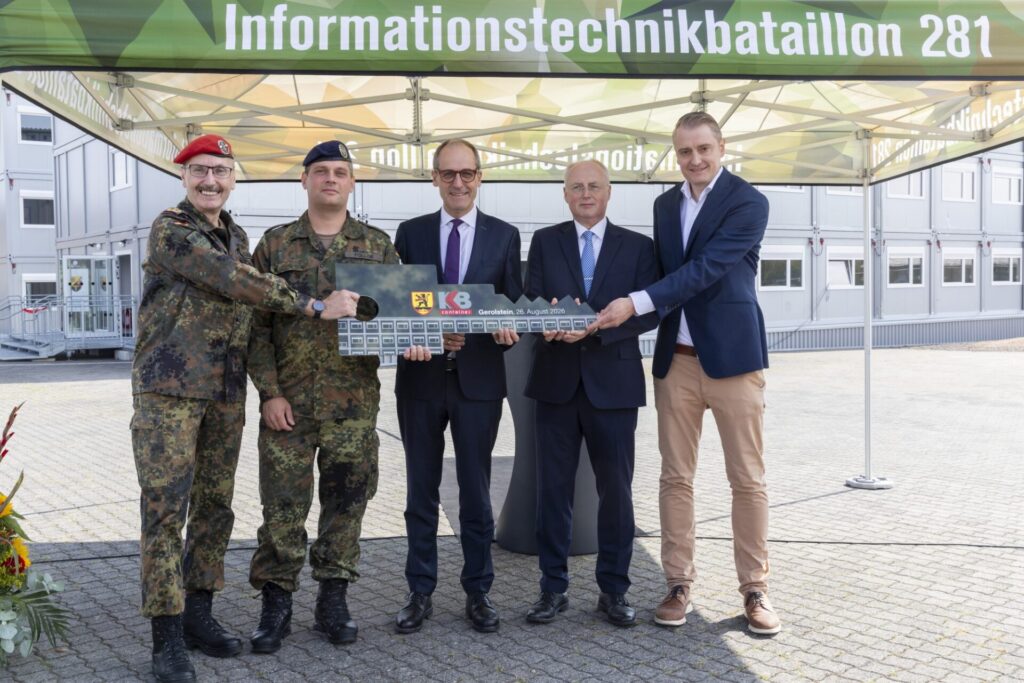
The Information Technology Battalion (ITBtl) 281, on Wednesday, 26 August, at the Eifel Barracks in Gerolstein, took over the first new accommodations from the “Immediate Program for Infrastructure Needs for Personnel Recruitment Organization” (SIPGO) for soldiers. The program’s objective is to quickly provide flexible container-based infrastructure at regional locations suitable for the growth of the armed forces.
The ceremonial event in Gerolstein marked a milestone of particular significance. Nationwide, the construction program coordinated by the Federal Office for Infrastructure, Environmental Protection and Services of the Bundeswehr (BAIUDBw) will create more than 8,600 accommodation places in 4,800 containers at 32 sites. For the recruits of the New Wehrdienst in Gerolstein, the necessary infrastructure will be ready in time for the fourth quarter of 2026.

At the Gerolstein site this means additional capacity for 200 basic training slots per cohort. According to BAIUDBw, functional container accommodations designed for double occupancy, sanitary modules, versatile functional spaces, and contemporary training rooms were created for ten million euros. The preparatory site access and earthworks were rapidly carried out in advance by the responsible Bundeswehr Service Center (BwDLZ) Mayen.
“A Gamechanger for the Upswing”
The Head of the Upswing Department at the Federal Ministry of Defence (BMVg), Ministerial Director Dr. Alexander Götz, believes that one does not have to hide behind the civilian economy “SIPGO is a gamechanger for the upswing. These buildings show: our plan has worked.” Professor Dr. Roland Börger, President of the Federal Office for Infrastructure, Environmental Protection and Services of the Bundeswehr (BAIUDBw), praised in his address the outstanding achievement of all involved: “This building behind me is far more than just a simple container construction.”
It stands, instead, as an exemplary instance of a previously unique effort by the Bundeswehr’s infrastructure organization and the commitment of many people who made this success possible, Börger stated. And the President of the Federal Office for Personnel Management of the Bundeswehr (BAPersBw), General Lieutenant Robert Sieger, emphasized: “Recruiting personnel and housing are two sides of the same coin. The New Wehrdienst stands and falls with whether we can actually admit the people who decide to join us. And that must be attractive, functional, and above all at the place where they are needed and want to serve.”
The Information Technology Battalion 281 in Gerolstein
The Information Technology Battalion 281 in Gerolstein, located in northern Rhineland-Palatinate, is part of the Cyber and Information Space of the Bundeswehr, the youngest of the Bundeswehr’s four armed services. The approximately 670 soldiers, with state-of-the-art information and communications technology, ensure the leadership capability of the armed forces – in domestic exercises as well as in deployments worldwide. In an era of growing security-policy challenges, reliable, protected, and high-performance IT infrastructure and communications are indispensable for the success of military operations.
Since October 2020, the 6th Company has ensured the training. Through the qualified core personnel, the future comrades learn in their twelve-week homeland defense training (formerly basic training) the necessary tools to succeed in their further military career. This includes, among other things: Internal leadership, political instruction, formal training, communications, NBC (Nuclear-Biological-Chemical) and medical training, as well as combat service, weapons and guard training.
