The U.S. armed forces listed 60 more wounded in the Iran War, ongoing since February, last week. From Wednesday to Thursday the published total rose from 697 to 757. Last month the Pentagon split the tally into two lists: one for the initial “Operation Epic Fury” with 418, and one for “Overseas Operations” since July 7 with 339 wounded. In addition, 14 killed in the first category and four more in the second.
According to official statements, this was due to the official end of “Epic Fury” following the signing of a Pakistan-brokered agreement to begin negotiations between the United States and Iran on June 12. The Trump administration thus avoided, in its own interpretation, the requirement to obtain authorization from the U.S. Congress for continuing the operation after the 60-day period mandated by the War Powers Resolution of 1973.
U.S. Cites Iran War as Reason for Cancellation in South Korea
As of the deadline July 7, Trump notified Congress of a resumption of hostilities, thereby, under the same interpretation, another 60-day period began. However, the United States and Iran, after the June 12 agreement expired, have not reached an official ceasefire and, according to American statements, are currently not negotiating. Critics argue that the interruption of hostilities was declared arbitrarily and that the resulting division of the statistics also serves to conceal total losses.
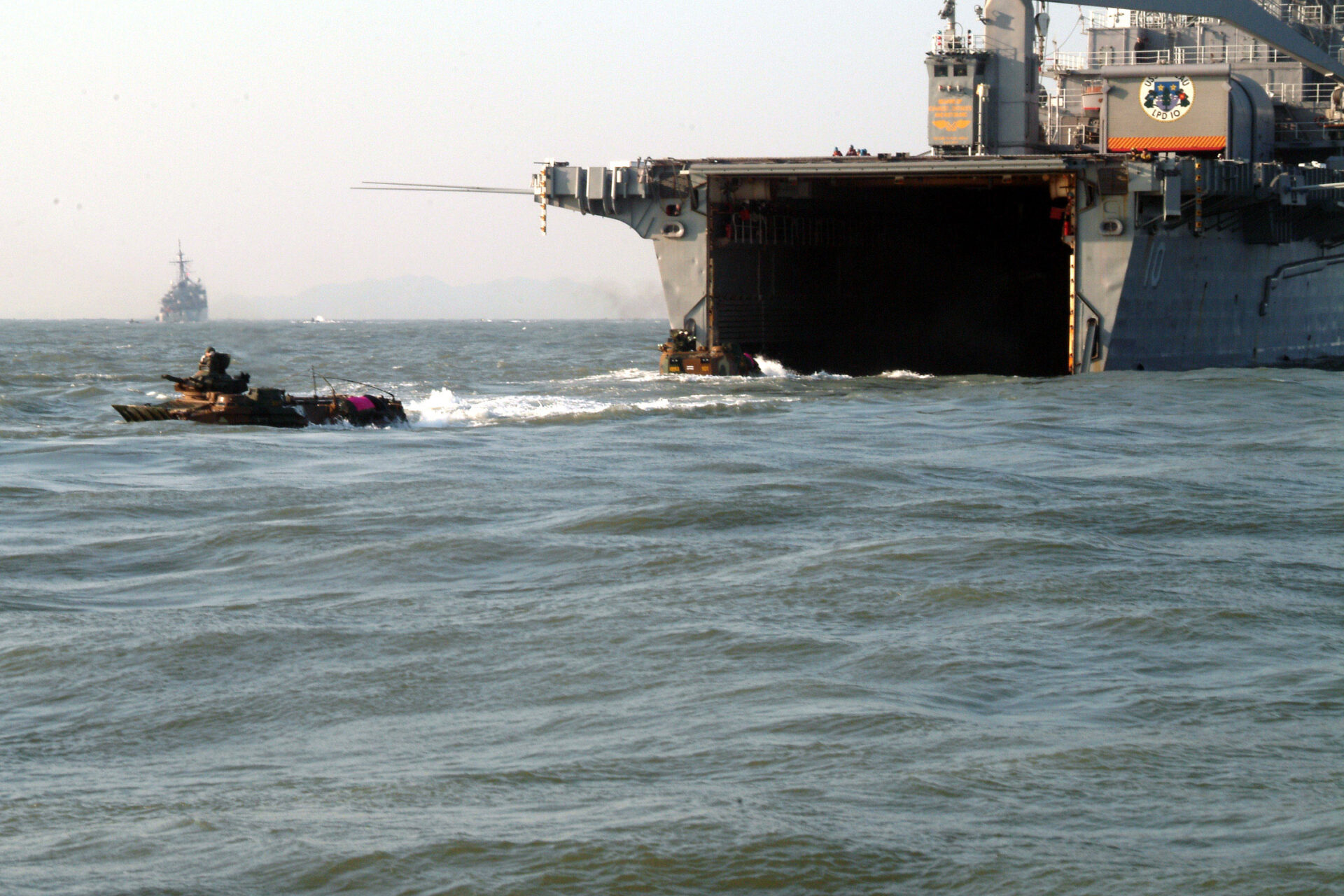
Meanwhile, on Monday this week the United States cancelled an amphibious exercise with the South Korean Marine Corps planned for next month, citing limited troop availability due to operations in the Persian Gulf. According to information from the South Korean side, there had already been a warning in June. Following the start of the Iran War, the United States initially deployed the amphibious task group around the helicopter carrier USS Tripoli with the 31st Marine Expeditionary Unit (MEU) from Japan, and subsequently the task group around the USS Boxer with the 11th MEU from California to the Gulf.
Trump Responds to North Korea Criticism
The 22nd MEU with the group around the USS Iwo Jima only returned home in June after nearly ten months of deployment in the Caribbean. Since the 11th MEU also went to sea prematurely because of the Iran War, the force posture of the U.S. Marine Corps is likely strained. For South Korea, the cancellation follows the reduced American participation in the annual Ulchi Freedom Shield exercise in the past week. After North Korea criticized it as usual, President Trump also described it, as in a similar case during his first term, as an “inappropriate and hostile” signal.
Trump had previously criticized South Korea for its lack of involvement in the Iran War and also pointed to his “very good” relationship with North Korean dictator Kim Jong-un, whom he had met several times in his first term and had claimed the issue of his country’s nuclear weapons was practically settled. Shortly before the start of the maneuvers, American participation was limited until last Friday. North Korea nonetheless demonstratively fired ten ballistic short-range missiles. In light of this, the new cancellation of the exercises in Seoul is likely to cause further irritation.
