
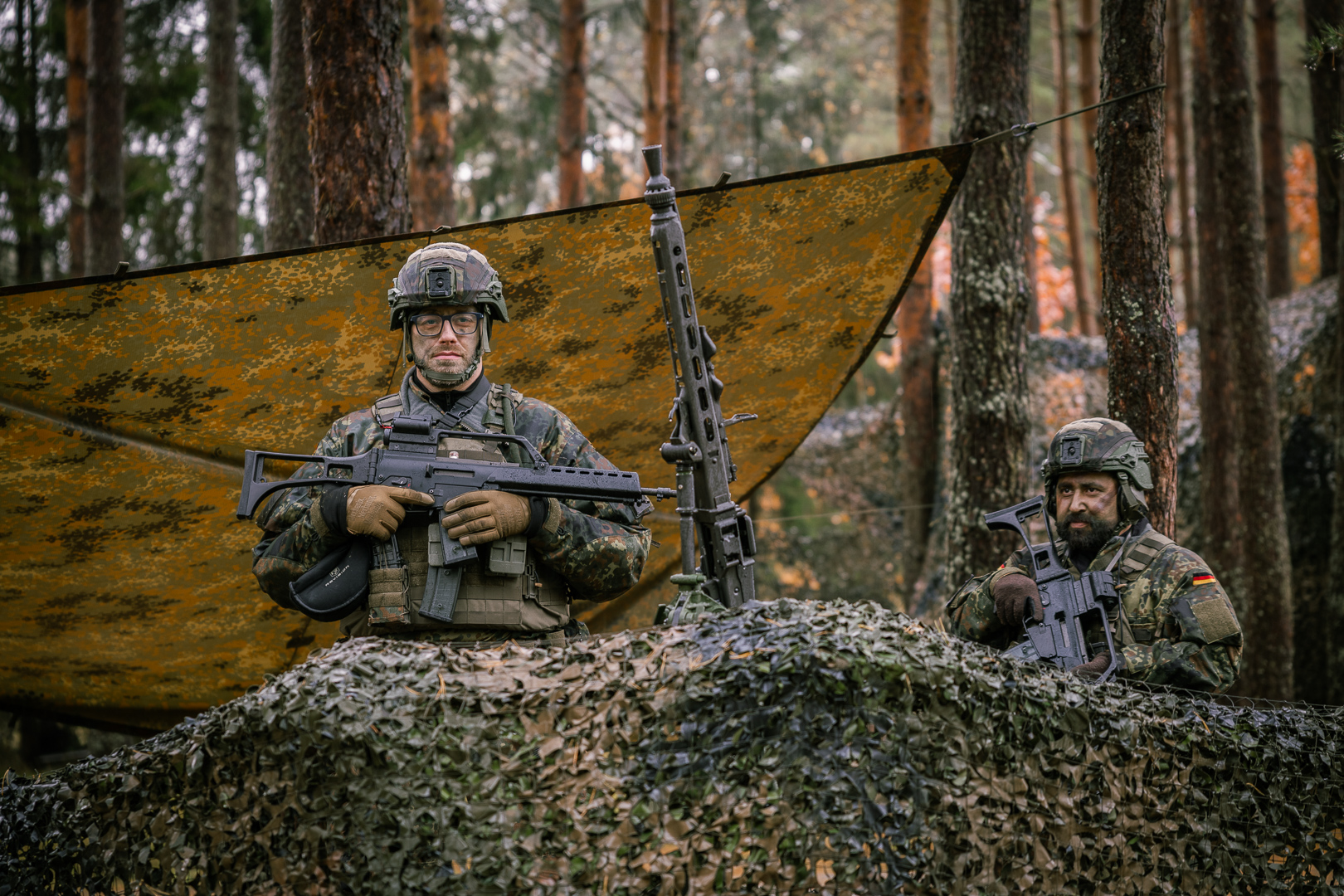
The Armoured Brigade 45 “Lithuania” is to be fully combat-ready by the end of 2027 as a fighting troops brigade on the NATO eastern flank. Currently, according to a Bundeswehr press release issued yesterday, Monday, almost 80 percent of the positions are already filled, so far exclusively by volunteers. Considering the long lead times and the partly high specialization required of the soldiers, this is a major success. The occupancy rate of the portion of the brigade that is already in Lithuania is even around 92 percent.
Since the end of April, there has been a notable increase from around 20 to 80 percent in voluntary registrations and the resulting postings. Since May, more than 2,500 soldiers have volunteered. This shows that the attractiveness measures are working and that the recruitment process is proceeding successfully. Therefore, it is to be expected that in the coming weeks and months, more soldiers will continue to volunteer. The principle of voluntariness remains the guiding policy.
From now on, supplementary mandatory measures
Federal Minister Boris Pistorius commented: “Not even three years after the first announcement, it is clear today that the Lithuania Brigade will, as planned, commence its deployment on the NATO eastern flank by the end of 2027. Infrastructure, equipment and personnel will be ready in time so that the first fully combat-ready Bundeswehr brigade can be deployed abroad. This applies to the troops’ accommodation as well as to the German Bundeswehr’s overseas school, up to the battle tank. This is an impressive result of the close cooperation between the armed forces and the Bundeswehr administration.”
This development is an achievement of the entire Bundeswehr, as personnel from all service branches and organizational sectors could be recruited for the Lithuania Brigade, the press release states. At the same time, Germany stands by its word as a reliable alliance partner. As already announced by Minister Pistorius, alongside further voluntary outreach for a few areas, supplementary mandatory measures for deployment would therefore also come into effect immediately. This is meant to staff this more than a year ahead of the planned full readiness.
Assignments to Lithuania in shortage areas possible
Similar to the civilian labor market, there are also postings in the Bundeswehr that require lengthy qualification and are inherently less available, for example in logistics or information technology. Therefore, in shortage areas the use of short-term assignments, rotation models and short-term official stays should also be examined. For example, a ship’s cook who is not needed during a longer dry-dock period of his ship could be deployed to Lithuania on an assignment basis for several months.
In this way, the operability and readiness of the brigade as well as of formations and units in Germany can be ensured. Based on current forecasts and considering continued expected voluntary registrations, the share of commitments is expected to remain in the mid three-digit range. These would be carried out in close coordination with the military organizational sectors and always with an eye to Germany’s overall contribution to the alliance.
The maintenance of the Bundeswehr’s deployment readiness has the highest priority and is the decisive criterion in all measures. In all decisions to be made, the personal concerns of the servicewomen and servicemen would be taken into account as far as possible. Nevertheless: readiness for deployment takes precedence over voluntariness in case of doubt.
