
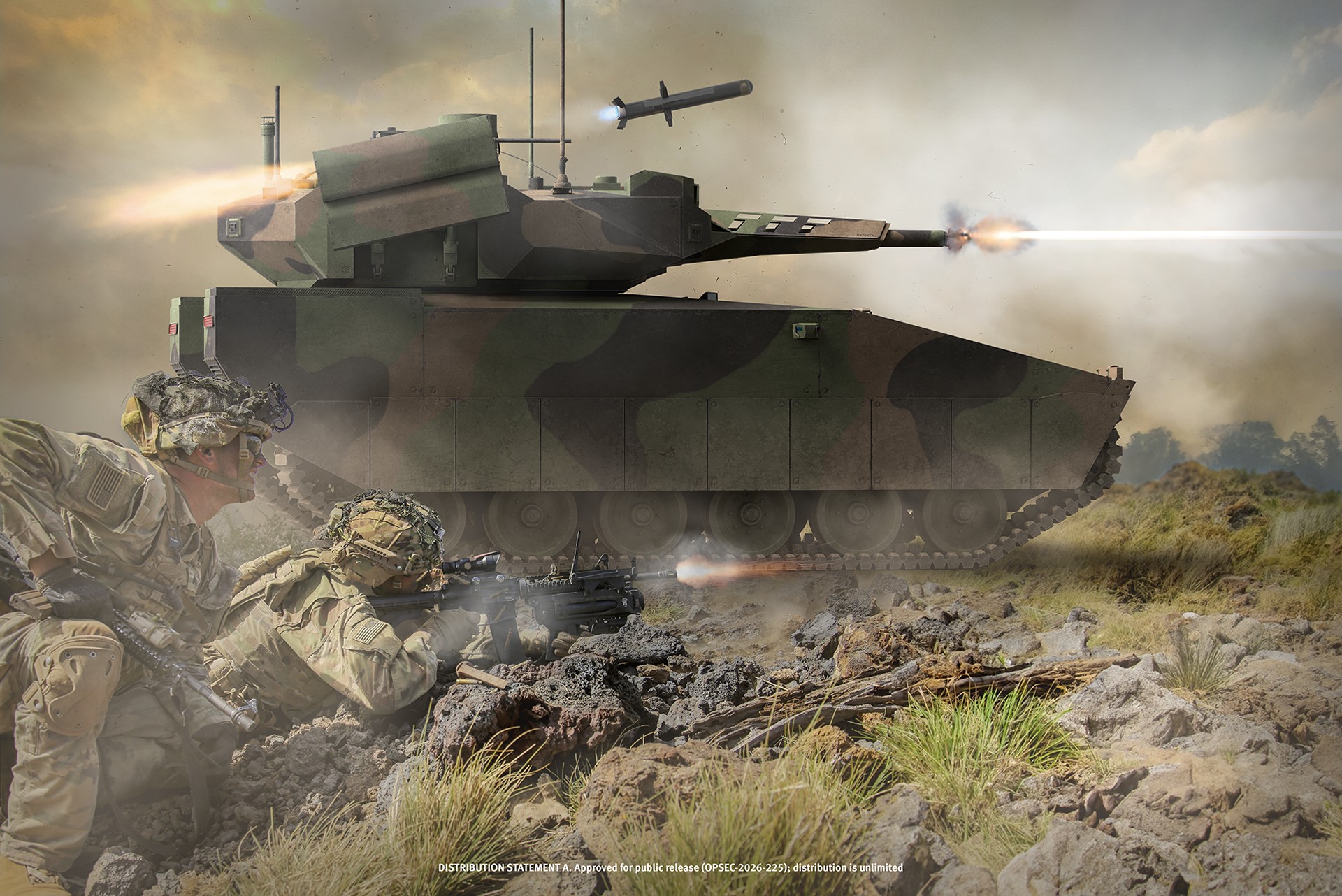
American Rheinmetall is currently completing the first prototype of the Lynx XM30 for the competition for the next US infantry fighting vehicle. Starting in autumn, soldiers of the 1st Cavalry Division will first become familiar with the Lynx and the competing GDLS design from General Dynamics Land Systems. Both companies had received development contracts in 2023 for a successor to the M2 Bradley, which is slated to be introduced in fiscal year 2029.
The program’s origins go back to the name Next Generation Combat Vehicle until 2016; from 2018 it ran as Optionally Manned Fighting Vehicle. As early as 2020 Rheinmetall with the Lynx KF41 and GDLS with the Griffin III based on the ASCOD 2 were selected. However, both vehicles did not meet the requirements, and the program was restarted in 2021 under the designation XM30 Mechanized Infantry Combat Vehicle with five participants.
XM30 with Hybrid Propulsion and Unmanned 50-mm Turret
The requirement was a tracked vehicle able to follow the M1 on the battlefield with a hybrid-electric drive, a crew of two and a seating capacity for six, as well as an unmanned turret for the remotely operated XM913 50-mm cannon or a 30-mm turret with the possibility for a corresponding upgrade. With the renewed selection of Rheinmetall and GDLS, the contenders BAE Systems, Oshkosh, and Point Blank Enterprises were eliminated. The final decision is expected in fiscal year 2027.
The Lynx XM30 is based again on the KF41, but was developed specifically to meet the requirements of the U.S. Army. The unmanned turret has no turret basket, which saves space in the hull. Crew, ammunition, fuel, and other critical components are housed separately. The protection consists of modular armor and passive as well as active defensive measures. Its energy supply, cooling, and computing capacity are intended to provide reserves for the later integration of new software, sensors, and unmanned systems.
