
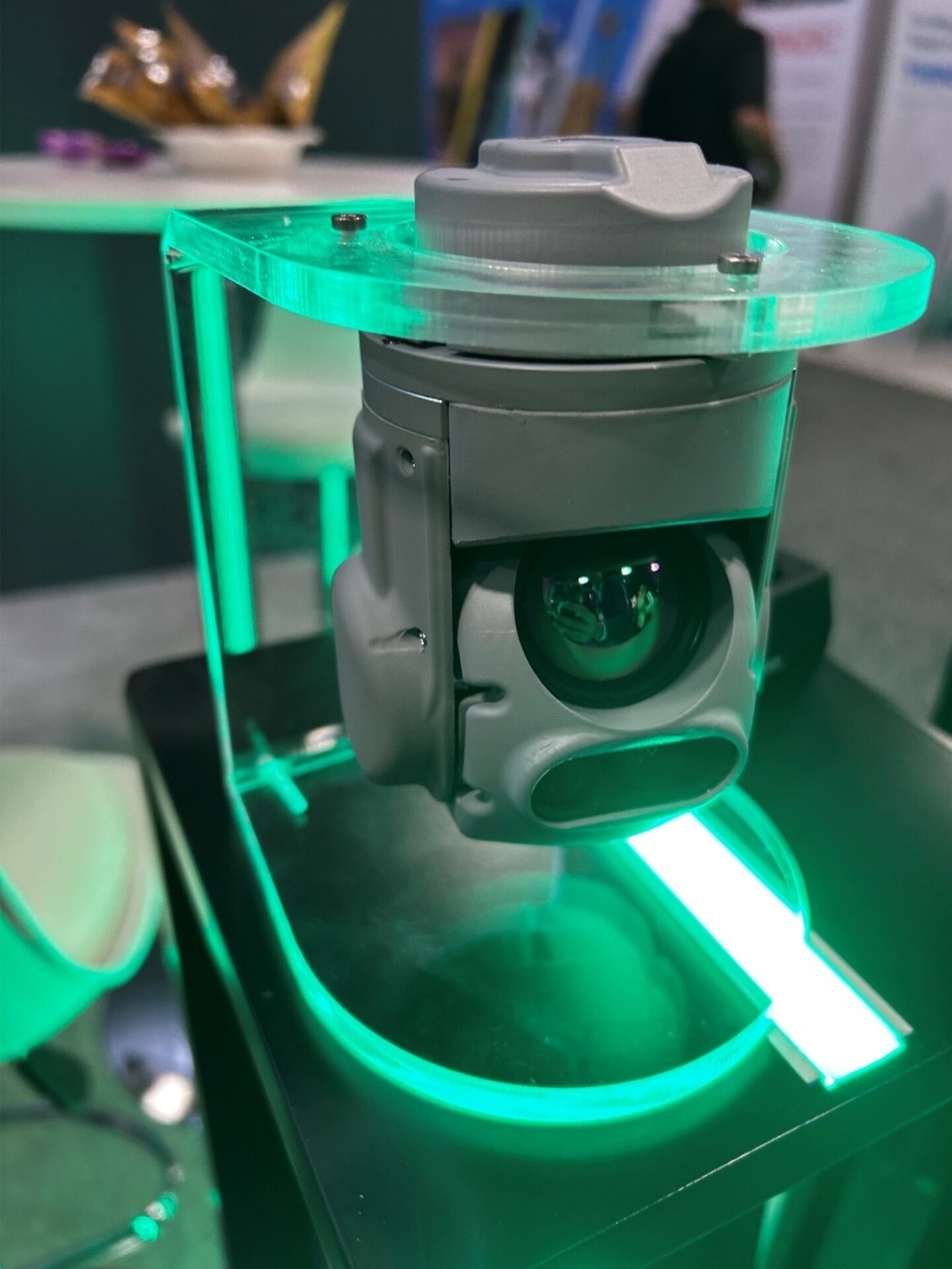
Microcon Vision from Israel is a developer of compact electro-optical systems for small aerial platforms. The company was founded only four years ago and has since focused on the development and manufacture of small, light and powerful payloads for tactical UAVs, loitering munitions and ground platforms. In doing so, it deliberately specializes only in small tactical platforms for ISR / reconnaissance purposes, loitering munitions, as well as lightweight manned and unmanned ground vehicles. Microcon Vision is a subsidiary of CONTROP Precision Technologies. Production is currently still exclusively in Israel, but production in Europe and Asia is planned soon. According to a company spokesperson, corresponding possibilities are currently being explored within the European Union (EU), and especially in Germany as well as in India.
Microcon Vision: Small and Lightweight Payloads
Currently the Microcon Vision portfolio consists of four payloads. The STING (or STING-I) is a highly precise, two-axis, gyrostabilized EO/IR search head (Electro-Optical / Infra-Red), specially developed for guided missiles and loitering munitions. The manufacturer states dimensions of 120 x 220 mm, and a weight of 1.6 kg. The gimbal includes a Full-HD video camera (FHD) with optical zoom and rolling shutter, as well as a thermal-/IR channel for day and night missions at high speed. The operating temperature is specified as -30 °C to +50 °C.
The MICRO 300 from Microcon Vision is a so-called Miniature ISR System for sUAS, and the smallest in the range. Also in this case it is a two-axis gyrostabilized EO/IR search head. The 300 stands for the weight of 330 grams. The system includes two FHD CMOS Global-Shutter VIS cameras with 20x zoom as well as an uncooled LWIR 640×512 IR camera (12 μm) with 4x zoom. The special feature, however, is the simultaneous dual video output despite the compact size. This gives the optics the ability to magnify an object and track/pursue it, while in the second image the larger surroundings remain. This provides the operator with much better situational awareness and can prevent surprises outside his (zoom) field of view.
All of this is delivered in a picture-in-picture mode. An H.265 encoder is also integrated to process data directly on board. As an option, the integration / functionality of Artificial Intelligence (AI) is offered. The AI then supports Video Motion Detection (VMD) as well as Automatic Target Recognition (ATR) and the Homing Tracker function. Small tactical 4×4 vehicles can be detected up to 5 km and identified up to 1 km, by day. At night, the distances are approximately half as far. A person can be detected up to 3 km and identified at 500 m.
The MICRO 600 is the bigger brother. The dimensions are 87×149 mm with a weight of 560 grams. The equipment is almost identical, only that the cameras in the daytime channel have a 31x zoom and in night vision a 16x zoom. The distances for detection and identification double.
Both operate with the HIVE – CPU / Processing & Interface Unit Box. This is a 160-gram complete system, including cooler, etc. The dimensions are 63x36x94 mm. Serial production of all systems takes place in Israel and the USA. And the MICRO 300 can also be used as a sensor for loitering munitions.
Here too, cost-effectiveness was a very important consideration during development. Thus there are “cheaper” variants for loitering munitions and ones for recurring ISR platforms.
Premiere with Designator
On the occasion of AUSA 2026, which S&T has reported on in detail, the MICRO-D celebrated its premiere. This is a new, lightweight and non-ITAR-restricted multisensor EO/IR payload that integrates a 30-mJ laser designator. The system weighs only 1.9 kg; first orders have already been received, and the first deliveries are expected by the end of 2026.
The MICRO-D was developed for small unmanned as well as other lightweight air platforms and combines ISR functions and laser designation in a compact payload. It is particularly suitable for platforms operating at low altitude – also below cloud cover. This enables the detection and tracking of targets as well as their marking for use with compatible precision-guided munitions.
The MICRO-D integrates seven sensors and functional channels into a single payload and offers functions for day and thermal imaging, target tracking, as well as laser designation. The STANAG 3733-certified laser designator enables the platform to mark targets for laser-guided munitions. This allows small aerial platforms to support the entire process from target detection and identification to marking for weapon employment.
In addition the payload offers simultaneous video outputs, stabilization of the line-of-sight (LOS), an ISR tracker for flight operations, and capabilities for inertial navigation. Optional AI features include video-based motion detection and automatic target recognition.
“The increasing use of smaller tactical platforms creates a need for capabilities that were previously largely reserved for larger systems,” said Chen Almog, CEO and co-founder of Microcon Vision. “MICRO-D was designed to close this gap and enable smaller platforms to play a more active role in the ‘Sensor-to-Shooter’ chain (from reconnaissance to engagement). The first orders reflect the operational demand for this kind of capability – especially in the United States, where our collaboration with partner company CONTROP USA gives customers on site a business presence, efficient project handling, as well as technical support and field services. This significantly improves our ability to serve our customers and partners.”
MICRO-D uses a two-axis, gyro-stabilized gimbal system and supports Ethernet-based integration, including an SDK and optional MAVLink connectivity. The system is ITAR-free, germanium-free and NDAA-compliant, according to the manufacturer.

What sets the MICRO-D apart from the other solutions, however, is that it possesses a designator. This allows targets for precision ammunition not only to be identified but also to be marked and illuminated. In addition, it features the Sea-Spot capability.
The Sea-Spot capability (also Laser Sea-Spot or See-Spot Detection) denotes in optronics and military technology the ability of optical sensors, infrared cameras, or laser designators to detect, display and track the laser spot projected onto a target by a laser (for example a laser designator from an observer or aircraft). In addition, the CPU is embedded directly in the gimbal and AI is also integrated into the system.
Microcon Vision notes that the sensor was designed from the outset for very high cost-effectiveness. Although the sensor has just been publicly shown for the first time, it is already in worldwide use by armed forces in initial testing. As an example, the size of the LUNA NG was cited for corresponding deployment options. MICRO-D is designed for flight altitudes from 1,300 to 5,000 meters. The range of the designator is stated to be around 2 km.
Crucial is also the embedded AI. It is intended to reduce the operator’s workload above all. The operator should be able to focus solely on the tactic; everything else should / must be automated. The prerequisite for the use of large swarms that are operated or controlled by a single operator.
In addition to tracking, the AI – if desired – can also perform targeting. That is, it can propose potential targets, which the operator then only has to confirm. If desired, and legally possible, fully automated engagement could even be possible. The Artificial Intelligence can certainly perform detection, classification, tracking of vehicles and people, tracking for engagement or tracking for surveillance / monitoring. In the future, further functionalities will be possible via software upgrades.
Author: André Forkert, Forces Editor
