Following the commissioning of a total of 149 additional protected and unprotected mobile emergency medical stations by the Federal Office for Equipment, Information Technology and Use of the Bundeswehr (BAAINBw) on July 13, 2026, Rheinmetall intends to start production in the first quarter of 2027. This call-off from a framework contract awarded at the end of 2024 is, according to Rheinmetall Project Solutions GmbH, the largest order the company has ever received, with a gross value of over 500 million euros.
With the order booked in July 2026, the number of emergency medical stations rises to a total of 165 systems with a total gross value of over 600 million euros. The BAAINBw had initially contracted Rheinmetall in December 2024 under a framework contract to deliver up to 137 emergency stations to the Bundeswehr. At that time, ten ballistic-protected and six unprotected systems were fixedly ordered. The call-off of further protected and unprotected systems is included as an option under the contract. In addition, training for the corresponding personnel is included.
New Emergency Medical Stations Implement Lessons from the Ukraine War
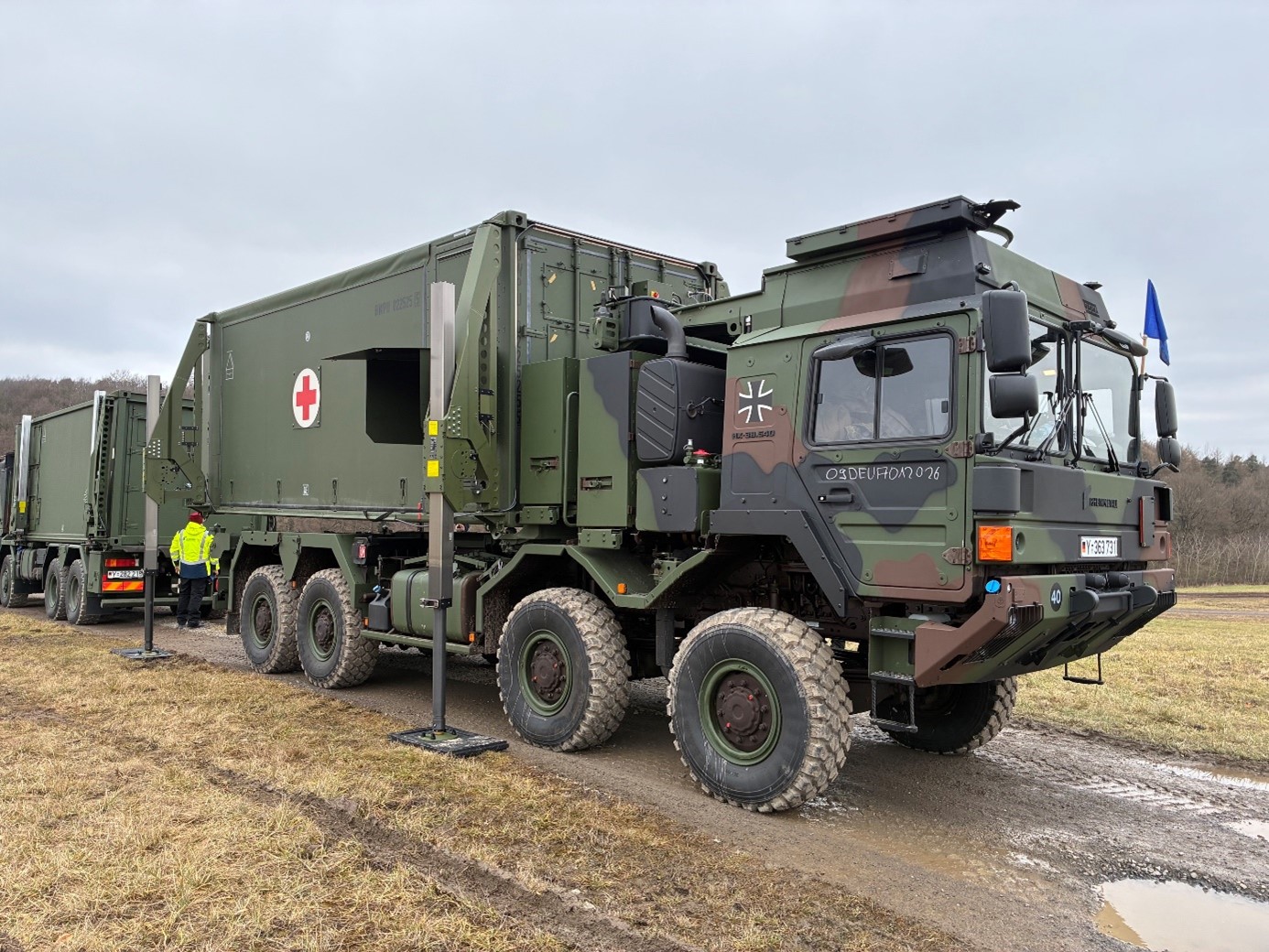
The emergency medical stations are part of the overall Modular Medical Facilities (MSE) system. Within the Bundeswehr’s medical service, the highly mobile emergency medical stations serve to ensure the initial emergency medical care of the troops. The systems can be assembled and dismantled within a very short time by four service members. This reflects a lesson learned from the Ukraine war, namely that highly mobile systems are required even for medical support.
Each emergency medical station consists of two containers that can be operated in tandem or independently. Each container is equipped with a generator and air conditioning and can be deployed autonomously for several days. If one generator fails, the overall system can continue to operate using the generator of a single container. The system offers a fully equipped emergency treatment area as well as four additional treatment sites. All medical equipment is mounted on Airliner rails and can be configured to meet the user’s individual requirements.
The system can be transported by the carrier vehicles used by the Bundeswehr. It can be deployed on terrain with the appropriate longitudinal and lateral slope. For this, a dedicated lifting system had to be developed, as no commercially available system could meet the requirements. The new emergency medical station replaces a laborious tent component with a highly modular 3:1 container from Rheinmetall Mobile Systeme GmbH. This allows the new system to be transported and deployed more effectively in rugged terrain.
