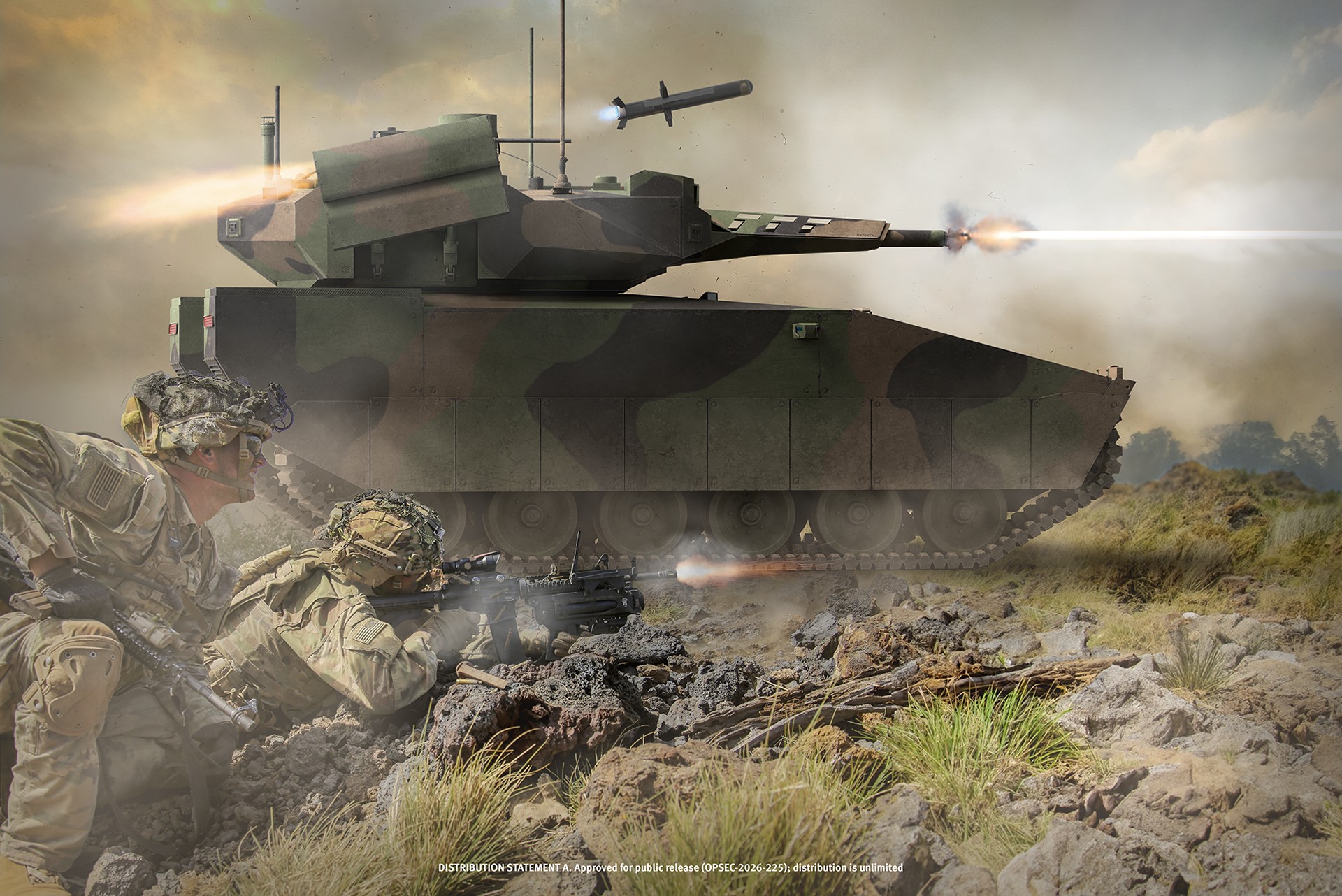
Not long ago, American Rheinmetall announced that it was currently completing the first of eight prototypes of the Lynx XM30 for the competition to replace the next U.S. infantry fighting vehicle. On Tuesday, the company now reported its delivery to the U.S. Army. The move is decisive in the bidding process to replace the old M2 Bradley infantry fighting vehicle. After delivery, the first prototype will immediately be subjected to the development and performance tests led by the U.S. government.
This evaluation is a key component of Phases 3/4 of the Engineering and Manufacturing Development (EMD) contract worth around $764 million. This includes digital design, physical prototype construction, and validation of the entire system. Over the course of this year, American Rheinmetall will deliver the remaining seven prototypes that are intended for training and operational use. This delivery will take place in parallel with the technical assessments under the U.S. Army’s Transformation in Contact (TiC) 2.0 initiative.
Lynx production chain across multiple US states
According to a press release, the delivery of the prototypes rests on a tightly coordinated production chain spanning several states. This underscores the agility and resilience of the American defense industrial base. The work will begin with precise manufacturing of the turret assemblies in Plymouth, Michigan, before the subsystems are transported to Slidell, Louisiana. Here, the final integration into the structure and chassis takes place.
The finished vehicles then underwent extensive testing drives to ensure their mechanical readiness for deployment, before returning to Louisiana for final painting and finishing. The integration of these separate sites into a single production chain ensures strict quality control, according to American Rheinmetall. The process will be completed by a joint inspection with the Defense Contract Management Agency (DCMA), before official government acceptance takes place.
Components for the Kongsberg MCT-30 turret
On Wednesday, American Rheinmetall added that it had also received an order from Kongsberg Defense & Aerospace to manufacture components for the mid-caliber turret MCT-30. These machined parts are destined for the Marine Corps’ Amphibious Combat Vehicle (ACV) variant, known as the ACV-30. As part of the roughly USD 710,000 (EUR 607,000) contract, American Rheinmetall’s plants in Lapeer and Lansing, Michigan, will produce parts for MCT-30 turrets.
Deliveries are planned for 2026 and 2027. American Rheinmetall will perform the work as a subcontractor for Kongsberg Defense & Aerospace. This is Kongsberg’s first order to American Rheinmetall’s Michigan sites and, according to the press release, reflects the company’s ongoing growth and diversification of its U.S. customer base. The order also builds on the long-standing successful collaboration between Kongsberg and the American Rheinmetall site in Maine on the CROWS weapon station program.
American Rheinmetall sees its role in the US industry strengthened
“The opportunity to support Kongsberg on the ACV-30 program reflects our growing partnership and strengthens American Rheinmetall’s role in delivering high-quality components for key U.S. military platforms,” said Tom McDonnell, Senior Vice President for Sales and Marketing at American Rheinmetall. “We are grateful that our sites in Michigan will contribute to the United States Marine Corps’ modernization goals as it develops into a more mobile and capable force.”
By supporting the production of the MCT-30 turret for the ACV-30, this contract directly contributes to the Marine Corps’ readiness and flexibility. The contract also solidifies American Rheinmetall’s growing position within the Tier-1 landscape of the defense industry, as the company continuously expands both its capacities and its customer base.
