
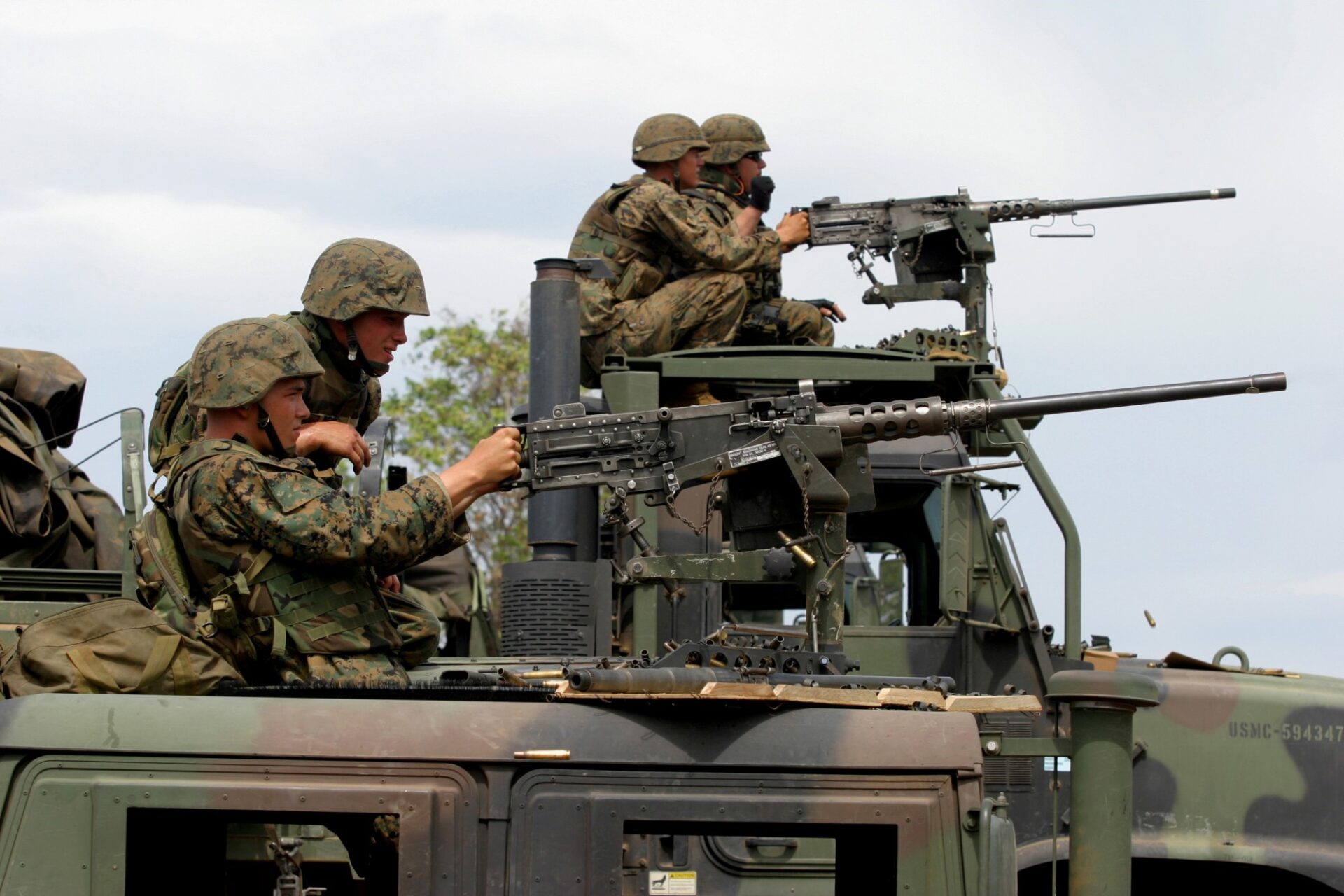
The U.S. Army Combat Capabilities Development Command (DEVCOM) Armaments Center has introduced a new training ammunition in .50 caliber (12.7 x 99 mm) with reduced range. The “reduced-range ammunition (RRA)” is intended to increase training options for weapons such as the M2 heavy machine gun. Because of the large danger zone of large-caliber ammunition, until now only a limited number of firing ranges could be used.
A standard .50 caliber round has a maximum ballistic range of 7,400 meters, while NATO-standard 7.62 x 51 mm ammunition is usually listed at 5,000 meters. Accordingly, the training area must be large if shots cannot be confined to a limited lateral and elevation range toward targets that are secured to the rear. This is, for example, the case in anti-aircraft or convoy-protection scenarios. Due to the increasing threat from drones, there is a growing need for training in this area.
New training ammunition becomes unstable at sonic speed
The new training ammunition features a projectile that destabilizes at sonic speed, causing drag to rise rapidly and the velocity to drop accordingly. Typical 12.7-mm projectiles have a muzzle velocity of around 900 meters per second and remain supersonic up to roughly one mile (1,609 meters). While the new ammunition is designed to maintain the same ballistic performance in this range, it subsequently loses energy very quickly.
As a result, its ballistic range is even shorter than that of the 7.62 mm caliber. It can thus be used on the far more numerous firing ranges that are approved for the latter. It is available in the M1181 variant without and the M1199 variant with tracer. The principle is of course also applicable to smaller calibers: DEVCOM has meanwhile also developed RRA ammunition for 7.62 mm and for the Army’s new 6.8 mm family of weapons.
