
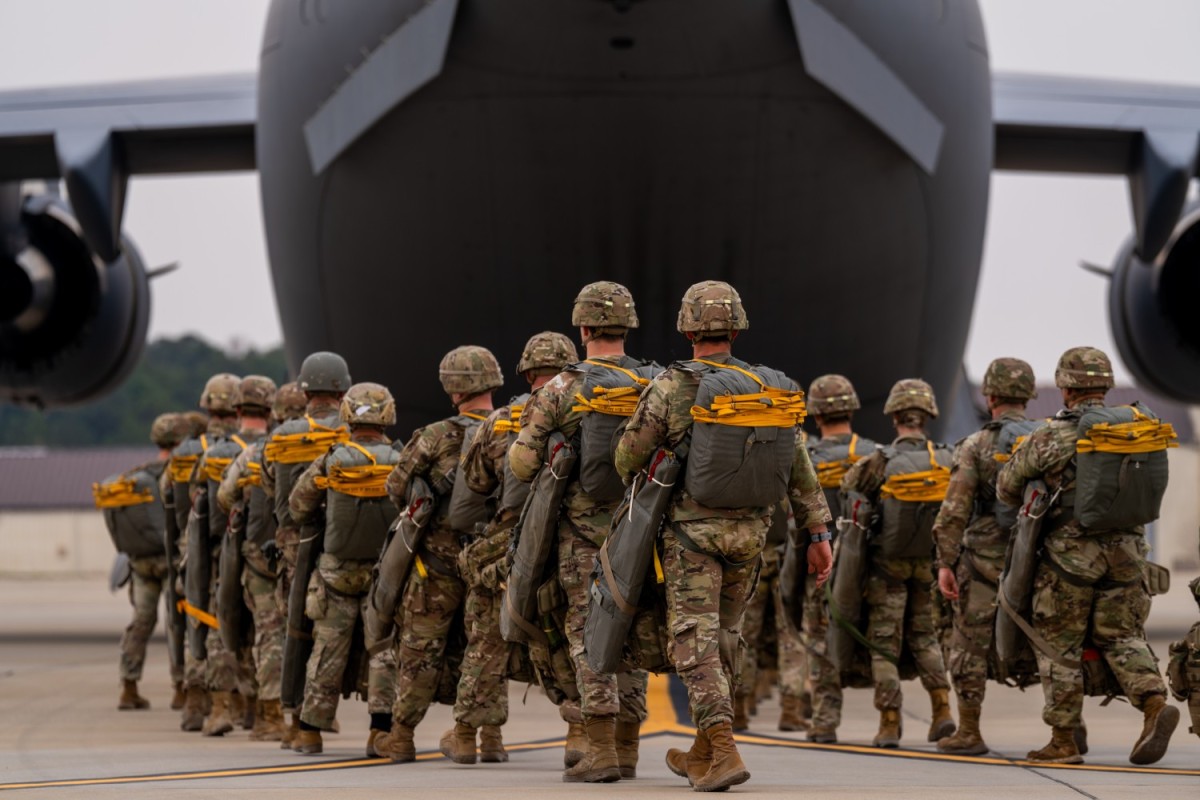
The deployment of elements of the American 82nd Airborne Division that had been relocated to the Middle East in March due to the Iran war has been extended by an entire year. As Division Commander Major General Brandon R. Tegtmeier informed in a letter to family members yesterday and confirmed by the U.S. Army, about 2,000 paratroopers and combat-support troops are to remain stationed in the region for up to twelve months in total due to operational requirements.
According to the social media-posted letter by General Tegtmeier, this concerns female and male soldiers of the headquarters, the 1st Brigade Combat Team, the Combat Aviation Brigade (Army Aviation), the Sustainment Brigade (Logistics), the Division Artillery, the 3rd Battalion, 4th Air Defense Artillery Regiment, and the 307th Engineer Battalion (Pioneers). In total, more than 50,000 members of the American armed forces are currently deployed within the area of responsibility of U.S. Central Command (CENTCOM).
82nd Airborne Division Should Give Trump More Options
The units had been relocated to the Persian Gulf at the end of March together with the 31st and 11th Marine Expeditionary Units (MEUs) of the U.S. Marine Corps (USMC) and additional forces, after the American-Israeli strikes on Iran since February 28 did not, as hoped, lead to a rapid collapse of the Tehran regime and its forces but instead to the de facto closure of the Strait of Hormuz. The ground troops were intended to provide U.S. President Donald Trump with more military options, including operations against islands and the coast of the Persian Gulf.
Since then, the conflict has been characterized by mutual naval blockades, fragile ceasefires and unsuccessful negotiations, as well as limited operations by both sides. On the night into Monday, the United States attacked Iranian forces for the first time in a long time, claiming strikes against missile launchers on Larak Island. CENTCOM said this had prevented the laying of mines in the Strait of Hormuz. President Trump had recently stated that all mines there had been cleared.
In response, Iran attacked U.S. bases in Jordan and the United Arab Emirates (UAE) with ballistic missiles and drones. Additionally, an oil tanker in the Strait of Hormuz sustained two mine hits during an illegal crossing attempt and caught fire. Jordan stated that eight missiles had been intercepted, while the UAE confirmed an air force operation against drones. CENTCOM, for its part, stated that under the American blockade of Iranian ports ongoing since April, by August 30 a total of 83 merchant ships had been redirected, three intercepted, and two boarded.
