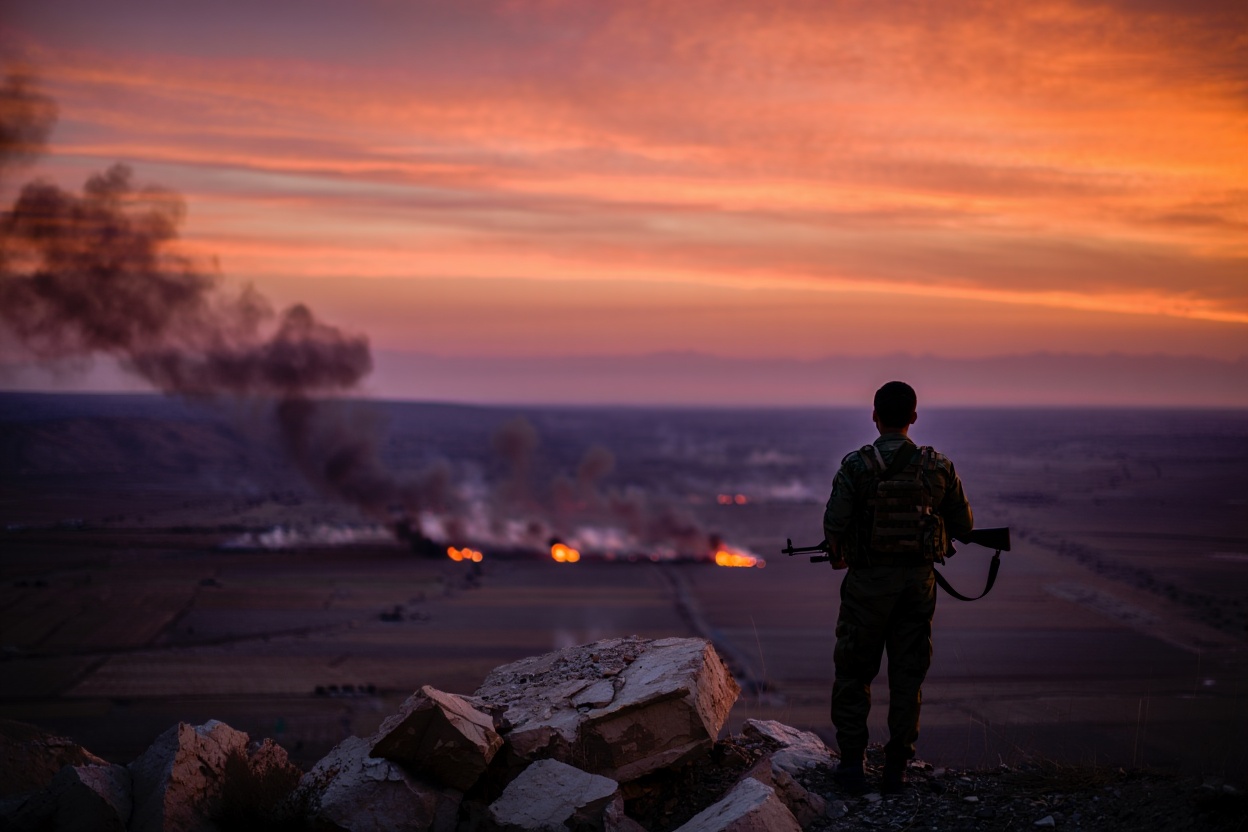
While most attention remains focused on direct strikes and visible military movements, another dynamic is quietly taking shape across the Middle East. It does not always appear in official statements, and it rarely dominates headlines, yet it is becoming increasingly important in understanding how the conflict is evolving.
This emerging front is not defined by large armies or clearly marked battlefields.
It is defined by indirect actions, local actors and operations that often unfold without immediate visibility.
A conflict spreading beyond traditional battle lines
In recent weeks, the confrontation has extended beyond direct exchanges between major states. Smaller groups, regional militias and allied forces are becoming more active across multiple countries.
These actors do not always operate under official command structures, but they often align with broader strategic interests. Their actions can take place in border regions, remote areas or densely populated zones where distinguishing between military and civilian activity becomes more complex.
This creates a fragmented landscape where multiple operations can occur simultaneously without forming a single, clearly defined front.
For observers, this makes the conflict harder to track and even harder to predict.
Indirect operations are shaping the situation
Unlike conventional warfare, this hidden front relies heavily on indirect methods. These can include targeted strikes, logistical disruptions, surveillance activities and coordinated actions carried out by smaller units.
Because these operations are often limited in scale, they may not receive the same level of attention as large military offensives. Yet their cumulative effect can be significant.
A disruption in one location can affect supply routes elsewhere. A local escalation can trigger responses in neighbouring regions.
Over time, these smaller actions contribute to a broader pattern that shapes the direction of the conflict.
Multiple countries are now involved
One of the defining characteristics of this hidden front is its geographic spread. Activity is no longer confined to a single territory.
Operations linked to the conflict are now appearing across different parts of the region, involving countries that are not always directly engaged in open confrontation.
This expansion increases the complexity of the situation. Each new area introduces its own local dynamics, political sensitivities and potential points of escalation.
As a result, the conflict becomes less predictable and more difficult to contain.
Why it remains under the radar
There are several reasons why this front receives less attention. First, the scale of individual events is often smaller, making them less visible compared to large-scale military actions.
Second, information about these operations is frequently limited or delayed. In some cases, details are not publicly confirmed, or they emerge only after the situation has already evolved.
Finally, the focus of media coverage tends to remain on major developments, leaving less space for analysing the cumulative impact of smaller, scattered events.
Yet for analysts, these quieter developments are often where significant changes begin.
A shift in how modern conflicts unfold
The emergence of this hidden front reflects a broader transformation in modern warfare. Conflicts are no longer confined to clearly defined battle zones. Instead, they unfold across multiple layers, combining direct confrontation with indirect pressure.
This approach allows actors to influence the situation without always engaging in open conflict, reducing immediate risks while maintaining strategic pressure.
At the same time, it creates a more complex environment where escalation can occur gradually and from multiple directions.
For now, this hidden front continues to expand quietly.
And while it may not dominate headlines, its role in shaping the future of the conflict could prove far more significant than it first appears.
