
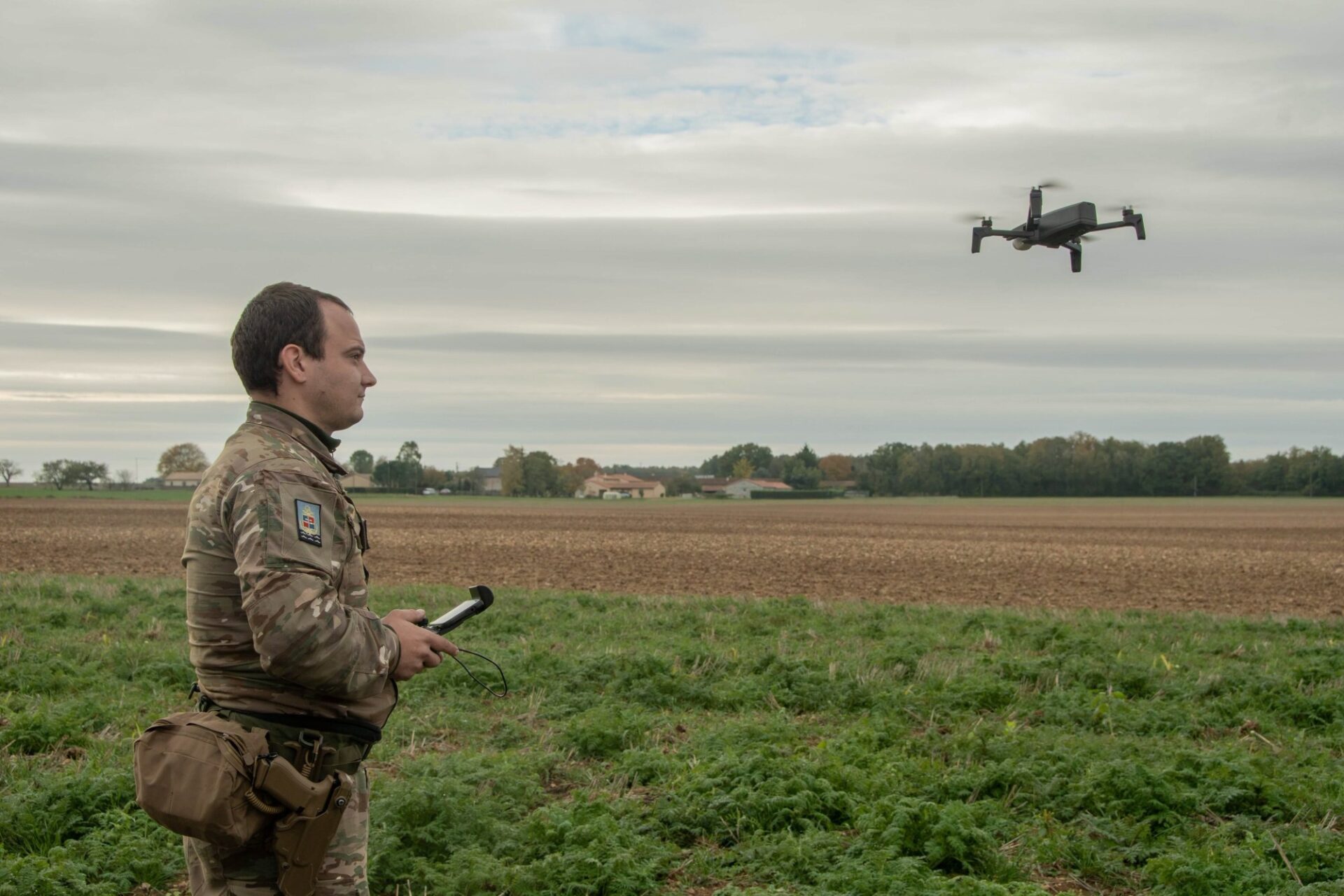
The ongoing French experiments with new organizational forms in response to the widespread threat posed by drones, as seen in the Ukraine war, also encompass the Armée de Terre’s armored reconnaissance or cavalry formations. A leading role has been taken by the 1er Régiment d’infanterie de marine (RIMa), which has converted one of its three squadrons previously equipped with the wheeled AMX-10RC into a drone unit. This 1er Escadron de drones de chasse is the model for around 15 such units that the French Army intends to establish by mid-2027. More are to follow.
The idea was already developed within the 1er RIMa in 2023, based on observations from the Ukraine war. Instead of simply adding drones to existing units, they aimed to transfer the classic principles of light cavalry to their own organizational form: recon the enemy, fix them, flank them, and destroy them. The experimental squadron was equipped with a mix of reconnaissance and attack drones as well as loitering munitions. In a first exercise, these caused, according to the regiment, “an incredible mess” on the opposing side.
An Experiment Becomes the Official Organization
In 2025, the 1er RIMa deployed about ten drone pilots as part of a mixed French battle group to the Hedgehog exercise in Estonia, where Ukrainian training opponents within NATO formations inflicted heavy “losses” with such means. The French experienced similar results: although the drone pilots made up only about five percent of their battle group, they caused 20 percent of the losses in a simulated opposing squadron of the American 7th Cavalry Regiment with infantry- or reconnaissance-type M2A4 Bradley vehicles during one training day.
This success convinced the Army to broaden the experiment. Within two months, the structure of the new squadron was formalized, while retaining the existing core structure: a command and supply platoon, a reconnaissance platoon, two teams with first-person view (FPV) drones, and one with long-range loitering munitions. Of the 120 personnel, about 100 are trained as drone pilots, with deployment carried out in teams of three to four on light vehicles.
More Drone Squadrons for the French Army
These consist of a team leader, a driver and a pilot, with an optional fourth man who can also serve as pilot or scout. Alongside the drones, the armament includes the standard HK416 rifle, a machine gun, and an AT4 anti-tank weapon. In April 2026, the squadron was declared fully operational. During the French large-scale exercise Orion 2026, it reportedly “destroyed” four opposing regimental command posts, several supply convoys, as well as air- and drone-defense units through the use of combat drones or requested artillery strikes.
Thus the opposing force was practically neutralized according to the report. However, the assessment was sober: the opponent apparently had insufficient own drone and drone defense capabilities and was also hampered in electronic warfare operations; had the roles been reversed, they would have suffered the same fate with their former AMX-10 RCs. The Army subsequently decided to establish drone squadrons in five more regiments, which are to be ready for use later this year.
Operations Must Follow the Regiment’s Role
The 6th Armoured Cavalry Brigade (6e Brigade légère blindée, BLB) even decided to establish a third such unit in addition to its two AMX-10RC regiments, funded from its own resources. Currently, this unit is with one of the brigade’s infantry regiments deployed with NATO in Romania. In practice, the infantry drone pilots retain their primary role as operators of 81-mm mortars and Akeron anti-tank missiles in a secondary capacity, to provide fire support even in adverse weather. The deployment of the units must follow the role of the respective regiment, according to the 6e BLB.
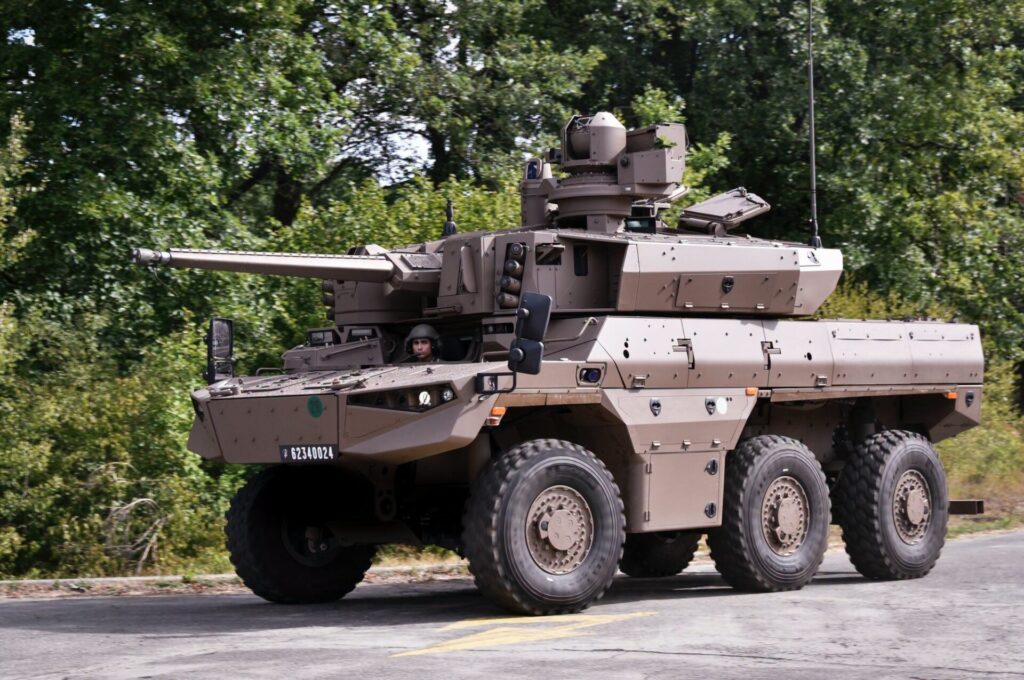
Meanwhile, the 1er RIMa is also testing operations against better-prepared opponents. In June, it trained at the CENTAC Training Center in Mailly-le-Camp with the local training unit, which had been equipped with a variety of tools from shotguns to camouflage-colored umbrellas procured from an outdoor equipment supplier. The latter simple tool forced drone pilots to identify their targets more precisely to avoid confusion with wildlife – although in war, this restriction would probably be mainly a matter of the available attack resources.
Drones Alone Do Not Win a Battle
So, not only supply must be managed with drones—one pilot explained that on a typical training day he uses ten to twenty drones, which is still modest compared with the Ukraine war—and also power for recharging batteries. The hit rate even among experienced operators is only 30 percent versus 95 percent for a tank cannon. Drone warfare also imposes challenging conditions with few combat pauses for the operators. In the regiment, they therefore hope for increased use of artificial intelligence to raise the hit rate and to control drone swarms.
The CENTAC exercise adversary also operated more loosely, avoided moving in larger groups and brought its vehicles to the contact line only when necessary. Overall, the squadron was forced to focus more on priority targets. Nevertheless, the 1er RIMa achieved the best rating among about 30 units that had trained at CENTAC over a twelve-month period. However, the regiment emphasizes that drones alone do not win the fight and are not a complete substitute for armored vehicles.
Their weaknesses remain weather conditions, electronic warfare, and other drone defense systems. A prepared opponent cannot therefore be necessarily destroyed, only slowed down—with numerical superiority, he would eventually break through. And development does not stand still: the 1er RIMa, which has already brought teams from several start-ups to the Hedgehog exercise in Estonia, continues to work closely with industry, also to protect itself against drone attacks.
