
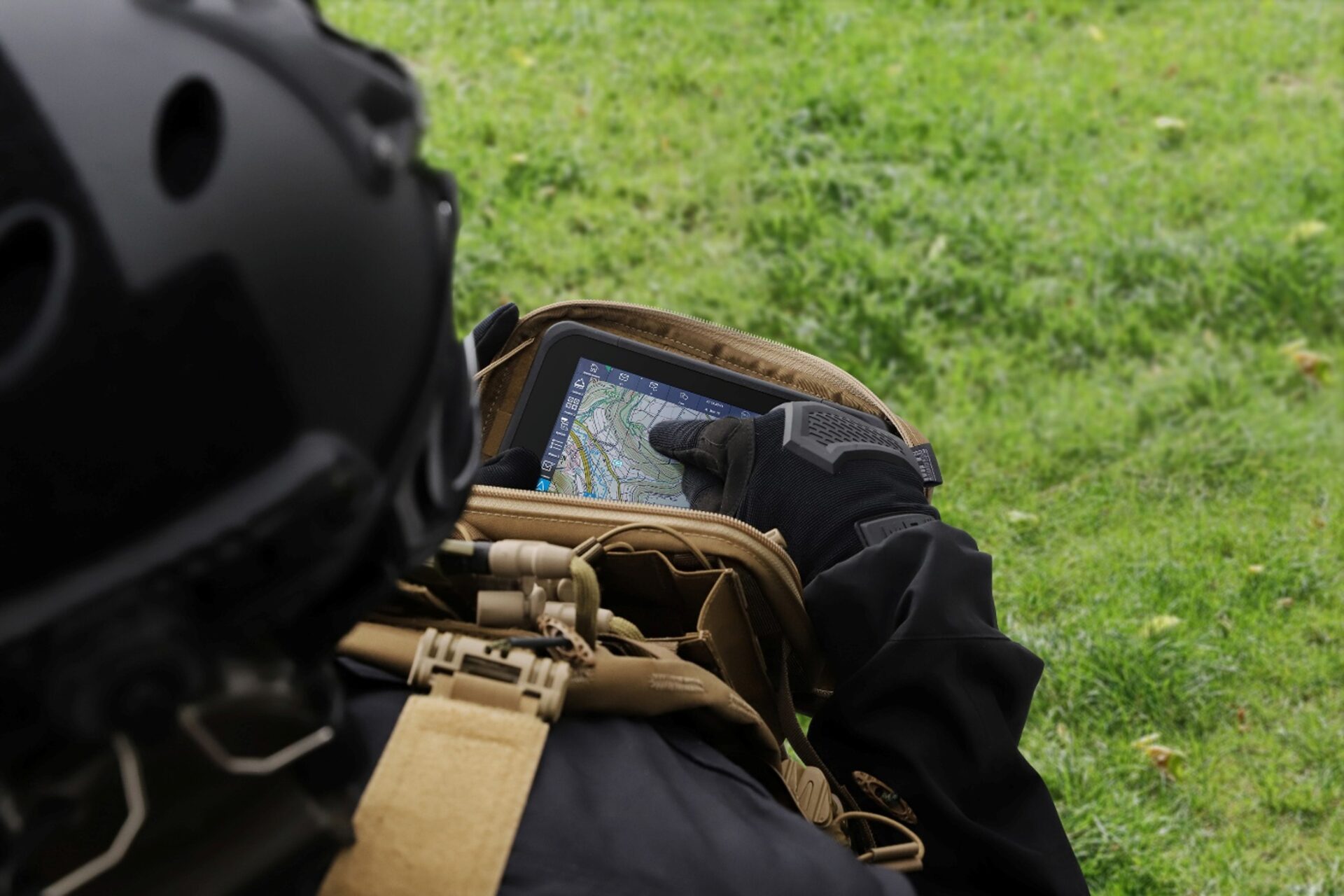
Sensor specialist Hensoldt has been contracted by the Federal Office for Equipment, Information Technology and Use of the Bundeswehr (BAAINBw) to supply the equipment for the so-called Joint Fire Support Teams (JFST abg.). After the successful demonstration of the performance of the system developed by Hensoldt in a previous contract, a serial order followed.
The Joint Fire Support Team (abg.) project encompasses the equipment of the Joint Terminal Attack Controller / Joint Forward Observer (JTAC/JFO), whose task is to request and direct ground forces’ Close Air Support (CAS) as well as indirect artillery fire. The JFST abg. will primarily be used by infantry-oriented forces as well as deployed forces for use. The system is intended to enable operation independent of vehicles such as the JFST Fennek or JFST Boxer in rugged terrain. In addition, the systems will also be used on the JFST Boxer heavy vehicles yet to be ordered.
Hensoldt ist Generalunternehmer, L3Harris liefert Handfunkgerät
As the prime contractor, Hensoldt is responsible not only for the procurement of the Joint Fire Support Teams but also for the full integration effort and the development of the software component for Digitally Aided Close Air Support (DaCAS). The software ensures the digital link between the JTAC and the aircraft. This also includes the integration of a video downlink system that ensures the transmission of video data from the aircraft to the JFST. In this way, the proven “man-in-the-loop” concept is transferred from air to ground.
As part of this video downlink system, the Tactical Network ROVER (TNR) 2i – broadband ISR handheld radio from L3Harris Technologies is procured. This is intended to ensure reliable and secure broadband communication up to the forward edge (Tactical Edge). The TNR 2i offers broad compatibility with ISR platforms. The TNR 2i supports both analogue and digital waveforms, thereby ensuring interoperability with common U.S. and NATO aircraft platforms.
Bidirektionale IP-Netzwerkfähigkeit
Beyond the traditional video downlink function, the TNR 2i provides bidirectional IP network capability (Net-T). This network connectivity enables features such as Digitally Aided Close Air Support (DaCAS), the exchange of ground-troop position data, chat functions, and the transmission of large files, giving deployed ground troops an unprecedented level of situational awareness. In addition, the TNR 2i is a Software Defined Radio (SDR) that enables field upgrades for future waveforms. The TNR 2i is easy to configure and flexible enough for any deployment.
It also allows automatic configuration via the “ROVER code,” and it offers keypad-selectable presets for simple, fast, and intuitive use. The TNR 2i also provides extended coverage of the UHF (RX-only; 225 to 512 MHz in 1 kHz steps), L-band (1.625 to 1.850 GHz in 0.25 MHz steps), and S-band (2.025 to 2.110 GHz and 2.200 to 2.500 GHz in 0.25 MHz steps). Optional, depending on configuration, are the C-band (RX-only; 4.400 to 4.950 GHz and 5.250 to 5.850 GHz in 1 MHz steps) and the Ku-band (RX-only; 14.40 to 14.83 GHz and 15.15 to 15.35 GHz in 1 MHz steps).
Joint Fire Support Teams abgesessen stärken Fähigkeiten
To enable ground-based indirect fire requests, the software “Artillery, Data, Situation and Mission-Computer Network III (ADLER III)” is fully integrated into the deployed JFST. In addition, modern communications equipment and intelligent power-supply and networking solutions are added. Likewise, suitable electro-optical sensors for target ranging as well as laser target markers are integrated.
Not least, the field-ready design of the carrying system for housing the system components, with regard to weight distribution, cable routing, and their ergonomically optimal arrangement as specified for the JFST, is deployed. The delivery of the Joint Fire Support Teams equipment deployed strengthens the German Armed Forces’ ability for multi-domain operations within the framework of national and alliance defense. The current contract covers an initial lot of over 100 systems. In the long term, this could total more than 600 systems.
