
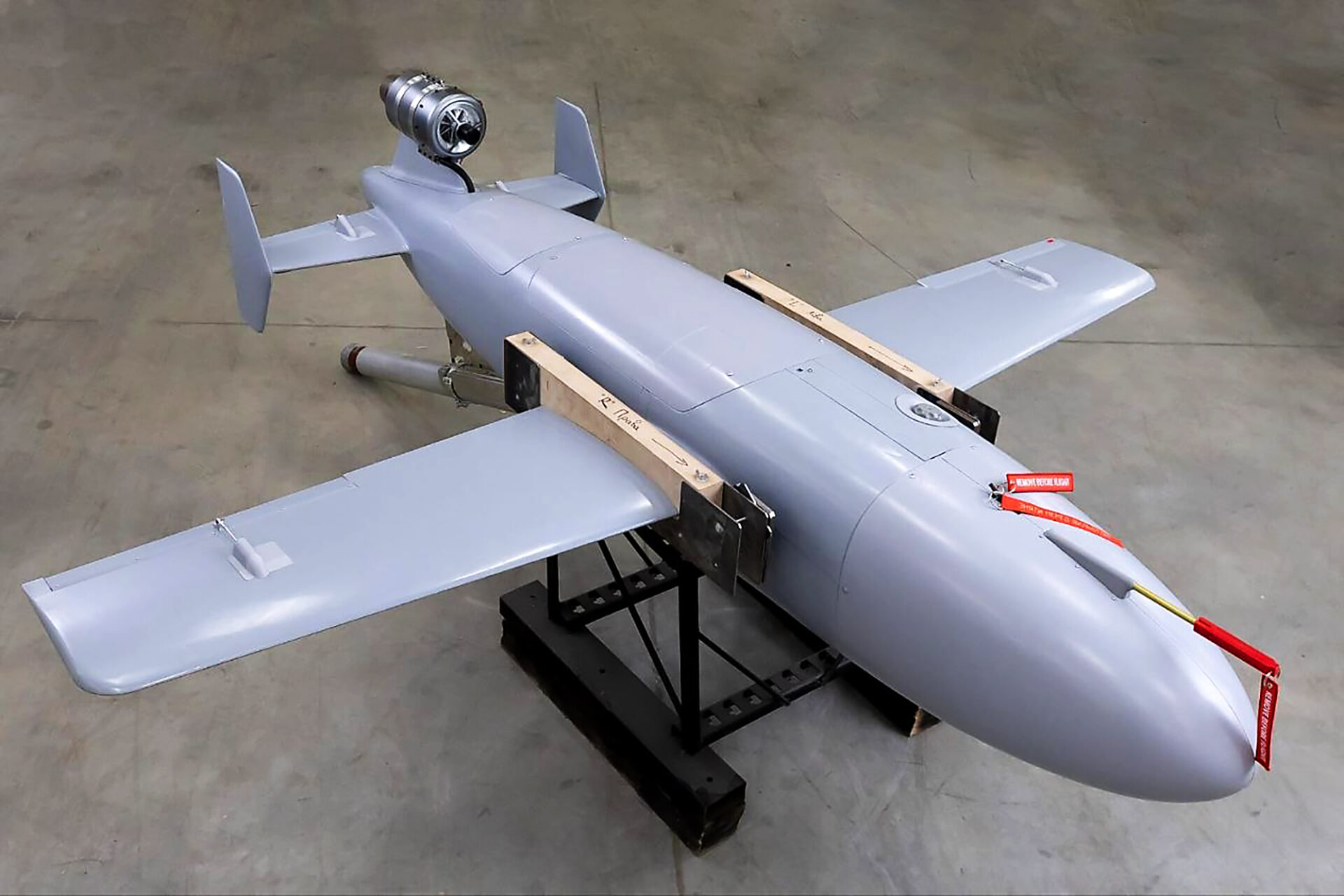
Germany plans to procure cruise missiles from Ukraine for the Bundeswehr. As early as next week, a small initial batch of the cost-effective Bars missiles is to be purchased for technical testing. The Financial Times had reported on this a few days ago, and now a military source has told the author that it is highly likely.
If the tests are successful, a subsequent order for several hundred units could follow. The Bundeswehr could then begin technical testing of the first missiles in early 2027. Of particular interest: Bars are already being produced in Germany — so far exclusively for the Ukrainian armed forces.
With Bars, the Bundeswehr would not only procure for the first time an offensive weapon system developed in Ukraine for its own use, but also take a significant step in expanding Germany’s deep-strike capabilities. And third, it would mark a departure from high-cost weapon systems toward an approach that treats cruise missiles as a cheap consumable asset.
Up to 1,000 kilometers of range
However, affordable does not equate to poor performance. Bars, whose name means Snow Leopard in Ukrainian, is a jet-powered missile which Ukraine itself describes as a rocket drone. In Germany the system is referred to as a cruise missile. Depending on the version, Bars can reach a range of up to 1,000 kilometers and carry a payload of up to 105 kg.
The Ukrainian President Volodymyr Zelensky had already described Bars as one of the weapons systems with which Ukraine attacks Russian military bases and energy facilities in the Russian hinterland. Successfully. Unlike traditional cruise missiles, which are often intended for particularly high-value targets primarily because of their price — for example, Taurus NEO is said to cost around three million euros — Ukraine relies on a deliberately low-cost production of its rocket drones in large quantities. This allows more targets to be hit, and enemy air-defense systems to be saturated simply by the mass of the incoming missiles.
Bars production in Germany
What is particularly noteworthy about the now-public procurement plans is that Bars production in Germany has already begun. As part of the Ukrainian initiative “Build with Ukraine,” a German-Ukrainian joint venture has been established for this purpose.
The relevant agreement was signed in July 2026 by Defense Minister Boris Pistorius and Ukrainian Foreign Minister Andrij Sybiha. The aim of the initiative is to produce Ukrainian defense technologies outside Ukraine as well. This is intended to create additional production capacities and protect manufacturing from Russian attacks. Production in Germany would be financed initially by the German government.
The first batch of Bars produced in Germany was reportedly delivered to the Ukrainian forces in October, according to RBC-Ukraine. In the future, the joint venture could supply not only Ukraine but also the Bundeswehr.
Germany would then no longer act solely as a financier and supplier of arms, but would also adopt Ukrainian weapon technology itself. This would at least partially reverse the course of German-Ukrainian arms cooperation: while Germany contributes its industrial capacities and financial resources, Ukraine provides a weapon system already used in the war and the experience gained from it.
Over 2,000 cruise missiles per month
How far Bars has advanced is evidenced by reports from the Ukrainian technical portal Militarnyi. According to them, development of the system began in 2023. Since then the missile has undergone more than 40 technical revisions, and currently more than 2,000 Bars are produced in different variants and configurations per month. The missiles are reportedly used daily in Ukrainian operations.
Bars is modular and can be adapted for different mission profiles. These include attacks on distant targets (Deep Strike), medium-range strikes (Middle Strike), and operations closer to the front lines (Front Strike). The range is up to 1,000 kilometers, and the speed is said to exceed 700 km/h.
In total, Bars currently exist in three known configurations with warhead weights of 22 kg, 60 kg and 105 kg, with the smaller members of the family serving as intercept drones against Shahed, while the larger ones attack targets well beyond the front as cruise missiles.
In propulsion, Ukraine is working toward greater independence from foreign suppliers. According to Militarnyi, a Ukrainian turbojet engine for Bars has already passed its final tests, while the engines have until now been imported. The share of Ukrainian components in Bars is said to be more than 74 percent today.
The combination of relatively low costs, high production rate, and extensive wartime deployment experience against Russia makes the cruise missile interesting for European armed forces as well.
Cost-effective cruise missiles for the Bundeswehr
For the Bundeswehr, Bars would primarily be an addition to the high-cost cruise missiles already planned. Germany is planning, among other things, to procure American Tomahawks. These cost between four and six million US dollars per unit. In addition, there are limited production capacities, which could delay deliveries possibly into the 2030s. Then there is of course the Taurus NEO at around three million euros and also with limited delivery capacities. None of the established Western manufacturers is currently capable of producing 2,000 units per month, which is the scale envisaged for Bars.
Therefore Germany is simultaneously examining cheaper alternatives that can be procured more quickly and in larger quantities. In addition to Bars, the Bundeswehr is also testing the Covenant Anthem cruise missile (produced in Leipzig). The procurement of the Flamingo cruise missile, also developed in Ukraine, has been postponed for the time being.
Ukrainian wartime experiences for the Bundeswehr
The procurement of Bars underscores a fundamental shift in European arms procurement. Ukraine has in recent years, under wartime conditions, developed, tested, and rapidly iterated numerous new weapons systems. In particular, the country now has extensive experience with drones and inexpensive, far-ranging missiles.
Fabian Hoffmann, a researcher at the Norwegian Institute for Defence Studies, even described Bars to the Financial Times as the most frequently produced cheap Ukrainian cruise missile: “It is the one that has flown the most. That means the system is probably the most mature. The Ukrainians—and the Germans—have the most data on how it behaves in action.”
However, Ukrainian operational experience does not replace testing by the Bundeswehr. In addition to actual performance and reliability, integration into German command, operational, and weapon systems, as well as long-term supply and maintenance, must be evaluated. No German procurement contract for Bars has yet been signed, although a military source told the author that there is a lot of truth to the Financial Times’ information. This would therefore bring German-Ukrainian arms cooperation to a new level.
From the joint production for Ukraine, a common basis could emerge for the armed forces of both countries. If Germany manages to align its procurement pace with the tempo of modern development cycles. For now, it remains to be seen how long the BAAINBw will test Bars before (if ever) the cruise missile makes its way into the Bundeswehr. In recent times, years have passed even for war-tested systems used in other countries. But perhaps this time it will be faster; only time will tell.
Author: Dorothee Frank, Online Editor-in-Chief
