
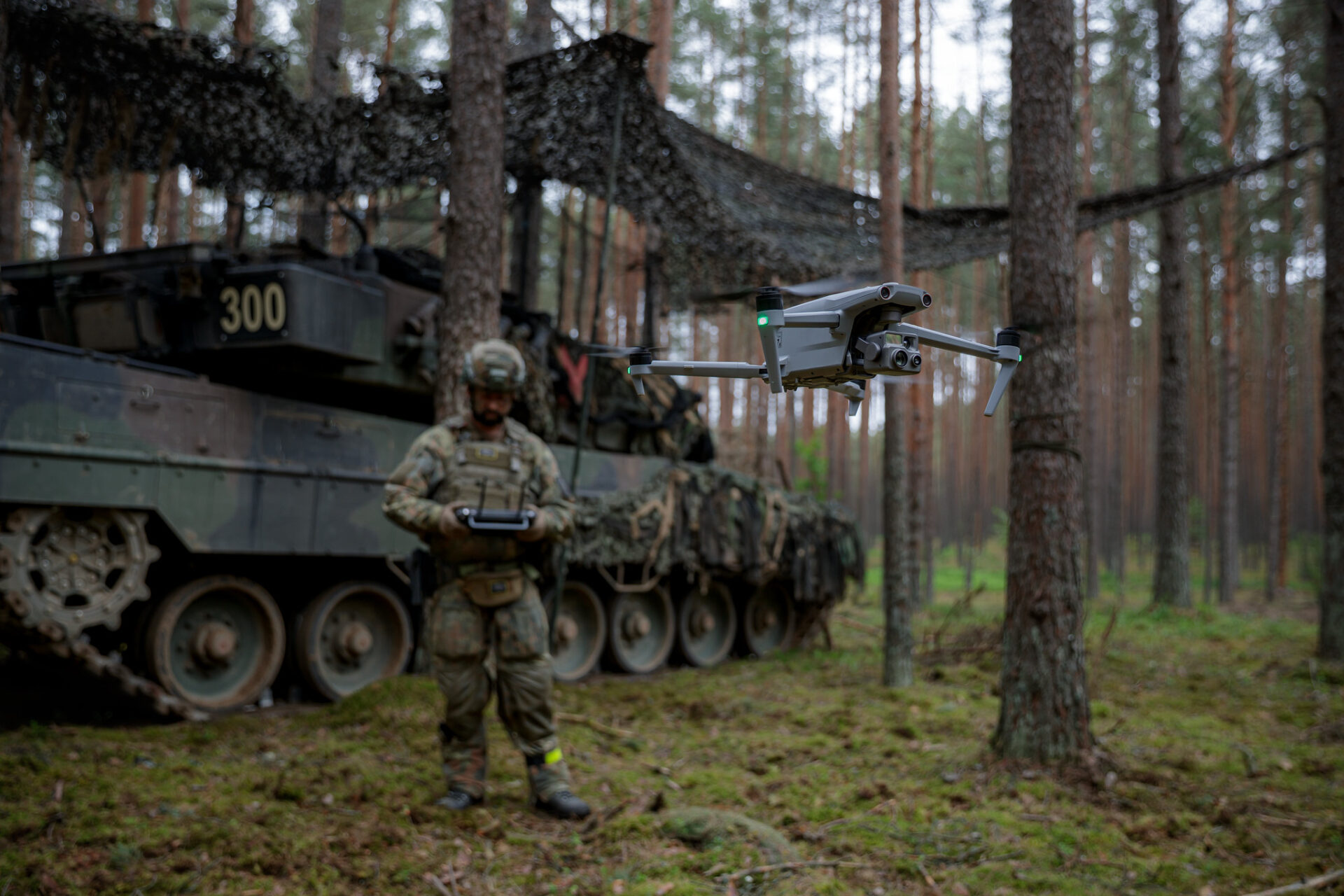
With more than 6,000 soldiers, the 10th Panzer Division of the Bundeswehr will begin training the defense of the NATO eastern flank in early November. The German Army even now refers to its 10th Panzer Division as a “Warfighting Division” in official statements.
Within the framework of two exercises taking place concurrently, the Panzer Brigade 45 “Lithuania” and the Panzergrenadier Brigade 37 “Free State of Saxony” will train under joint division command. The focus is on the readiness of the heavy combat formations, the division’s leadership capability, and the cooperation with NATO partners Poland and Lithuania.
The Bundeswehr on the NATO Eastern Flank
With the exercises “Freedom Shield 26-II” and “Grand Eagle 26,” the 10th Panzer Division of the Bundeswehr is preparing for its mission of national and alliance defense on the NATO eastern flank. While Panzer Brigade 45 trains at the Rudninkai Training Area, Panzergrenadier Brigade 37 conducts its exercises concurrently in Pabradė. The division’s leadership coordinates both exercises on site in Lithuania as well as from the home base in Veitshöchheim, Bavaria. This is not only about the combat of the individual brigades of the Bundeswehr. The 10th Panzer Division aims to test its command and planning processes from the moment of alarm through the execution of operations to the return of the troops. Another emphasis lies on cooperation with the Lithuanian and Polish armed forces.
“Our goal as a Warfighting Division, which in an emergency is commanded by Multinational Corps Northeast in Stettin, is the holistic attainment of combat readiness,” explains Major General Jörg See, Commander of the 10th Panzer Division. “For that, we train with our brigades on site in Lithuania, because: there is no second winner in war.”
The two brigades of the Bundeswehr taking part in the exercise currently assume different tasks in defending the NATO eastern flank. While Panzer Brigade 45 is permanently stationed in Lithuania, Panzergrenadier Brigade 37 remains ready in Germany as a quickly available combat formation.
Panzerbrigade 45 Lithuania
Panzer Brigade 45 was put into service on 1 April 2025. Its official activation parade followed on 22 May 2025 in Vilnius. It is the first combat brigade permanently stationed outside Germany and is expected to reach full readiness by the end of 2027. In January and February 2026, the brigade was assigned its three combat formations: Panzergrenadier Battalion 122 from Oberviechtach, Panzer Battalion 203 from Augustdorf, and the Multinational Battlegroup Lithuania. The latter had previously been part of the reinforced NATO presence in Lithuania and brings roughly 1,700 soldiers to the large formation.
By the end of 2027, the brigade is to grow to around 4,800 soldiers as well as about 200 civilian employees. Add the forces of the multinational battlegroup. At the same time, new housing, training facilities and military infrastructure are being built, including at the Rudninkai site.
The permanent stationing is militarily significant: Unlike before, the German combat formations do not have to be relocated from Germany to Lithuania in the event of defense. They are already in the designated area of operation and can respond immediately to a threat together with the Lithuanian armed forces.
At the same time, they are located so close to the border with Lithuania that in the event of an attack they would actually be among the first NATO defense forces. Because of this particular vulnerability, these Bundeswehr units should also be the first to be digitized and networked for combat readiness. Thus, the digital readiness of the Forward Land Forces Brigade under the leadership of Panzergrenadier Brigade 37 should be realized by year-end, and the digitized Panzer Brigade 45 in Lithuania by mid-2027, according to the latest statements by the BMWi (Federal Ministry of Defense and Economic Affairs). Delays in D-LBO may therefore directly affect the defense capability of German troops on the NATO eastern flank.
Panzergrenadier Brigade 37 Securing the Transition
Until Panzer Brigade 45 attains full personnel and material readiness, Panzergrenadier Brigade 37 “Free State of Saxony” will play a central role in defending Lithuania, i.e., the NATO eastern flank. It stands as Multinational Brigade Lithuania with high readiness in Germany to support Lithuania in the alliance’s defense. The formation includes, among other things, battle tanks Leopard 2, infantry fighting vehicles Puma and Marder, and the 2000-series self-propelled howitzers. In addition, reconnaissance, engineer, and other support troops. Thus, the brigade can not only conduct armored combat but also provide the support services required for a longer defensive operation.
The exercise “Grand Eagle 26” is thus also intended to train the relocation and deployment of a heavy German combat formation in the designated NATO area of operation. At the same time, the Panzer Brigade 45, already stationed in Lithuania, trains for local defense with “Freedom Shield 26-II.”
For the 10th Panzer Division, this creates a demanding leadership task: It must command two spatially separated brigades simultaneously, coordinate their operations, and ensure cooperation with NATO partners.
NATO Eastern Flank: Deterrence by Forward-Deployed Units
The permanent stationing of Panzer Brigade 45 is part of the reinforced NATO defense planning, which was significantly expanded after the Russian attack on Ukraine. Since 2017, the alliance has maintained multinational combat formations in the Baltic states and Poland. After the start of the Russian invasion in 2022, NATO member states decided to further strengthen their presence along the eastern flank. Lithuania plays a particularly strategic role. The country borders both Belarus and the Russian exclave of Kaliningrad. Between Lithuania and Poland runs the so-called Suwałki Gap. This relatively narrow land corridor connects the Baltic NATO states with the rest of the alliance’s territory.
Protecting the Baltics underscores the importance of securing this connection. In a conflict, NATO forces, and especially the Bundeswehr soldiers stationed there, must not only fend off an attack on Lithuania but also keep open their supply and reinforcement routes. Therefore, the Bundeswehr with Panzer Brigade 45 should not merely demonstrate NATO presence. Its mission is the actual defense of the alliance’s territory. The combination of permanently stationed combat troops and rapidly deployable reinforcement forces should signal to Russia that an attack on Lithuania would trigger an immediate military response by the alliance.
Drone Incidents Prove the Threat
How tense the security situation in the Baltic region has become is shown by several drone incidents in Lithuanian airspace. On 18 October 2026, an infiltrating drone triggered an air alert in Lithuania. Authorities urged residents in the center and north of the country to seek shelter. NATO combat aircraft took off to identify the aircraft.
The drone ultimately crashed near the village of Juodžionys in northern Lithuania. Debris damaged a civilian vehicle; no one was injured according to authorities. The Ukrainian government expressed regret over the incident and stated that possibly Russian electronic warfare may have diverted a Ukrainian drone from its course.
Earlier, on 15 September, Italian Eurofighters, as part of NATO airspace surveillance, shot down a drone over Lithuania. Later statements from the Lithuanian government indicated that the aircraft carried explosives and probably originated from Russia. It was reportedly intended to attack Ukraine and apparently deviated from its course. Lithuanian authorities did not suspect a targeted attack on Lithuania.
These incidents, however, illustrate an additional challenge for defending the NATO eastern flank. Beyond fending off conventional attacks, the Bundeswehr must also be able to respond to unmanned aircraft whose origin, flight path, and intent may be unclear. There is also the possibility that electronic jamming could unintentionally steer drones into NATO airspace. And, of course, the networking with other nations to ensure the early warning system can function reliably.
Bundeswehr: Practicing for the Real Thing
The exercises in Lithuania are thus part of a broader preparation by the Bundeswehr for national and alliance defense. “We have no time to lose,” emphasizes Major General See. “Exercises are a cornerstone of our readiness, which shows: we can fight and we can win.”
Whether NATO can defend its eastern flank successfully in an emergency does not depend solely on the number of stationed soldiers and weapon systems. The rapid provision of the latest technologies and their integration into German and international army units are also decisive. It is also crucial that the participating formations are available in time, that their command structures function, and that armed forces from different nations can actually and effectively operate together, with networking again playing a decisive role. These capabilities are to be further improved within the framework of “Freedom Shield 26-II” and “Grand Eagle 26.” Because effective deterrence requires capabilities, and it is indeed part of the concept to present such capabilities within exercises.
Author: Dorothee Frank, Online Editor-in-Chief
