
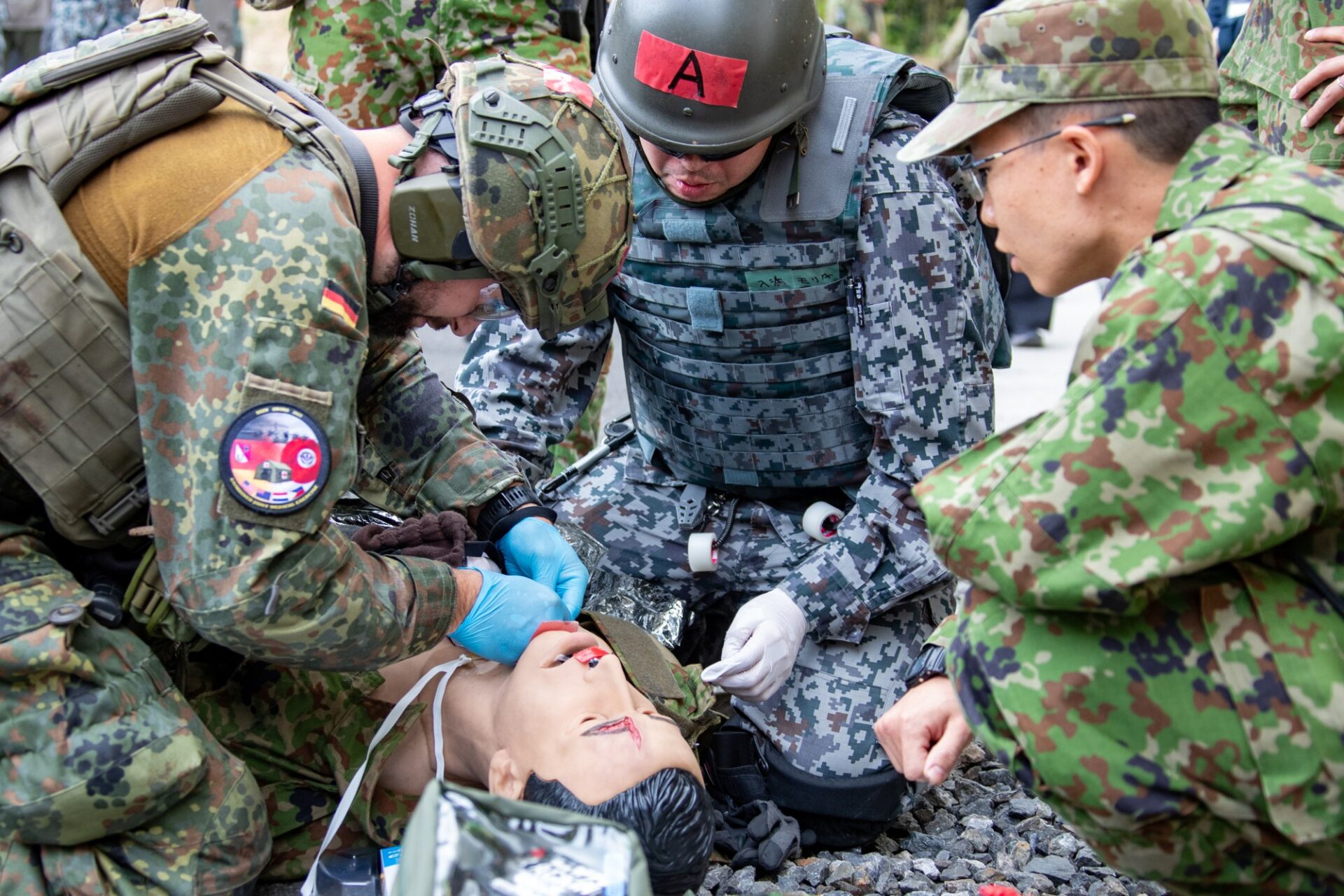
When the wounded have to be cared for and lives saved, different languages, cultures and procedures must not be obstacles. That cooperation across such differences was demonstrated by the German–Japanese medical exercise Keen Sword 27 in Japan, according to a Bundeswehr press release issued this Wednesday. Together with the Japanese armed forces as well as medical personnel from New Zealand, the United States, the Philippines and the Netherlands, it trained multinational cooperation under near-operational conditions.
The exercise clearly demonstrated: despite varying structures, channels of communication, and doctrinal approaches, the medical services could work superbly in multinational teams. Within just a few days it had already become evident: if you know each other, engage with one another, and practically rehearse joint procedures, interoperable medical care can be successfully delivered. This was also the message to Chancellor Friedrich Merz, who during his Asia trip took time to meet with German service members who participated in Keen Sword 27.
Further Expand German–Japanese Cooperation
That for the first time so many German service members trained on Japanese soil together with their Japanese partners, according to the Bundeswehr, is an important signal for bilateral cooperation. The focus was on the deployment and operation of a medical facility in Role 2, the air-delivered wounded care (Air Medevac), as well as the Forward-Located Lightweight Decontamination, Decontamination and Detoxification Site (VLEP). In doing so, it was tested how the capabilities and procedures of the participating nations interlock.
Following numerous discussions with leaders of the Japanese medical service on site, there is thus agreement to further develop the cooperation beyond the exercise. A number of concrete joint projects should now be undertaken. The aim is to intensify professional exchange, to learn from one another, and to consolidate cooperation through further joint activities and exercises.
The Indo-Pacific as an Important Strategic Region
The importance extends beyond bilateral relations. The Indo-Pacific is an important strategic region. In light of the changed security landscape, it is important that democracies and champions of the rules-based order work more closely together, strengthen each other, and be able to act jointly if needed. The Bundeswehr makes a concrete contribution to this with its on-site engagement.
The Commander of the Bundeswehr’s Central Medical Service, Generaloberstabsarzt Dr. Ralf Hoffmann, thanked all participating service members as well as, in particular, the Japanese hosts, for the professional cooperation, openness and great commitment. The exercise has shown that differences can be overcome when everyone works toward a common goal. Germany and Japan want to build on this experience and further deepen their partnership.
