
As the Israeli specialist IMCO announced on June 24, 2026, the Israeli Ministry of Defense has placed an arms contract valued at around five million US dollars for electrical systems for armored land vehicles of the Israel Defense Forces (IDF). The IMCO Group is an end-to-end solution partner for advanced platforms and a developer and supplier of subsystem solutions for land, in the field of air and missile defense and at sea.
The IMCO Group develops, manufactures and delivers highly sophisticated electronic and electromechanical solutions and systems – both according to existing design documentation (Build-to-Print) and according to specification (Build-to-Spec) – for mission-critical defense platforms as well as for demanding industrial applications. In doing so, the company offers turnkey services, including development, testing, mass production, delivery, and long-term logistics support (ILS). The IMCO Group has existed since 1974.
To this, Ariel Kandel, CEO of IMCO, stated: “This contract marks another important milestone in our long-standing partnership with a strategic customer and reflects the continued confidence in IMCO’s competence as a leading provider of electrical systems for military platforms. We are proud to contribute to the readiness of the Israeli armed forces with our advanced, reliable, and field-proven solutions.”
Rising demand beyond the IDF as well
Kandel added that the group, in light of the rising demand, would further expand its manufacturing capabilities and increase production capacity. This also includes the use of the new IMCO production site in Romania, which was opened about six months ago, to support the group’s international growth, increase manufacturing flexibility, and improve support for customers in Israel and worldwide.
The focus of the systems includes, among other things, situational awareness systems, platform monitoring and control, remote weapons stations (RWS), protection, energy, and driver-assistance systems. In doing so, the systems close the so-called sensor-to-shooter cycle from the sensor or the operator in the vehicle up to the Battle Management System (BMS), thereby linking to the command level.
IMCO’s main systems are SAVS 360 (360° Situational Awareness Video System) and HUMS (Health & Usage Monitoring Systems). SAVS has proven itself, according to the provider, particularly in the Israelis’ latest deployments. The crew — especially the driver and the commander — can operate with closed hatches and still maintain full situational awareness. This increases crew protection. It also makes it harder for the opponent in urban or heavily wooded environments to approach the vehicles undetected, for example to place an IED on the vehicle or to use a short-range anti-armor weapon.

Systems must not burden the crew any further
The crew always knows what is happening inside and outside the vehicle. In addition, all vehicle protection systems and the remotely operated weapons station/RWS are interconnected to form an overall system. The platoon leader also has the complete overview of all his platoon elements, even when he is not leading from the front. HUMS connects the sub-systems, of which more and more are being integrated into modern vehicles, without each weapons station, each protection system requiring its own screen or its own operating system.
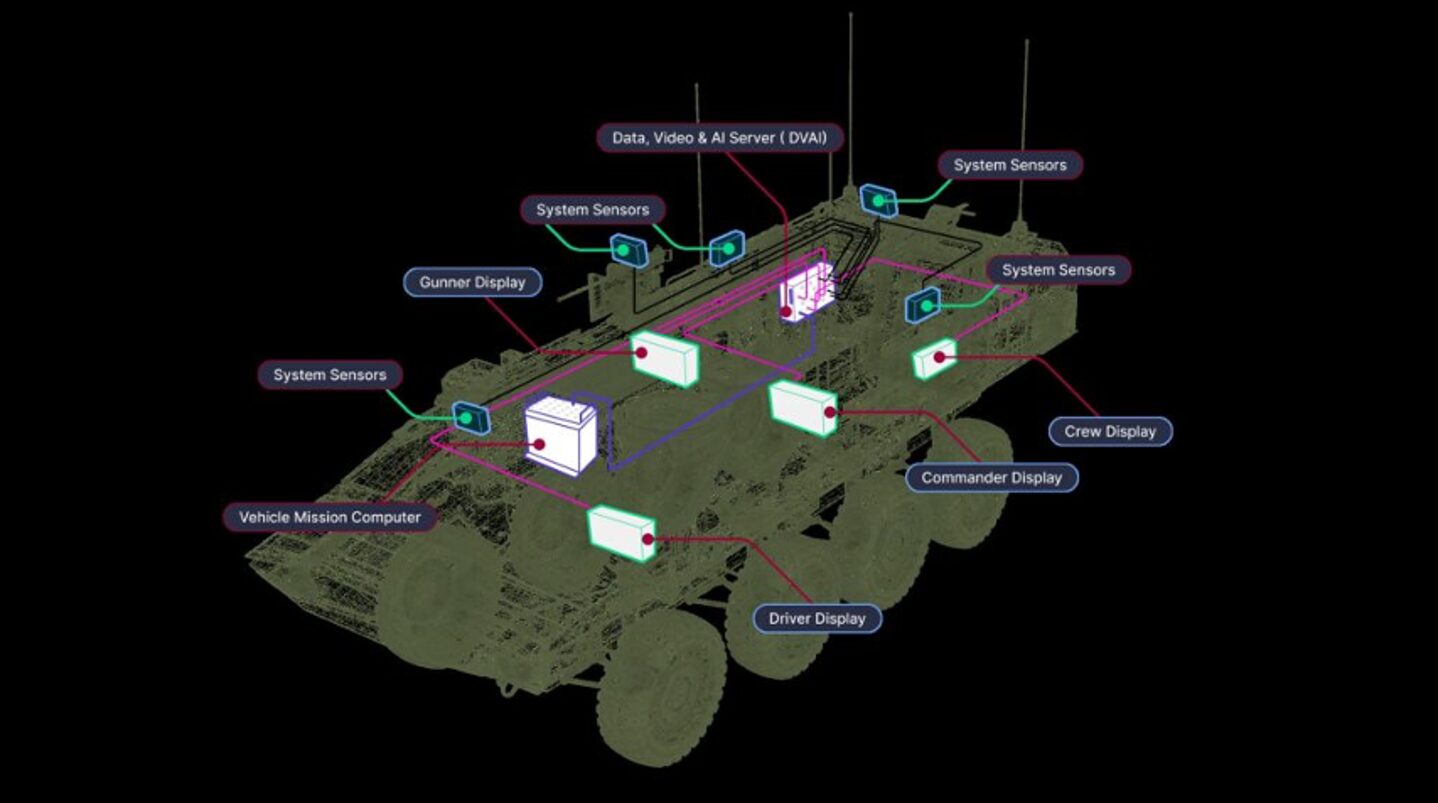
The SAVS 360 system offers AI-assisted prioritization of threats, improved decision-making foundations for the driver and commander, as well as seamless integration into the vehicle’s active protection and weapon systems. The centerpiece of SAVS is the Data, Video & AI Server (DVAI), to which are connected the Vehicle Mission Computer and all vehicle systems (sensors, anti-drone cameras, RWS cameras, SA cameras, etc.) as well as the displays and controls for the commander, driver, gunner, and the rear crew area.
Through the Vehicle Mission Computer, all vehicle sub-systems – such as Engine & Fuel, Suspension & Transmission, Electric Power, Chassis & Hatches, Data & Video Network as well as the Danger Control System – are connected. Vehicles today are intelligent, which is why systems like SAVS and HUMS are necessary. But these systems must not burden the crew further; on the contrary, they must lead to relief so that the crew can focus on their mission and the fight. Therefore they must be simple.
