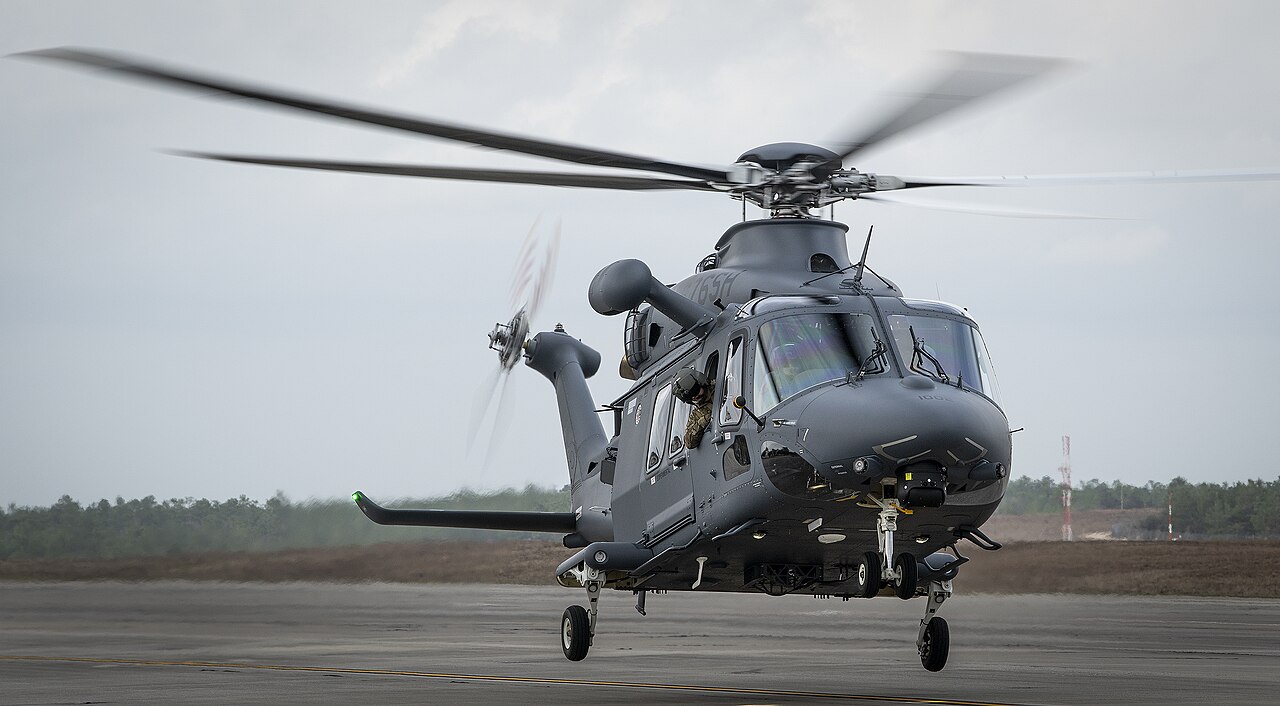
With the official attainment of initial operational readiness, the Boeing/Leonardo MH-139 Grey Wolf multirole helicopter is set to replace the Bell UH-1N “Twin Huey,” introduced in the 1970s, at the U.S. Air Force’s Global Strike Command. In 2018, the variant of the then AgustaWestland AW139 prevailed over two different bids for versions of the Sikorsky UH-60 Black Hawk. The USAF initially ordered four for delivery from 2021; the total planned is 84.
The UH-1N, a twin-engine version of the classic light transport helicopter UH-1 Iroquois, with the civilian designation Bell Model 212, was used by the USAF for search-and-rescue missions, VIP transport and especially to provision and secure dispersed control and protection facilities for nuclear intercontinental missiles (ICBMs). In addition, the U.S. Marine Corps (USMC) uses the upgraded UH-1Y Venom with a four-blade rotor for light transport and combat-support tasks from the decks of amphibious assault ships.
MH-139: faster, farther, heavier, quieter
While the USMC, in this choice, also considered synergy effects with its AH-1Z Viper attack helicopter, the USAF opted for a successor solution with a new design. Compared to the UH-1N, the MH-139 offers a 50 percent higher cruising speed, more than double the range, a higher takeoff weight, and a quieter flight. The main user will be the Air Force Global Strike Command with the 20th Air Force, to which the three USAF ICBM wings at Malmstrom Air Force Base in Montana, F. E. Warren Air Force Base in Wyoming, and Minot Air Force Base in North Dakota report.
The actual missile sites are distributed over an area of almost 90,000 square kilometers, with fields, prairies, and mountain ranges. In addition to the exchange of personnel and material between locations, the command’s helicopters are also used for security tasks, such as the rapid deployment of intervention forces in response to security incidents. This year, the Malmstrom-based 40th Helicopter Squadron also used two MH-139s for the first time to escort a convoy of LGM-30G Minuteman III ICBMs. They escorted the ground vehicles for six hours to a position more than 160 kilometers away and back, without refueling.
The demand for such missions is expected to rise in the coming decade with the replacement of Minuteman III by the future LGM-35 Sentinel ICBM. Like their predecessors, the MH-139 will also be used for search and rescue missions, medical evacuation, and disaster relief. By contrast, the 26 UH-1Ns currently stationed at Joint Base Andrews in Maryland, which are intended among other things for evacuating government members from nearby Washington, DC, will be replaced by the HH-60W Jolly Green II, also intended by the USAF for combat rescue tasks.
