
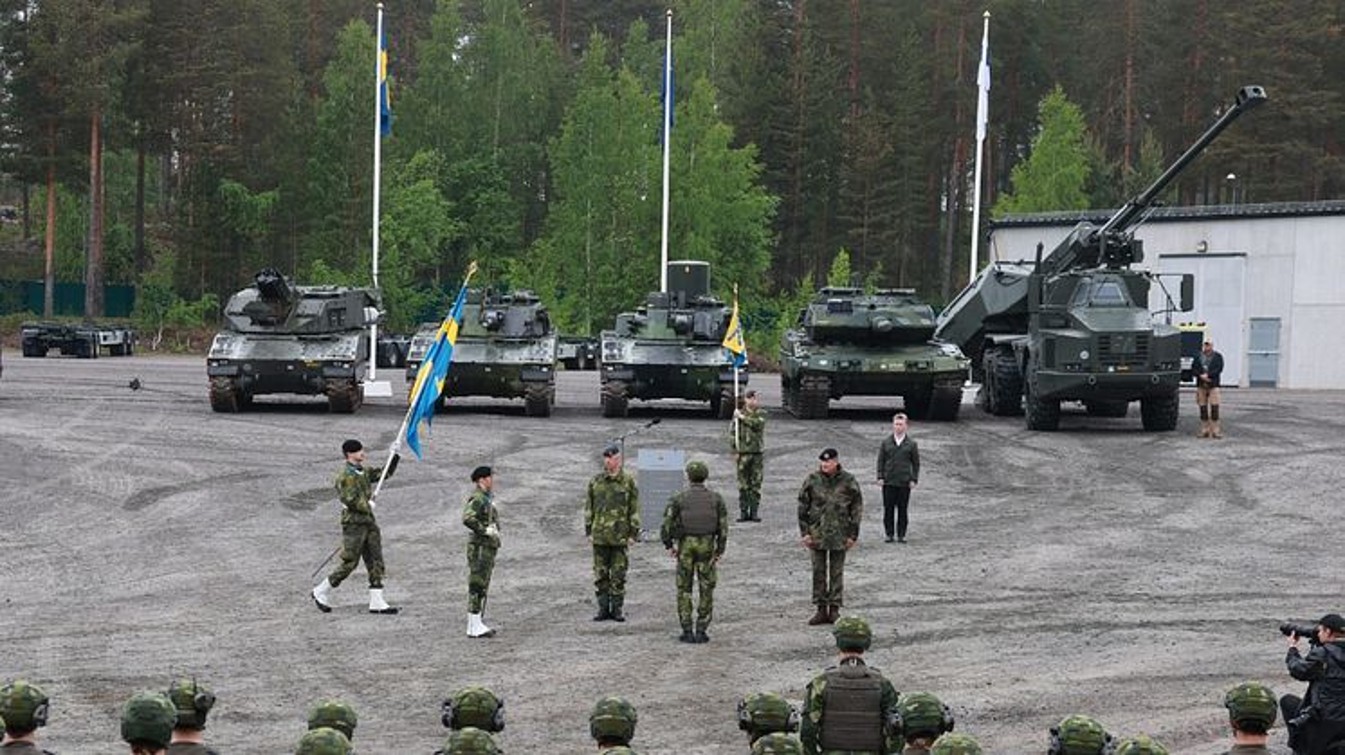
On Sweden’s National Day, June 6, 2026, a ceremony was held in Boden for the establishment of the latest multinational NATO command – the Forward Land Forces Finland (FLF FIN). Attendees included representatives from the Swedish Armed Forces, the Finnish Defence Forces, NATO, and other invited guests. Not far from Boden in northern Sweden, soldiers of the Norrbotten Brigade with their military equipment gathered to mark the establishment of FLF Finland. Sweden acts as the framework nation and Finland as the host nation. With this, the two countries aim to strengthen alliance deterrence on the northern flank.
The ceremony marks an important milestone in the creation of NATO’s latest “Forward Land Forces” formation on the northern flank. “The northern flank imposes special requirements on the units operating there. It is characterized by subarctic climate, vast distances, limited infrastructure and expansive, roadless terrain. The units of the Norrbotten Brigade have long experience in training and operations under these conditions and can act quickly across the entire area of operation,” explained Daniel Rydberg, commander of the multinational NATO command in Boden.
Battalion Battle Group as the Core
The newly formed formation initially consists of a trained battalion battle group. By incorporating units and capabilities from other alliance states, it can be expanded to brigade level. Stationing in Boden ensures excellent endurance while maintaining the required readiness. In Finnish Rovaniemi, the Multinational Support Element (MNSE) will also be established.
This command element is part of the same FLF structure and initially consists of officers from Sweden, Finland and the United Kingdom. “The Swedish-Finnish defense cooperation is built on long-standing, close collaboration and creates excellent prerequisites for the establishment of FLF Finland. Finland has the longest land border of NATO with Russia. This makes the northeastern flank a region of great importance for the alliance’s collective deterrence and defense,” said Jonny Lindfors, Chief of the Swedish Army.
Strengthening NATO in the High North
“The integration of Finland and Sweden into the joint operational area of NATO Joint Force Command Norfolk has significantly strengthened NATO’s posture in the High North,” emphasized Vice Admiral James Morley, deputy commander of NATO Joint Force Command Norfolk. “By integrating their capabilities, their expertise and their national defense plans into NATO’s regional defense architecture, we have improved our ability to deter aggression, reinforce allies and defend the alliance’s northern flank. The Forward Land Forces Finland are a concrete expression of this integration.”
As a key component of NATO’s deterrence and defense strategy, the FLF Finland strengthen leadership and control of the Allies, enhance regional responsiveness and increase the alliance’s ability to host, integrate, sustain and deploy multinational forces. The brigade will also play an important role in the Arctic Sentry activities under the leadership of JFC Norfolk. It contributes to validating NATO’s operating concepts, improving interoperability and ensuring that the alliance remains ready to defend the region even under the most challenging conditions.
The Forward Land Forces
The Forward Land Forces are part of NATO’s reinforced deterrence and defense measures along the alliance’s northeast flank. The concept is based on multinational forces kept in a high state of readiness and reinforced when needed. The Swedish units of the FLF Finland are stationed in Boden but will be able to operate across the entire area of operations. At the same time, in Rovaniemi, as an integral part of the same FLF structure, a permanent multinational staff (Multinational Staff Element – MNSE) will be established.
Since Sweden and Finland now belong to the joint operational area of NATO Joint Force Command Norfolk, the FLF Finland will play a key role in “Arctic Sentry” – the Alliance’s military activity in the Arctic and the High North. They contribute to an increased presence and an improved situational picture of the allied forces, to synchronized activities, as well as to the integration of modernized capabilities.
