
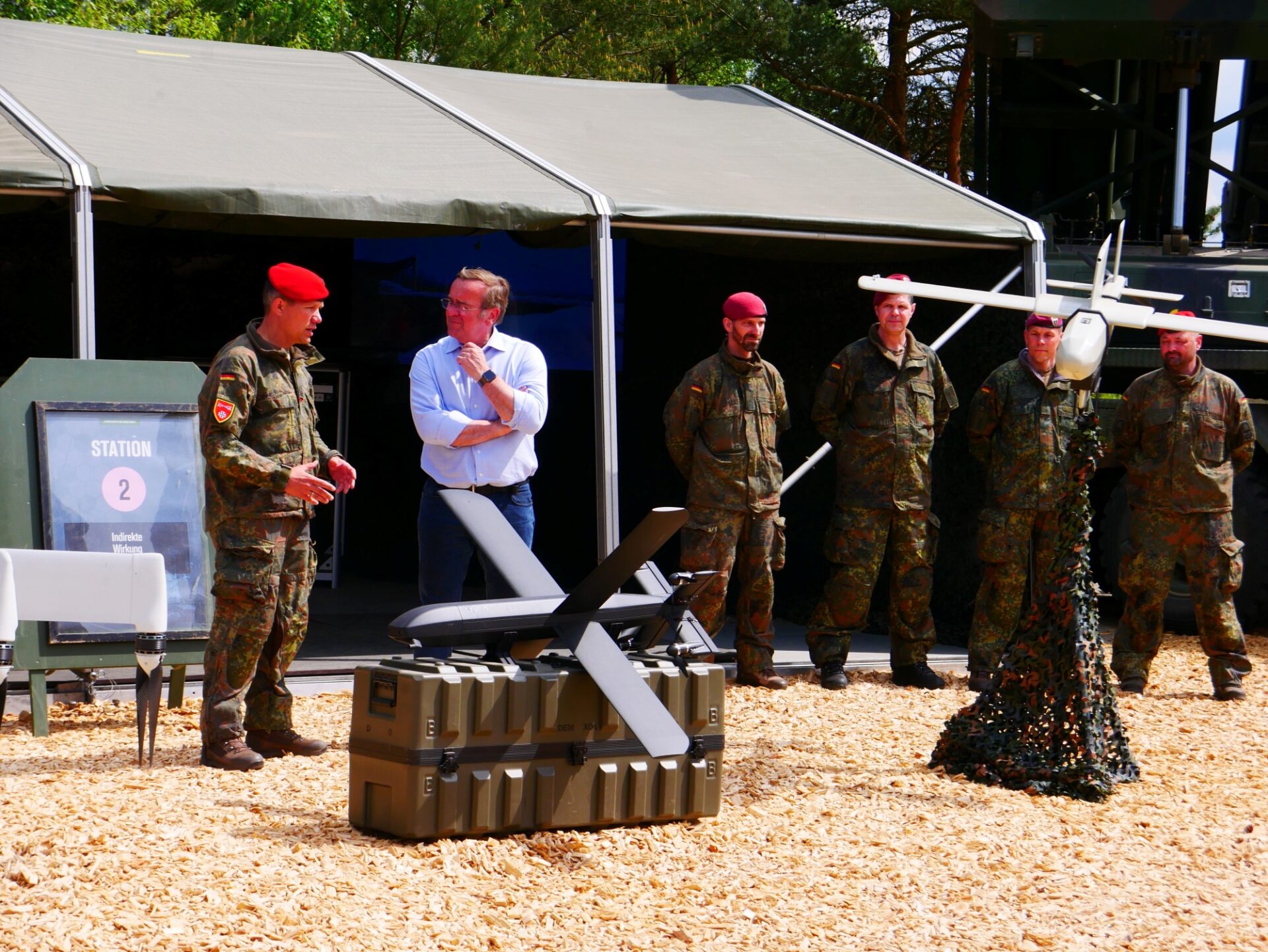
Following Federal Chancellor Friedrich Merz’s remarks last Thursday, on Monday the Federal Minister of Defence Boris Pistorius also visited the army in Münster and observed the demonstration “How the Army Will Fight.” The troops demonstrated how a war of the future would have to be fought by the land forces in their domain. “Everyone here is aware that there is rapid development across all system areas,” Pistorius said afterwards. “We experience this daily in Ukraine, we see it in the various developments across the different technical domains. This applies especially, but not only, to drones of all kinds.”
Anticipating these developments is a difficult task. It also involves satellite internet, radar, GPS, artificial intelligence, and AI-assisted analysis of sensors. All of this plays an ever-growing, even omnipresent, role in modern warfare. “That means the protection of one’s own forces when advancing or defending becomes increasingly demanding,” the minister said. “Consequently, the pace of operations itself must be higher. Secondly, because of the possibility to exert precise influence at long range, there are practically no protected or secure spaces on the battlefield today.”
Pistorius: “Assault Rifle and AI Drone Simultaneously”
High technology and affordable mass-produced goods, traditional and modern means, must be able to be deployed simultaneously. “And we are seeing both—the assault rifle and the AI drone—simultaneously,” Pistorius said. “Modern technology and proven military excellence must complement each other. What does this mean for the road ahead? We must deliberately push forward the development of capabilities that are especially urgently needed and continually adapt to the evolving technological developments. Whether, for example, in protecting against threats from the air or in the deep integration of unmanned systems in all domains.”
In addition, market-available intermediate technologies will continue to be evaluated to build capabilities faster. The Inspector of the Army, Lieutenant General Christian Freuding, added: “What you have seen here is real. This is the combat picture that we are convinced will develop in such a way in the future that we will face it.” They had hard-earned these insights in preparation: “If you had asked me on the first day of our training and testing exercises whether it would look like it does at the end today, I would have told you no—we had completely different ideas.”
Over just over three weeks, they had intensively learned to build a coherent overall picture here in Münster with the systems they already have, those that were being introduced, and those still in the experimental stage, involving more than 1,000 company chiefs, battalion-, brigade-, and division-commanders, allied forces, and the industry here in Münster. Step by step, they would also attempt to bring the interim solutions in the five fields of action—indirect effects, protection against air threats, electromagnetic warfare, and the integration of unmanned systems—connected by digitalization—into realization.
