
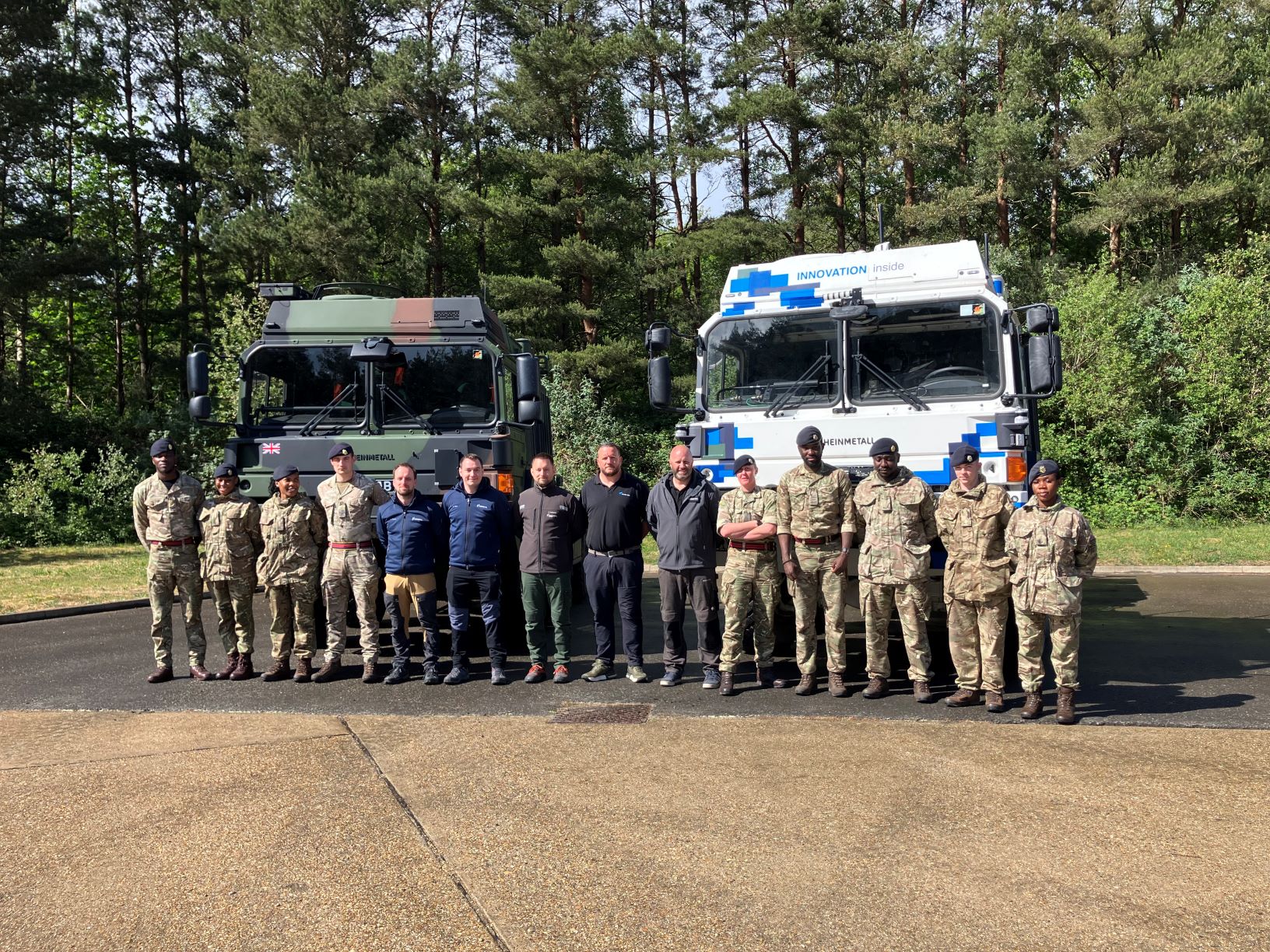
Rheinmetall and the British Ministry of Defence (MoD) have successfully conducted a training program on autonomous logistics for members of the British Army. Its culmination was the first autonomous “UK HX” convoy. It was steered by British soldiers from the British “Advanced Land Autonomy Centre of Excellence” (ALACoE) using the PATH kit.
The program, which took place over two weeks at the Combat Service Support Trials and Development Unit (CSS TDU) in Aldershot, prepared personnel of the 8th Squadron of the 27th Regiment of the Royal Logistic Corps (RLC) to participate in the “Convergence Capstone 6” project (PCC6). This is part of the MAIA project — an initiative of the British Army to research and evaluate autonomous systems for future logistical operations.
The successful completion of the first automated HX convoy in the United Kingdom marks an important milestone in the British Army’s exploration of autonomous capabilities. It demonstrates how advanced technologies can increase operational effectiveness while soldiers simultaneously acquire the skills and confidence to plan, lead, and operate autonomous logistics convoys.
British Army personnel gain valuable experience
The training was conducted using the HX2 development vehicle “White Pony”. It was equipped with Rheinmetall’s PATH Autonomous Kit (A-Kit) — a platform-agnostic autonomous driving system that enables existing fleets to drive autonomously. By combining advanced sensors, AI-assisted navigation, and robot-control software, the system enables vehicles to operate both autonomously and in convoys. This allowed British Army personnel to gain valuable practical experience in realistic operating scenarios.
As part of the program, the soldiers were initially trained in the roles of convoy lead, lead vehicle driver, and security driver, before undertaking increasingly demanding on-road and off-road exercises. Training scenarios included closed routes, immobilized vehicles, and dynamic convoy management. The challenges were simulated to reflect those expected during PCC6 at Fort Irwin, California.
The program was implemented jointly by Rheinmetall teams from Austria, the United Kingdom, and Canada, underscoring, according to the company, the strength of the group’s international know-how and its commitment to collaborating with partners in the defense industry in the development, testing, and delivery of innovative capabilities.
Preparation for “Convergence Capstone 6”
Christoph Müller, CEO of Rheinmetall MAN Military Vehicles, said: “Autonomous technologies are changing the future of military logistics. Through our collaboration with the British Ministry of Defence and colleagues across the Rheinmetall Group, we are helping British Army personnel develop the capabilities and confidence required to deploy autonomous systems of the next generation. This milestone shows what can be achieved when innovation, collaboration, and operational expertise come together.”
As part of the Convergence Capstone 6 project, international partners will come together to evaluate new technologies in realistic operating environments, gaining valuable insights into how autonomous systems can strengthen logistics, enhance operational resilience, and serve as a basis for the future development of capabilities. The program’s successful completion underscores Rheinmetall’s commitment to delivering innovative technologies that meet the evolving demands of modern armed forces and help shape the future of military logistics.
