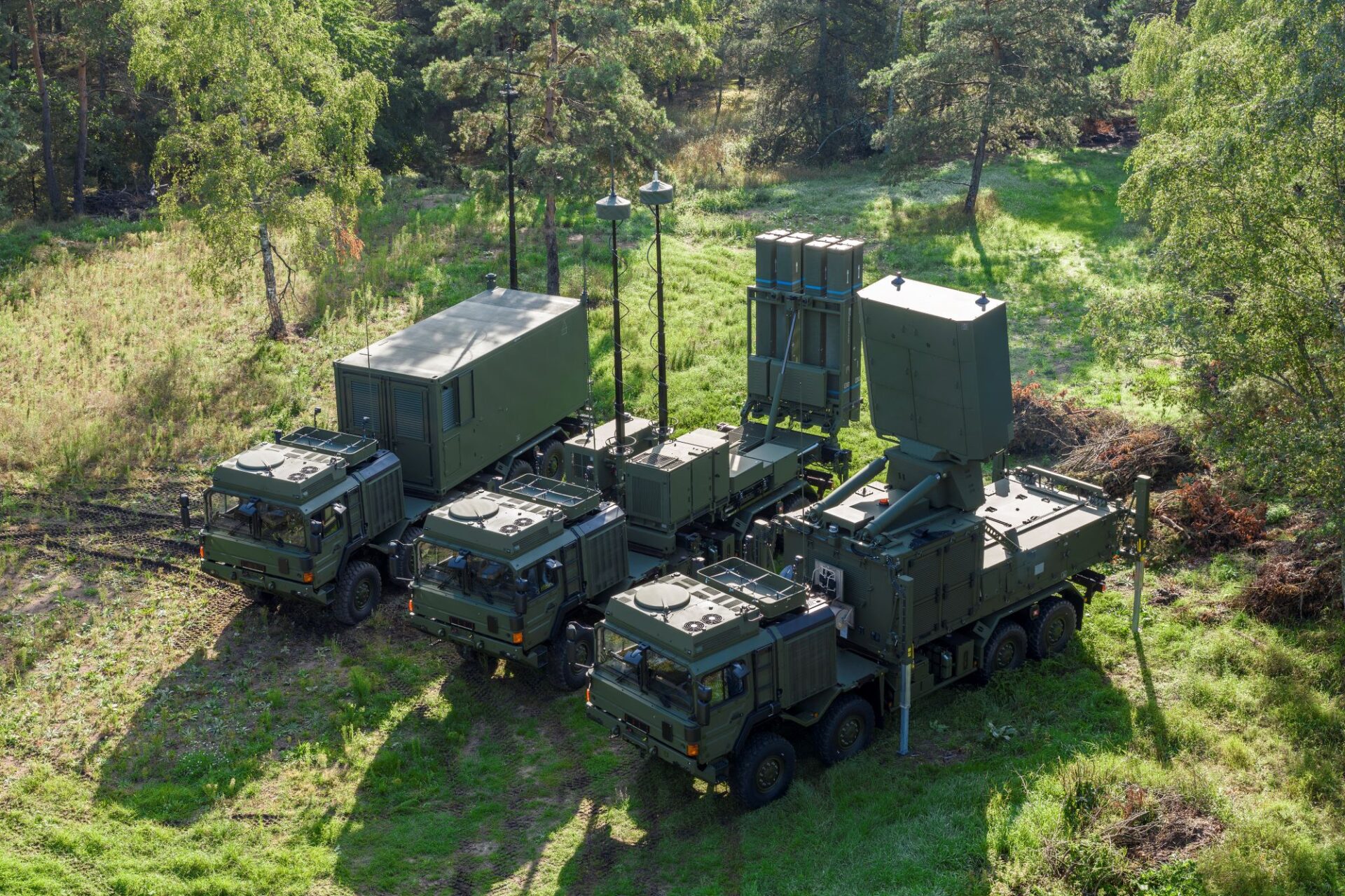
The Swiss government, the Federal Council, will request an additional credit of 970 million Swiss francs (1.03 billion euros) for air-defense procurements from the Parliament of the Swiss Confederation. It announced this last Wednesday. The funds are intended to cover down payments for projects from the Army’s 2026 Defence Message, the annual defense planning: 250 million and 650 million francs (258 and 670 million euros) for ground-based air defense of short and medium range, 60 million francs (62 million euros) for a semi-mobile medium-range radar, and ten million francs for the defense against mini-drones.
The down payments are intended to ensure timely deliveries as well as the setup and training of deployment procedures for the ground-based air defense. The background is the sharply increased demand for air-defense systems due to the Ukraine and Iran wars, with production still unable to keep up despite ongoing expansion. Customers thus stand in effect in competition for suppliers rather than the other way around, which affects financing design. Switzerland has already painfully experienced this in the case of the Patriot system ordered in 2022, whose delivery will be delayed by years despite the down payment due to U.S. domestic demand.
Switzerland intends to procure IRIS-T SLM and Skynex
Due to the delivery date not before 2032 being postponed, Switzerland is now examining, among others, the French-Italian SAMP/T NG as an alternative to the planned five Patriot fire units. Talks are also to be conducted with Israeli and South Korean suppliers, according to a statement from June. In addition, for a total of one billion francs (1.06 billion euros) IRIS-T SLM from Diehl as ground-based air defense medium-range and for 800 million francs (850 million euros) the Skynex cannon system from Rheinmetall’s domestic subsidiary Oerlikon for shorter range would be added.
Neben den zusätzlichen Mitteln zur Flugabwehr will der Bundesrat laut der gleichen Mitteilung in den kommenden Jahren auch 100 Millionen Franken (106 Millionen Euro) investieren, um die Sicherheit an über 60 militärischen Standorten zu stärken. Geplant sind unter anderem verbesserte Umzäunungen, Videoüberwachung, elektronische Zutrittskontrollen und Sicherheitsräume. Aufgrund der veränderten Sicherheitslage sei eine rasche Umsetzung dieser Maßnahmen dringend notwendig, so die Regierung. Damit dürften vor allem hybride Bedrohungen wie Spionage, Sabotage und gelenkte Proteste gemeint sein.
