
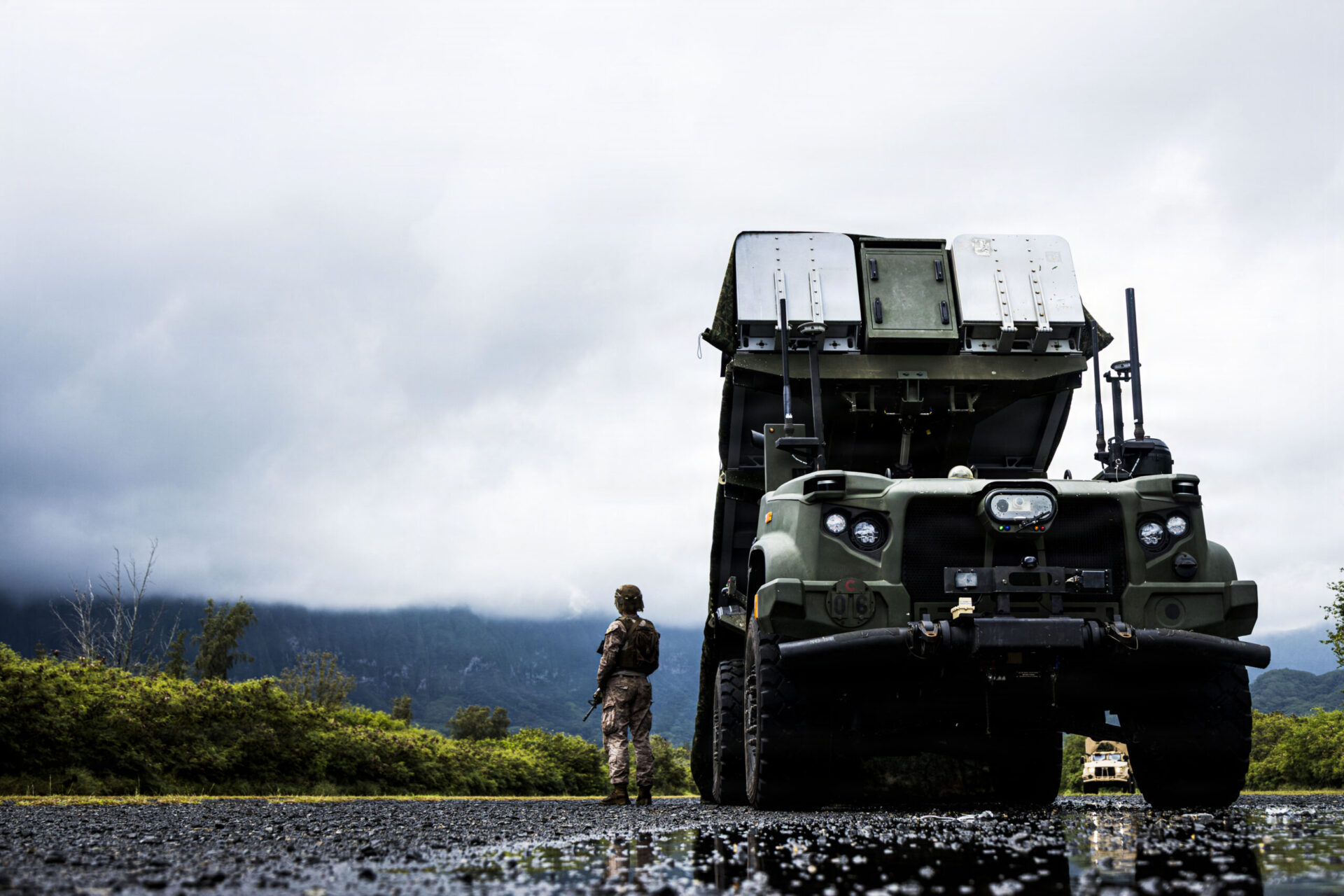
The United States Marine Corps (USMC) has officially commissioned its first battalion fully equipped with the NMESIS anti-ship missile system (Navy-Marine Expeditionary Ship Interdiction System) of medium range, belonging to the 1st Battalion, 10th Marine Regiment of the 2nd Marine Division. Since October 9, this battalion, according to a USMC announcement, is designated to support the II Marine Expeditionary Force (MEF). The task force, consisting of elements from the 2nd Marine Division, the Marine Air Wing, and the Marine Logistics Group, with its headquarters at Camp Lejeune, North Carolina, is primarily responsible for operations in the Atlantic region.
This is significant because NMESIS was developed in particular with a view to the Marine Corps’ new Pacific strategy. It is a land-mobile system using the Norwegian Naval Strike Missile (NSM), which is also being procured by the German Navy as a prospective sea-launched missile. A battery consists of 18 launch vehicles in six platoons, each carrying two missiles. NSM weighs 400 kilograms with booster and reaches Mach 0.93 in cruise with a microturbine engine, with a range of over 200 kilometers, and in the latest version 1A even over 300 kilometers.
NMESIS can be used against sea and land targets
Using a combination of satellite and inertial navigation as well as an imaging infrared seeker, the missile can also be deployed against land targets. The primary purpose under the Force Design concept introduced in 2020 for the USMC is to rapidly move fire units across the sea lanes among the numerous islands of the Pacific region, thereby denying adversaries such as China access to the surrounding sea routes from those positions. In the course of the controversial reform, the Marine infantry regiments in the Pacific were transformed into Littoral Combat Regiments.
These consist of a Littoral Combat Team with three infantry companies and one NMESIS battery, as well as a Littoral Anti-Air Battalion and a Littoral Logistics Battalion. The system is already in service with the 3rd Littoral Combat Regiment based in Hawaii and the 12th Littoral Combat Regiment stationed in Okinawa; however, the conversion of additional regiments has been halted. Within the II MEF, NMESIS apparently now serves as a division-level asset. In addition to the 1st Battalion, which previously employed the 155-mm Howitzer M777, the 10th Marine Regiment also includes the 2nd Battalion with the artillery rocket system M142 HIMARS and a Fire Support Battalion.
China reacts to the reorganization of the USMC in the Pacific
The reorganization in the Pacific naturally also concerns the expected main adversary, China. In the past two years, several Chinese expert articles have appeared on the subject. Not surprisingly, the Littoral Combat Regiments are viewed among other things as a means to bring sea-skimming missiles within range of the Chinese sphere of influence and, not least, to prevent the “Chinese reunification” — that is, the seizure of Taiwan, which Beijing regards as a renegade province. The small, mobile fire units are thus not easy to detect.
There is also concern about the possibility that the Marines could use sensors to detect submarines and other reconnaissance assets, which would heighten the threat posed by new weapons systems such as sea drones and the stealth sea-launched missile LRASM. As an enemy vulnerability, various analyses identify the weak air defense and the logistical support of U.S. forces. As countermeasures, they recommend a more aggressive forward presence by China and, in particular, a strengthening of its own submarine capabilities.
