
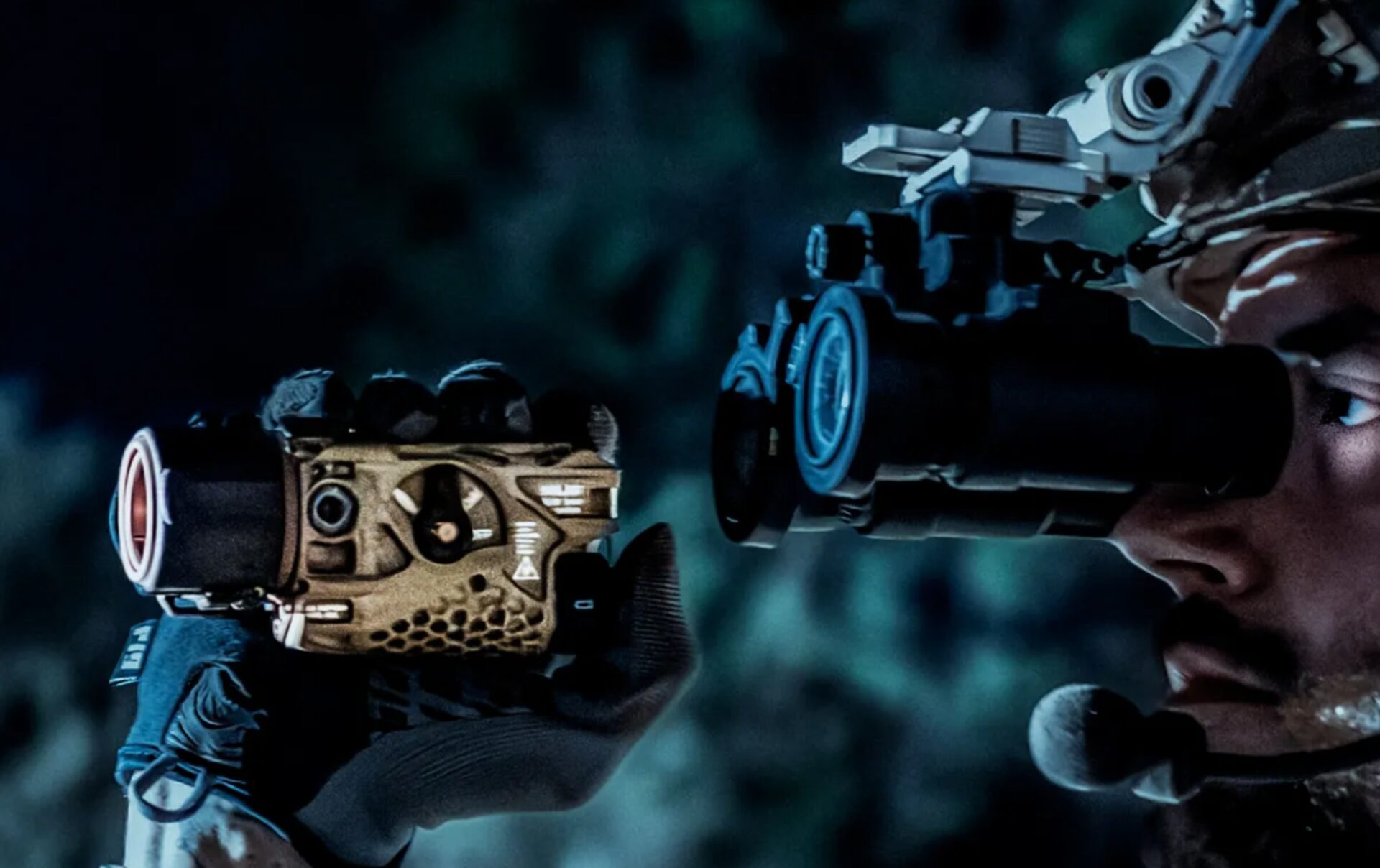
With the introduction of the new serial variants of the VSLAP (Variable Six Laser Advanced Pointer), B. E. Meyers & Co. Inc. has unveiled the spiritual successor to the IZLID family of high-performance lasers—a product line that is widespread among Joint Terminal Attack Controllers (JTACs) worldwide. Almost all Western JTACs and special forces have used IZLID in recent decades to mark targets, including within the German Armed Forces. Since its introduction in 1993, it has set the standard for high-performance near-infrared laser pointers and illuminators.
IZLID has been used in Tactical Air Control Parties (TACP), Combat Control Teams (CCT), Joint Terminal Attack Controllers (JTAC), Special Operations Terminal Attack Controllers (SOTAC), Air Naval Gunfire Liaison Companies (ANGLICO), as well as Joint Fires Observer (JFO) applications and other air-to-ground applications. From these decades of combat experience, B. E. Meyers produced the VSLAP-V1 as a development. The US company first presented the new serial variants of the VSLAP at the SOF Week in Tampa, Florida.
It was developed to improve target marking, illumination, and communication with aircraft. Its design offers higher performance, an ergonomic format, and better integration with weapon systems than the predecessor IZLID. Users can thereby request airstrikes, coordinate close air support, and direct ship artillery fire. The tools they use for target marking and for communication with the aircraft above them form a critical link in the chain between the ground troops and the firepower available to support them.
DeathStar Laser Technology
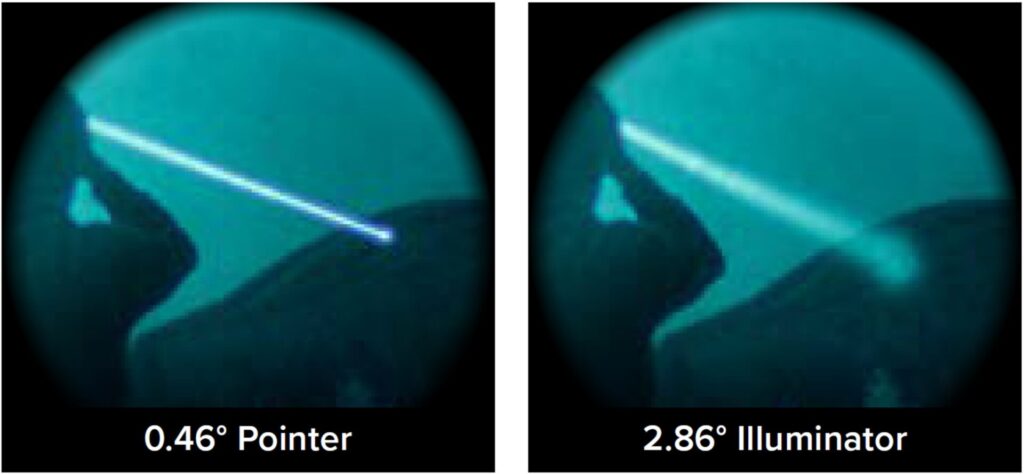
The VSLAP-V1 builds on the IZLID heritage—and specifically through an innovation that B.E. Meyers terms “DeathStar” technology. This is a patented system that, according to the manufacturer, bundles six individual laser diodes into a single, concentrated beam (0.8 mrad / 0.46 degrees) and produces an output power of up to 1.21 watts in the near-infrared spectral range (NIR), selectable in continuous-wave operation or in three different pulse modes. In addition to the High Power Output of 1.21 watts, VSLAP also offers a Medium Power Output of 375 milliwatts and a Low Power Output of 125 milliwatts. The wavelength of the IR laser is 840 nanometers.
The physics underlying the design encounters a limitation inherent in individual laser diodes: while a single beam travels its course, its profile remains comparatively narrow. This limits both its visibility for aircraft at high altitude and the uniformity with which it illuminates a target area. By aligning six diodes together, B. E. Meyers creates a combined beam that, over distance, fans out to such an extent that it—at the same power level—exhibits a significantly larger profile than a system with a single beam source.
This improves visibility for high-flying aircraft and at the same time increases the uniformity of illumination in the target area. As the six individual beams diverge and begin to overlap, they compensate for the irregularities inherent in edge-emitting laser diodes. According to the manufacturer’s technical description, this creates a substantially more homogeneous illumination pattern in the system’s 2.5-degree floodlight mode. This floodlight mode has operational relevance that cannot be fully captured by the technical specifications alone.
The VSLAP Series
When a JTAC or TACP needs to illuminate a target area for an attacking aircraft—or to point to more than a single point—the quality and uniformity of the illumination directly influence how clearly the aircraft crew can identify their target using night vision and targeting systems. An uneven or hotspot-dominated illumination can create ambiguity at precisely the moment when absolute clarity is most critical. The “DeathStar” system addresses this problem, according to B. E. Meyers, through a special compensation of beam overlap.
The ergonomic design of the VSLAP-V1 reflects insights from decades of practical field experience with IZLID systems under combat conditions—an environment in which even minor design compromises in weapon-mounted equipment can translate into significant problems given the physical and cognitive demands of close-quarters combat. The device enables one-handed operation; a thumb-accessible switch serves to toggle between four power levels: Off, Low, Medium, and High.

A operator aiming a near-infrared laser at a target can relay its position to a flight crew above without the signal being visible to persons without night vision— a fundamental advantage for operational safety that has made powerful near-infrared lasers indispensable for both special forces and conventional forces.
Remote Adjustment Interface
The integration of weapon systems is realized through the possibility of azimuth and elevation adjustment on weapons operated by the crew as well as on rotorcraft platforms— complemented by a proprietary Wakizashi interface, which enables simultaneous remote triggering, power supply, and data transmission. This interface allows a single operator to activate the laser while simultaneously firing a weapon system. This eliminates the coordination problem that typically occurs when a laser device requires a dedicated manual control that cannot be combined with weapon control.
The ability to remotely adjust settings via the Wakizashi interface deepens this integration further, allowing the operator to change the output power and operating mode of the laser without having to release the fixed grip on the weapon system. The near-infrared spectrum in which the VSLAP-V1 operates is invisible to the naked eye, yet clearly detectable by night-vision devices and targeting systems—as routinely used by modern military aircraft and ground forces.
This makes it the standard medium for covert target marking, ground-to-air communication, and friend-foe identification in operations conducted under poor lighting conditions. An operator aiming a near-infrared laser at a target can relay its position to a flight crew above without the signal being visible to those without night vision devices—a fundamental advantage for operational safety that has made powerful near-infrared lasers indispensable for both special forces and conventional forces.
Applications on Different Weapon Systems
The VSLAP is a Class 4 near-infrared laser target designation and illumination device. By turning the beam steering ring, it can be configured to either produce a tightly focused near-infrared target point or to aggregate all individual beams into a homogeneous near-infrared floodlight (50 mrad / 2.86 degrees). The design enables one-handed operation and intuitive control of all system functions. These settings cover a wide range of output powers, ensuring the user can always choose the optimal level for the surrounding environment. The VSLAP can also be deployed on a variety of weapon systems—from crew-served weapons to rotorcraft.
For these applications, the device offers azimuth and elevation adjustments to ensure precise aiming at the target. The proprietary Wakizashi connector enables remote triggering and power supply of the device and additionally supports data transmission functions. Two CR123 batteries provide the power. The dimensions are 7.8 x 2.3 x 3.0 inches or roughly 19.8 × 5.8 × 7.6 centimeters (L × W × H), with a weight of 9.45 ounces (268 grams) excluding batteries. The device is rated for two hours of immersion down to a maximum depth of 20 meters and is MIL-STD 810G/H certified.
