
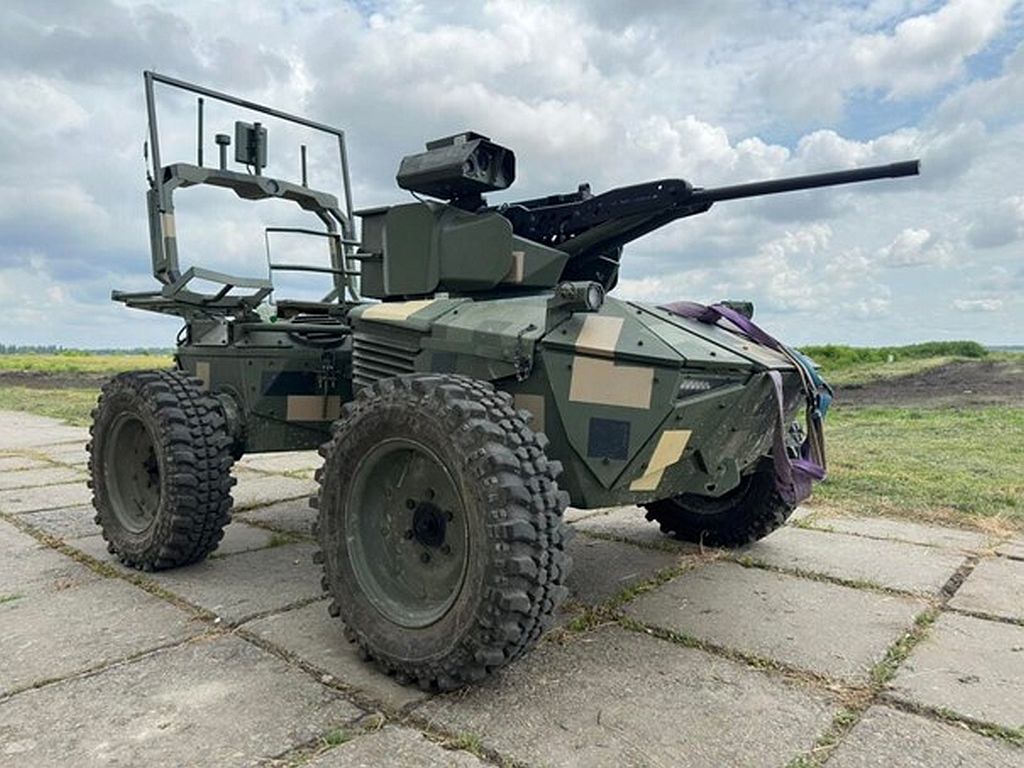
Ukraine aims to have unmanned systems take over the entire logistics at the front in the war against the Russian invasion. This is a consequence of the increasing drone warfare along the front lines, creating a “kill zone” with a constant threat to all troop movements and the already existing manpower shortage of the Ukrainian armed forces. As Defense Minister Mykhailo Fedorov stated in mid-April, a total of 25,000 unmanned ground vehicles (UGVs) would be ordered in the first half of 2026, more than twice as many as in the entire previous year.
In March alone, the armed forces conducted more than 9,000 UGV missions for logistics and evacuation purposes, according to Fedorov. Shortly before, President Volodymyr Zelensky had stated that the number of unmanned missions in the previous three months was over 22,000. He had particularly pointed to the first case in which a fortified Russian position in Kharkiv Oblast was captured only with unmanned air and ground systems. Russian soldiers reportedly displayed a cardboard sign reading ‘We want to surrender’ and were led into captivity by drones.
Ukraine deliberately exploits the enemy’s troop strength
Although certainly an isolated case, this also questions the principle that terrain can ultimately still only be occupied and held by human soldiers. It is becoming clear that even Russia is reaching the limits of its manpower resources for offensive operations. In March it actually lost some ground overall. According to Russian military bloggers, Ukraine has shifted from a strategy of defense of terrain to a targeted wear-down of the enemy’s troop strength, with sometimes up to 70 drones against a single soldier.
This situation also helps explain why Russia, in the past month, for the umpteenth time, failed to meet its recruitment targets for the Ukraine war. Military bloggers also continue to complain that even valuable specialists on the front for assault operations are being “burned out.” Overall, the current war effort could only be sustained for another year and a half to two years without at least partial general mobilization. Behind the front, resources must also be focused on defending against long-range drone attacks, which are now having serious effects on the country’s economy.
By contrast, Ukraine continues to rely on the automation of warfare and last year even allowed men aged 18 to 22 to leave the country again. Conversely, frontline units since the beginning of the year, according to Defense Minister Fedorov, via an electronic procurement system have received over 181,000 drones, UGVs and electronic warfare systems directly from manufacturers worth more than 14 billion hryvnias (266 million euros). His ministry has also already begun awarding UGV contracts for 2027 to ensure long-term supply.
