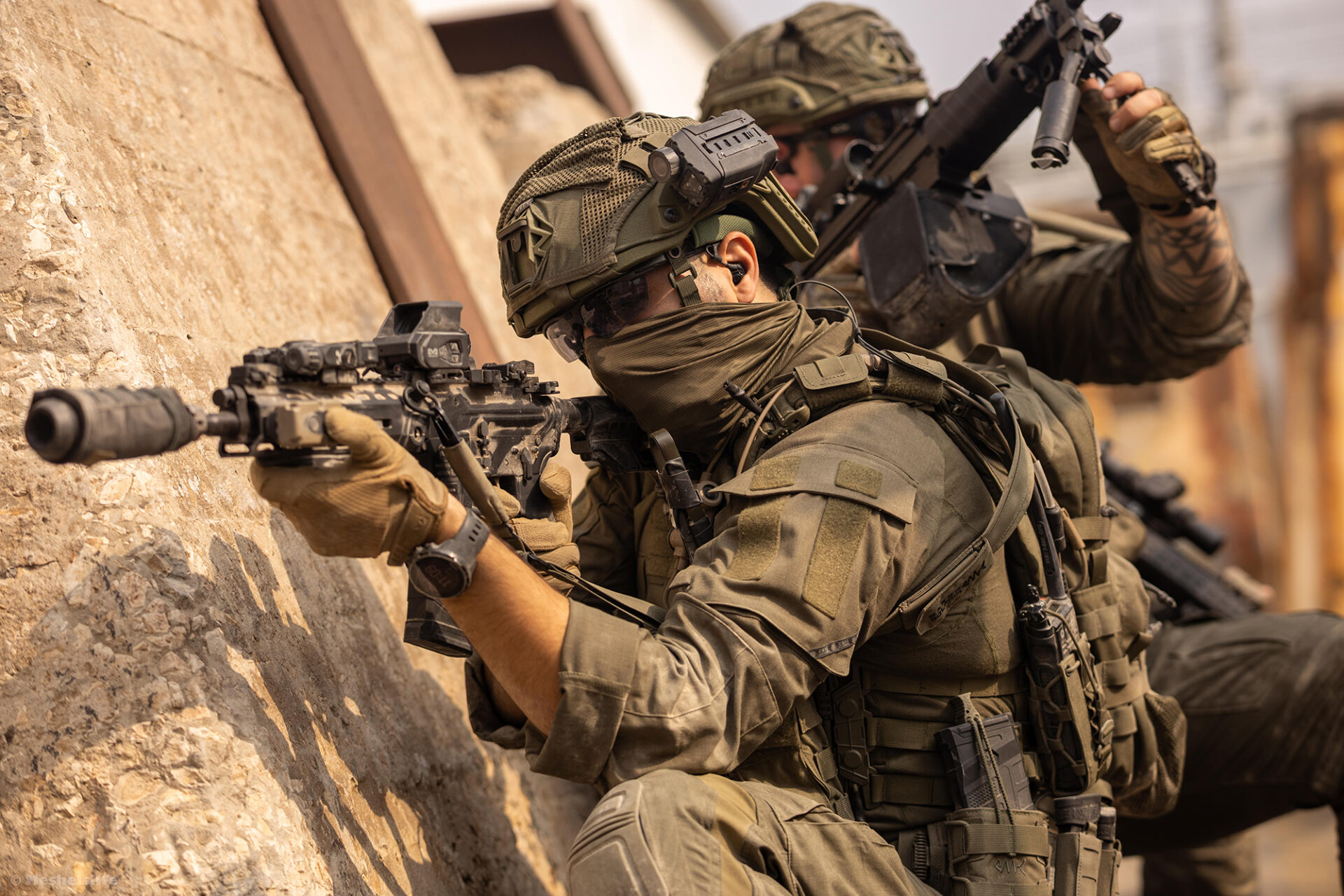
Israel Weapon Industries (IWI) and the Dutch arms manufacturer Artillerie Inrichtingen Armaments (AIA) intend to produce assault rifles and machine guns in the Netherlands in the future. The planned production includes the ARAD 5 assault rifle in 5.56×45 mm NATO and the NEGEV UX light machine gun in 7.62×51 mm NATO. While IWI provides the weapon technology and manufacturing know-how, AIA will handle the establishment of production. The weapons have several distinctive features.
Israeli Assault Rifles and MGs from the Netherlands
The Israeli company Israel Weapon Industries (IWI) and the Dutch defense manufacturer Artillerie Inrichtingen Armaments (AIA) have agreed on a collaboration to produce small arms in the Netherlands. Central to the effort are two infantry systems: the ARAD 5 assault rifle and the NEGEV UX light machine gun.
The cooperation envisions IWI supplying the necessary technologies, design data, and manufacturing know-how. AIA is to build the industrial infrastructure and to undertake production, assembly, and later technical support for the weapons.
According to the Dutch company, the production of the ARAD 5 and NEGEV UX will be rolled out in stages. Initially, assembly will take place at the existing Tilburg site. Subsequently, more production steps will be moved to the Netherlands until full production is possible domestically. In the long term, a larger site in the province of Overijssel is planned. This will create another European production base for Israeli infantry weapons. The Dutch government is reportedly not directly involved in the agreement, according to AIA.
ARAD 5: Assault Rifle in NATO Caliber 5.56 mm
The ARAD 5 is intended to be manufactured in the Netherlands as a modern assault rifle developed by IWI for use by infantry, special forces, and security agencies. The weapon fires the NATO cartridge 5.56×45 mm and structurally follows the configuration of modern assault rifles with the conventional arrangement of bolt, magazine, and stock.
The ARAD 5 operates as a gas-operated weapon with a short-stroke gas piston and a rotating bolt. In this operating principle, a piston driven by barrel gas transmits a short impulse to the bolt carrier. The bolt then returns to its initial position. In contrast to direct-gas systems, this design results in fewer combustion gases entering the bolt area directly. This can offer advantages in terms of fouling and maintenance, especially during intensive use and under adverse environmental conditions.
The assault rifle features an adjustable buttstock and ambidextrous controls. This allows operation by both right- and left-handed shooters.
A continuous Picatinny rail on the top of the receiver enables the mounting of optical sights. On the handguard there are additional mounting points for accessories.
Another feature is the exchangeable barrel. The ARAD 5 will be offered with different barrel lengths, allowing the weapon to be adapted to various mission requirements. Variants with 292 mm and 368 mm barrels weigh, according to the manufacturer, about 2.85 to 3.0 kilograms without a magazine. The theoretical rate of fire is about 700 to 1100 rounds per minute.
Thus, the ARAD 5 is aimed at regular infantry formations as well as forces requiring a comparatively compact weapon for use in buildings and at short combat ranges.
NEGEV UX: 7.62 mm Light Machine Gun
The second weapon system planned for Dutch production is the NEGEV UX. This is a particularly light version of the Israeli NEGEV machine gun in 7.62×51 mm NATO. The weapon was developed for mobile use by infantry forces and combines the firepower of a belt-fed machine gun with a weight comparatively low for this caliber class.
IWI offers the NEGEV 7 UX with barrel lengths of 330 and 420 millimeters. According to the manufacturer, the shorter variant weighs about 6.8 kilograms without ammunition, the longer about 7.0 kilograms. This places the weight below other variants of the NEGEV-7 family. For dismounted infantry forces, this weight reduction is important, as machine-gun crews must carry ammunition and personal equipment in addition to their weapon.
The theoretical rate of fire is about 600 to 800 rounds per minute. The NEGEV family machine guns can switch between semi-automatic and automatic fire. This allows the shooter to deliver individual targeted shots or to hold enemy forces with bursts.
The machine gun features a telescoping buttstock, mounting rails for optical sights and accessories, and an optional bipod. It can also be used with suppressors.
The combination of relatively light weight, belt-fed operation, and the more capable 7.62 mm NATO round is intended to improve the mobility of small infantry teams without sacrificing the firepower of a machine gun.
NEGEV UX Already Ordered by Israel’s Armed Forces
The NEGEV UX is not only an export product. The Israeli Defense Forces have also procured the weapon for their ground troops. In July 2025, the Israeli Ministry of Defense announced a contract worth around $20 million for NEGEV-7 and UX family machine guns. Deliveries to the land forces are planned for 2026 and 2027.
According to the ministry, the NEGEV UX was developed together with the Israeli forces. The experiences from fighting in the Gaza Strip were incorporated into the weapon’s further development. Particularly in operations in built-up areas, the combination of mobility and high firepower is expected to offer advantages.
With planned production in the Netherlands, a weapon would thus be manufactured in Europe that also plays a role in modernizing Israel’s infantry weapons.
ARBEL: Electronic Firing Support for the Machine Gun
For the NEGEV family, IWI also offers the electronic firing support system ARBEL. This is technology integrated into the weapon that uses sensors and electronic evaluation to capture the shooter’s movements and the weapon’s behavior.
An algorithm analyzes the movement pattern and is intended to influence the shot output during automatic fire to increase the likelihood of hits. The shooter retains control over the use of the weapon. The system does not autonomously identify targets or decide which targets to engage. Rather, it is meant to reduce deviations caused by weapon movement and recoil.
The system is compatible with different variants of the NEGEV machine gun. Whether future Netherlands-manufactured weapons will be equipped with ARBEL depends on the customer configuration.
The Netherlands Seek to Strengthen Their Own Weapons Production
For AIA, the collaboration with IWI is part of an effort to expand the Dutch defense industry also through the production of rifles such as the ARAD 5. The company develops and produces, among other things, ammunition, weapon systems, and drone-defense solutions. These include remotely operated weapon stations.
“A strong Dutch industrial base is fundamentally important for national security,” said AIA Chief Executive Gerard Zondervan. “The Netherlands must be able to manufacture the defense systems on which their security depends, build the corresponding expertise, and support these systems themselves.” The collaboration for the ARAD 5 and NEGEV UX is another step toward greater involvement of the Dutch industry in providing military capabilities.
Ronen Hamudot, Deputy Chairman of the SK Group, to which IWI belongs, also stressed the importance of local manufacturing capabilities: “The future of defense production will be shaped by how well proven technologies can be turned into deployable systems where they are needed.”
Author: Arie Egozi, Israel Correspondent
