
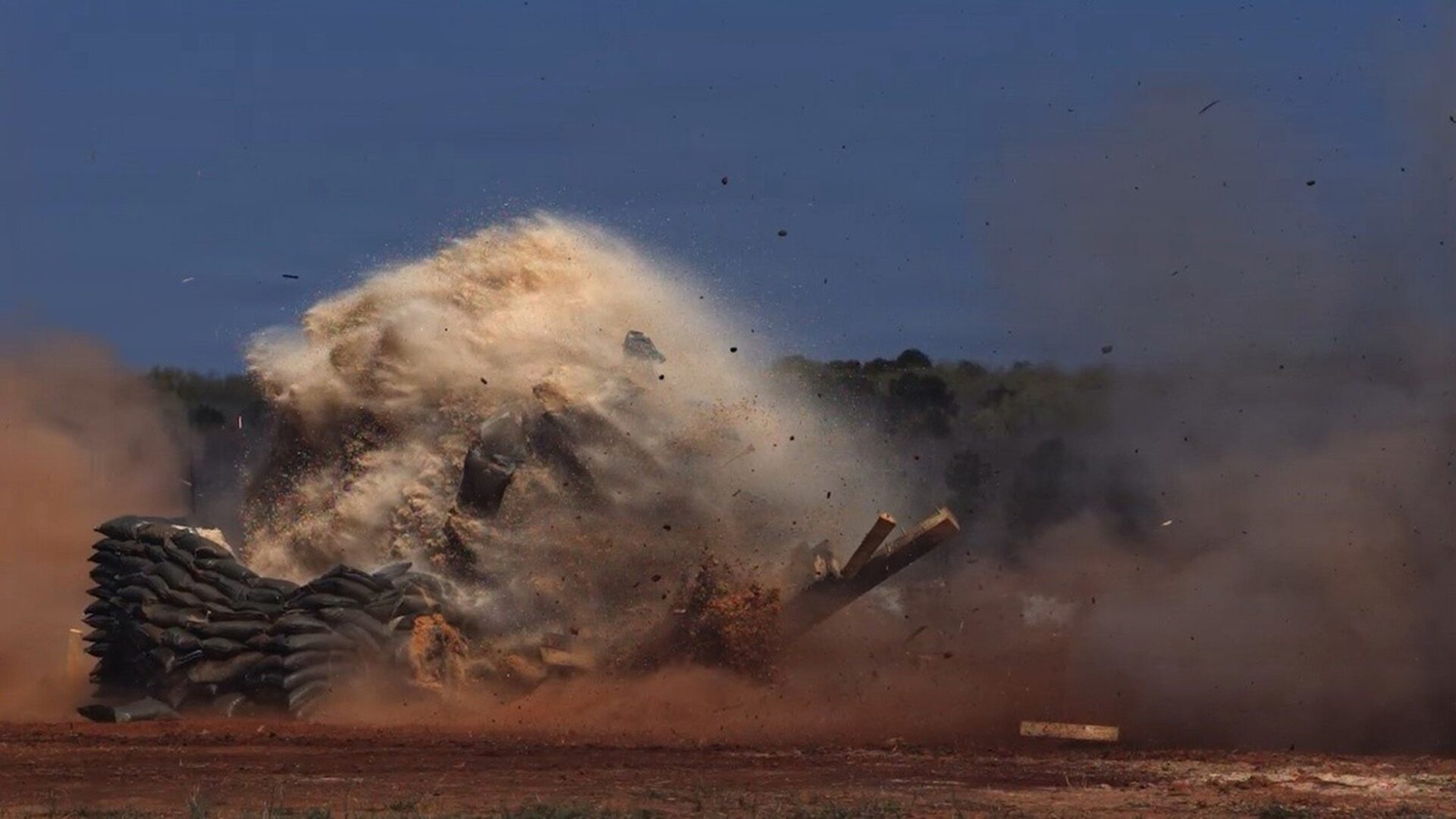
U.S. Marines and soldiers from the U.S. Army Aviation Center of Excellence at Fort Rucker have successfully tested a new warhead designed for use with unmanned aerial systems. The U.S. Army announced this at the end of April. The demonstration of the Bunker Rupture and Kinetic Explosive Round (BRAKER) with a live warhead took place on March 26 at Redstone Arsenal in Alabama. It occurred only a few weeks after the initial development and rapid prototyping of the system.
The BRAKER project, led by a team from the U.S. Army Combat Capabilities Development Command Armaments Center and the Close Combat Systems Project Manager—an office of the U.S. Army Capability Program Executive Ammunition and Energetics—sought to develop a light, high-performance, and effective warhead that can be deployed by a small, agile drone.

Two weeks from the BRAKER concept to the firing test
“Our Picatinny team managed to go from concept to firing test within two weeks,” said Colonel Vincent Morris, Project Manager for Close Combat Systems. “BRAKER demonstrates our ability to rapidly develop and safely deploy devastating effects from small unmanned aerial systems. We are now building the architecture with the Picatinny Common Lethality Integration Kit and the small universal payload interface, so that industry can scale this decisive advantage for the armed forces.”
The rapid development and testing of BRAKER was enabled by the U.S. Army’s focus on additive manufacturing, also known as 3D printing. In early March, engineers at the Armaments Center began designing, explosive pressing, housing fabrication, and integrating the warhead for a low-cost, disposable attack drone.
Rapid development for urgent requirements
Shortly thereafter, Picatinny transfer and compatibility tests were conducted, and about a dozen warheads were mounted. One of them was tested in a provisional bunker on one of the facility’s test ranges. After a successful demonstration of suitability and effectiveness, the prototype warheads were transported from Picatinny to Redstone, where a live demonstration for U.S. Army leadership took place.
The successful detonation of the drone-mounted explosive payload on a target demonstrates a new and effective capability for the modern soldier and shows how engineers can rapidly develop, manufacture, and integrate hardware to meet urgent and important requirements.
