
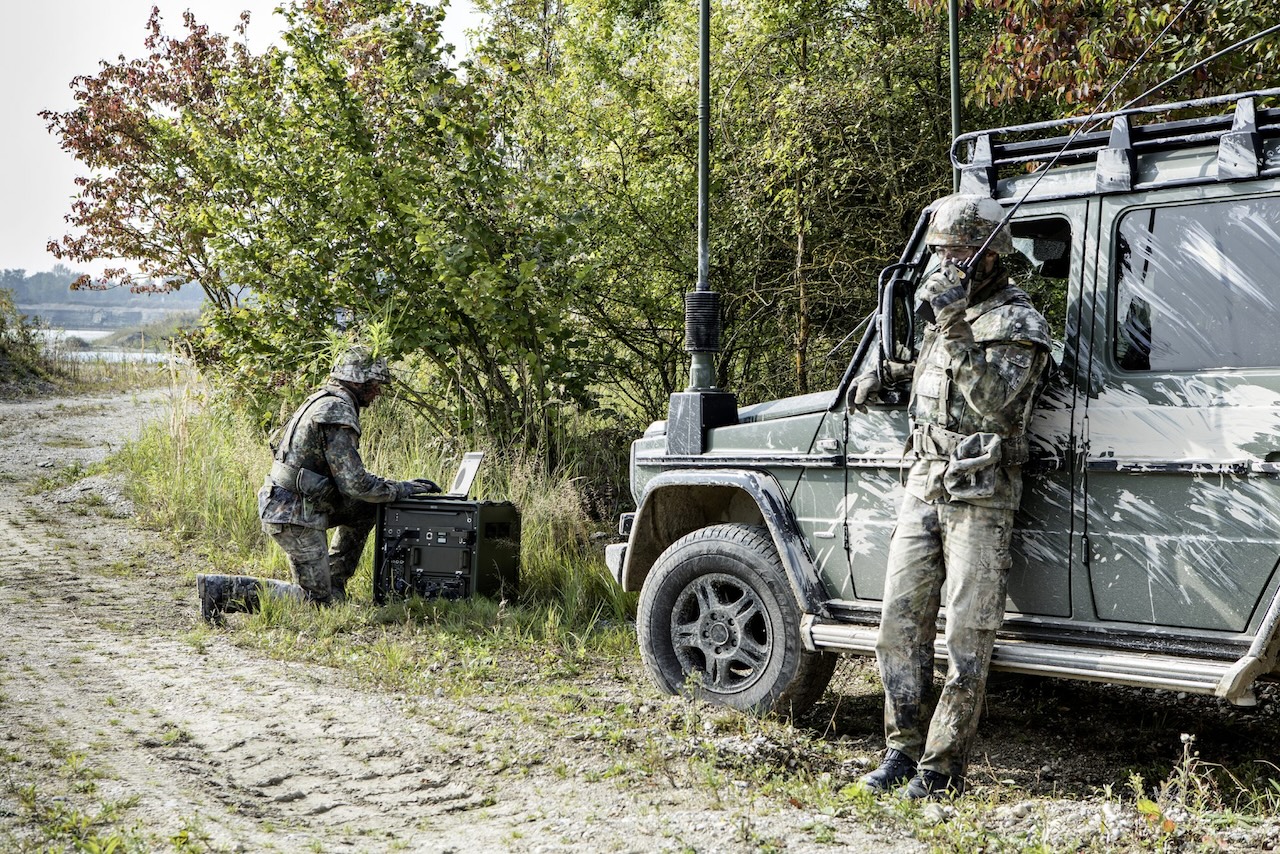
The first deployment test of the Armaments Program Digitalization of Land-based Operations (D-LBO) was completed at the end of this week. The Bundeswehr announced this on Friday. Together with industry and the Army, the overall system “D-LBO basic” was tested in a realistic, tactical deployment during the past weeks in Munster. In the past week, live fire was conducted during the deployment test. The basic functionality of the system is in place.
Thus, the Forward Land Forces Brigade promised to NATO under the leadership of Panzergrenadier Brigade 37 will be digitally capable at the start of the mission in January 2027. Regarding this, the Inspector of the Army, Lieutenant General Christian Freuding, said: “We can operate with D-LBO basic, drive, communicate – digitally, more resistant to interference and with increased range. That’s good! Based on the test results we have decided that both Panzergrenadier battalions will be formed by formations equipped with the new, modern and combat-capable Puma infantry fighting vehicle.”
The originally planned Marder formation will, according to the statement, not initially be part of the Forward Land Forces Brigade. The brigade will include vehicles fully upgraded to D-LBO basic, as well as digitized vehicles whose analog technology is linked via an interface within the framework of D-LBO. This “mixed operation” allows the digital and encrypted integration of vehicles that have not yet been upgraded or are not planned for upgrade. It was already successfully tested during the system demonstration in July.
Following Panzergrenadier Brigade 37, Panzer Brigade 45 is to follow
After the digital readiness of the Forward Land Forces Brigade under the leadership of Panzergrenadier Brigade 37 by the year’s end, the next target is the digitized Panzer Brigade 45 in Lithuania by mid-2027. Subsequently, D-LBO is to be rolled out gradually to the remainder of the Army’s land forces. For further retrofitting of the vehicles, industry should consistently push ahead with the serial integration of the new technology. Currently, they are about 300 vehicles behind the self-imposed target, according to the Bundeswehr.
The catch-up plan agreed jointly with industry must be implemented consistently in order to achieve the pledged target of 2,700 vehicles retrofitted at sites and in factories by the end of 2026. Currently, more than 2,000 vehicles have already been retrofitted to “D-LBO basic.” The technical deployment test in the past weeks has been an ongoing process in which increasingly complex land warfare scenarios have been practiced.
The insights gained were analyzed on-site directly and immediately fed into the next scenarios of the deployment test. After a meeting with industry representatives last Monday, the Inspector General of the Bundeswehr, Carsten Breuer, expressed confidence in the ongoing deployment test and the markedly improved radio communication quality. He had previously been on site in Munster together with State Secretary Plötner and the Inspector of the Army.
Digitization Mammoth Project in Record Time
Defence Minister Boris Pistorius has also decided to station the “Center for Land Digitization” in Munster. With its establishment on 1 October 2026, it is to serve as a central element to support digitization measures for the land forces. Through its direct connection to the Army’s combat formations, a nearby training area, coordination with the external office of the Bundeswehr Center for Digitization, and direct access to digitization projects such as D-LBO, Munster would bring together decisive competencies and harness synergies.
The retrofit to D-LBO is one of the most technologically demanding large-scale projects in the history of the Bundeswehr. It involves much more than just replacing radio equipment: the land forces are making a technological leap of four decades into the digital age. In principle, this digitization mammoth project would, according to the Bundeswehr, take ten to fifteen years, based on experiences in other countries.
Given the threat situation, the project should be implemented in less than half the time. To achieve this, retrofitting into the vehicles, testing, technical development and troop introduction including training will largely be carried out in parallel. Robust, interference-free communications and command capability form the foundation to be successful in potential future land war scenarios.
