
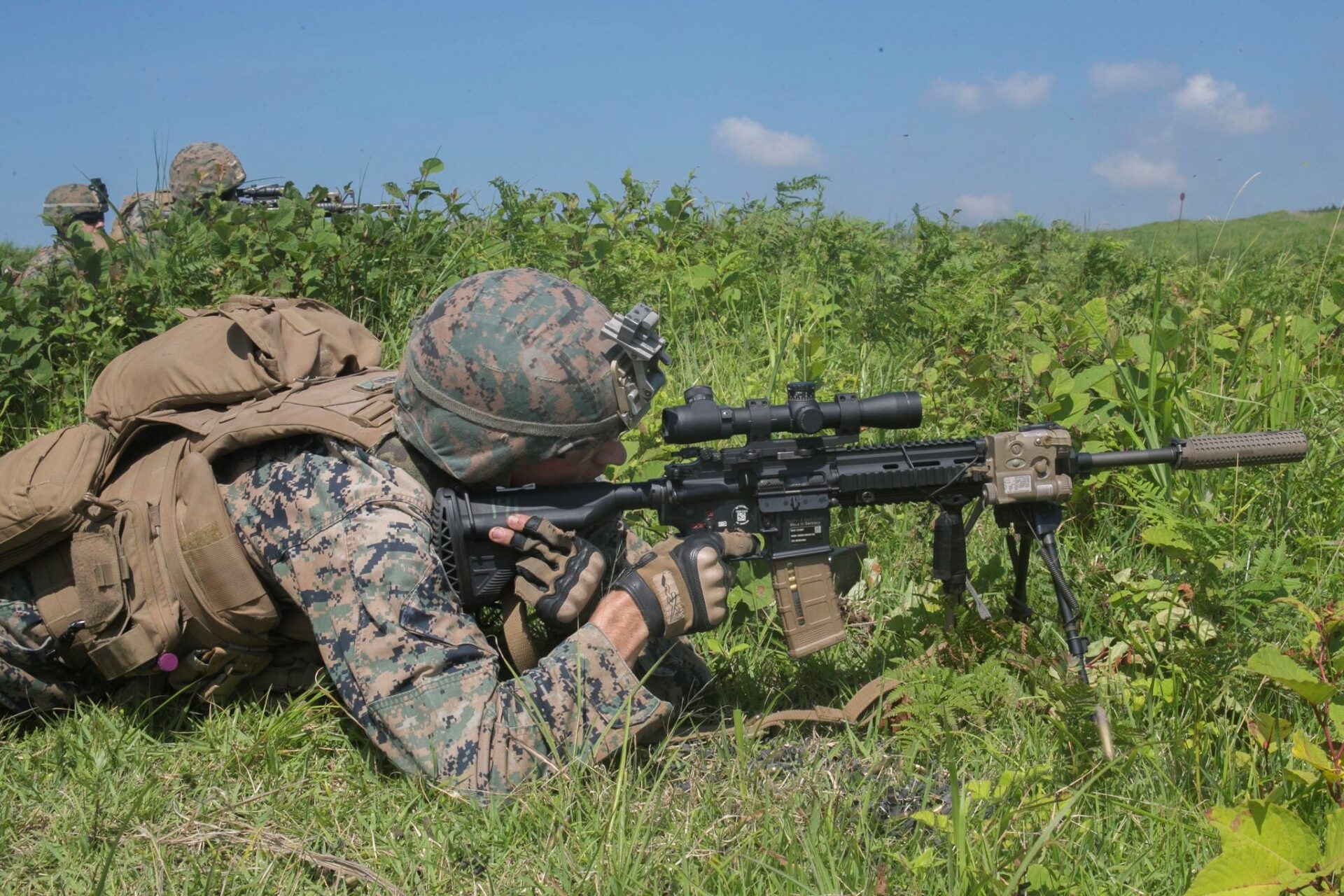
The United States Marine Corps (USMC) has more than doubled the procurement framework for its acquisition of the M27 assault rifle (HK416) from Heckler & Koch. As the U.S. Department of Defense announced in early November, this increases the contract value from $39.2 million to $84.6 million (35.7 and 77.0 million euros). This amount covers additional weapons, spare parts and further accessories through 2028. In the spring, the USMC had stated that it would not follow the U.S. Army and would not adopt their new rifle family M7/M8 in the 6.8×51 mm caliber.
The Marines had nominally introduced the M27 Infantry Automatic Rifle in 2010 as a replacement for the light machine gun M249 Squad Automatic Weapon (FN Minimi). This was justified by its lower mass and higher precision, although the M249, being belt-fed, offers a higher volume of fire. As early as 2018 the contract for Heckler & Koch was expanded and the M27 also became the successor to the previous assault rifle M16A4 and the carbine M4A1 – which perhaps was intentional from the outset.
The HK416 as the M27 and M38 in the USMC
Meanwhile, a version M38 with Leupold TS-30A2 Mark 4 MR/T 2.5-8 x 36 riflescope has also been introduced as a Designated Marksman Rifle. In addition to this largely unchanged version, there is the M27 Reconnaissance Weapon Kit (RWK) for the Recon Marines, which includes a shortened barrel of eleven inches instead of 16.5 inches (279 versus 419 millimeters). Up to 10,000 M249 machine guns remain in the USMC arsenal as weapons that can be issued at the company level.
The Corps has also shown interest in the Army’s new LMG M250 in the 6.8 mm caliber. According to a statement from February, the M27 is better suited for the Marines’ close-quarters combat units and the general requirements of the joint force than the SIG Sauer-developed rifle M7/M8, with which the Army outfits its respective units. These weapons are criticized, among other things, for their weight, dimensions, reliability, and the smaller ammunition stock per shooter.
Additionally, the combination of high-velocity ammunition and the complex overall system with a fire-control sight and a signature reducer contributes to the performance improvements demanded by the Army, making the enhancement feasible even against targets wearing body armor at greater distances. Other Western weapon manufacturers pursue more the approach of enabling rifles in the globally adopted 5.56×45 mm caliber for precise shots at less protected targets.
