
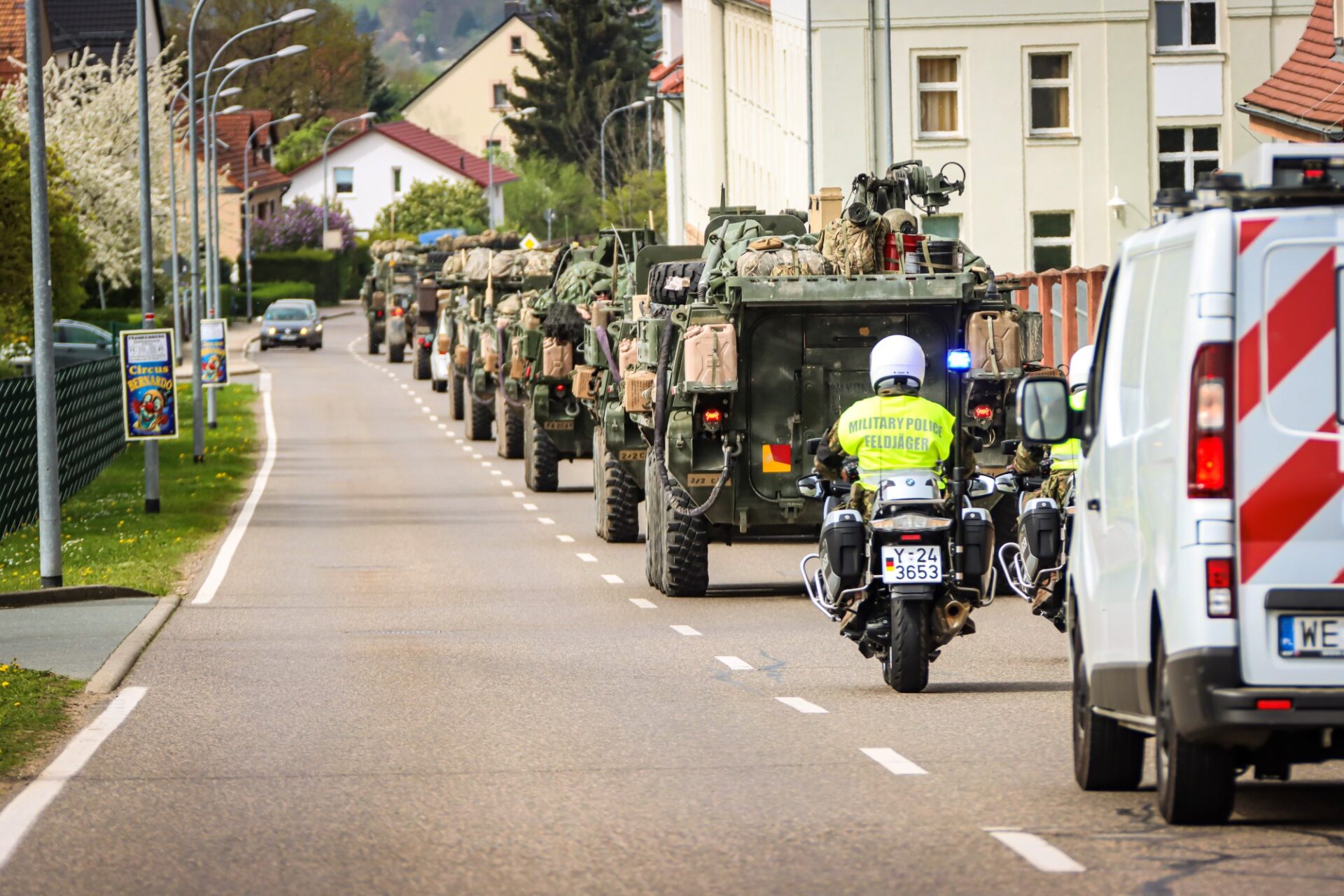
The long-announced withdrawal of American troops from Europe by the U.S. government under President Donald Trump is to comprise only about 5,000 personnel. This was reported by Bloomberg News Agency last weekend, citing sources familiar with the matter. Currently, around 70,000 U.S. soldiers are permanently stationed in Europe. In addition, at least 10,000 more are rotating as part of a heavy division under Operation Atlantic Resolve to reassure Eastern European NATO members in light of the Ukraine war.
Already in the spring, a withdrawal of 5,000 troops within six to twelve months had been announced, but at that time it was presented as a short-term response by Trump to the alliance partners’ reluctance to help him in the ill-conceived Iran war. The 2nd Cavalry Regiment stationed in Vilseck, Germany, was cited as an example. Ultimately, only some planned relocations were canceled, including the rotation of a brigade to Poland. Long-term decisions were to be made only after a thorough assessment that began in June and was to take six months.
US Congress Will Not Allow a Troop Strength Below 76,000 in Europe
According to Bloomberg, a reduction of up to 25,000 troops was under discussion. However, in this year’s defense budget, Congress had stipulated that troop strength in Europe may fall below 76,000 only if the Secretary of Defense and the Chairman of the Joint Chiefs of Staff had beforehand explained the reasons, potential implications, and consultations with allies. Since the recent midterm elections will give the opposition Democrats a majority in both the Senate and the House of Representatives, this stance is likely to harden.
Reasons for the reduction, Bloomberg says, also include that NATO partners have met Trump’s demands for higher spending on their own security, and that in particular the Iran war has again highlighted the United States’ dependence on European bases for operations in the Near East and Middle East. The final decision, however, lies with the President after the Department of Defense’s recommendations are presented to him on December 1. According to Bloomberg, various European officials expect the decision between December 3 and December 7.
Germany Could Be Disproportionately Affected by the Withdrawal
Germany, where with 37,000 U.S. soldiers the far largest contingent in Europe is stationed, could be disproportionately affected by a withdrawal, as reports suggest that Eastern European alliance partners are to be strengthened as part of the reorganization. For example, Poland and Lithuania have offered to bear the costs of corresponding infrastructure expansion. After a conversation with his American colleague Pete Hegseth last week, the Polish Minister of Defense already saw a green light for the stationing of 5,000 troops.
If this proves true, the 2nd Cavalry Regiment from Vilseck could indeed be relocated. Poland, which currently hosts around 10,000 U.S. soldiers mostly as rotating elements of Operation Atlantic Resolve, has been seeking a permanent American military presence for 25 years. For Germany, strategically it would be immaterial if these troops move there to defend the alliance’s territory. Additionally, the vacated barracks could be used for the ongoing expansion of the Bundeswehr.
