
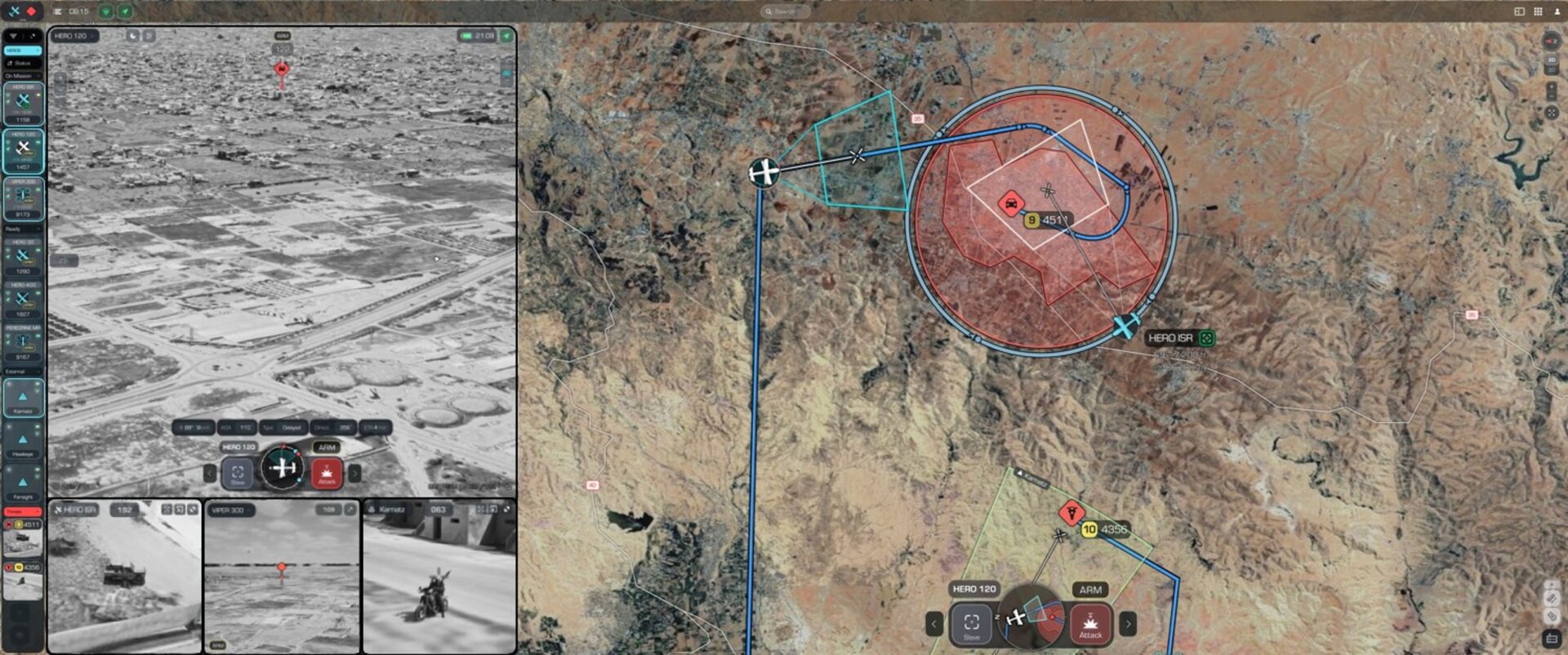
The Israeli specialist Uvision, a global provider of intelligent integrated systems and loitering munitions, announced on June 1 the introduction of Cortex – a new system for active battle reconnaissance and mission management, designed specifically to support next-generation multi-domain operations. This new software-driven platform links sensors, decision-making, and effectors into a unified battlefield ecosystem. Cortex will be publicly unveiled for the first time at ILA Berlin, which began today (Hall D, Stand No. 225).
Building on the concept of a “Common Operating System” (common operating system) that has already been introduced, Cortex provides a unified, software-enabled framework that connects sensors, decision-making processes, and various effectors into an integrated battlefield ecosystem. The goal is to shorten the sensor-to-shooter cycle (the time from target acquisition to impact), increase operational flexibility, reduce operators’ cognitive load, and enable coordinated management across the air, land, and sea domains.
Cortex enables dynamic mission coordination, resource allocation, simultaneous control of sensors and effectors, and synchronized execution of complex mission scenarios. It is based on a layered, modular architecture consisting of the levels “Sensing and Detection”, “Fusion and Decision-Making”, and “Response and Mission Execution”. This structure ensures seamless integration of a wide range of sensors, external command-and-control systems, unmanned platforms, and precision-guided munitions within a single, unified framework.
Continuous analysis of the entire battlefield
The sensor layer supports data capture and processing from multiple sources—including electro-optical/infrared (EO/IR) payloads, unmanned aerial vehicles (UAVs), radar systems, HF detectors, airborne platforms, and external reconnaissance sources. The fusion and decision-making layer handles the integration of data from various sources, threat verification, their classification, behavioral analyses, anomaly detection, and AI-powered decision support to produce a unified situational picture in real time.
The system continuously analyzes the entire battlefield, identifies and prioritizes threats that go beyond the immediate mission, and recommends the most suitable course of action – aligned with target characteristics and mission priorities. This enables operators to focus their attention on overarching mission management rather than dealing with the individual control of specific platforms.
The reaction layer controls the coordinated deployment and the dynamic assignment of the Hero, Viper, and Peregrine systems – based on target type, mission priority, and combat conditions – while human oversight remains in place throughout the engagement process. By linking sensing, detection, decision-making, and the deployment of loitering munitions into a continuous operational chain, Cortex enables faster and more precise countermeasures against emerging threats.
Uvision aims to link multiple levels into a single system
Its open architecture allows rapid integration of external C2 systems, battlefield management platforms, and third-party sensors; this enables military forces to establish a common operational picture across multiple units, systems, and domains. By shifting operators from direct control of frontline platforms to mission-level oversight from a safe stand-off distance, Cortex increases survivability and simultaneously improves the continuity of command and control, coordination, and responsiveness in highly dynamic combat environments.
“The battlefield of the future will be defined by speed, scalability, and networking across multiple domains,” explained Dr. Ran Gozali, CEO of Uvision Air. “As military forces increasingly employ autonomous systems, sensors, and effectors, the ability to unify and standardize leadership, control, and mission execution across complex operational environments will become a critical success factor. Cortex was designed to link these levels together and to integrate operational intelligence, command-and-control systems, as well as various effectors into a scalable, software-driven ecosystem.”
