
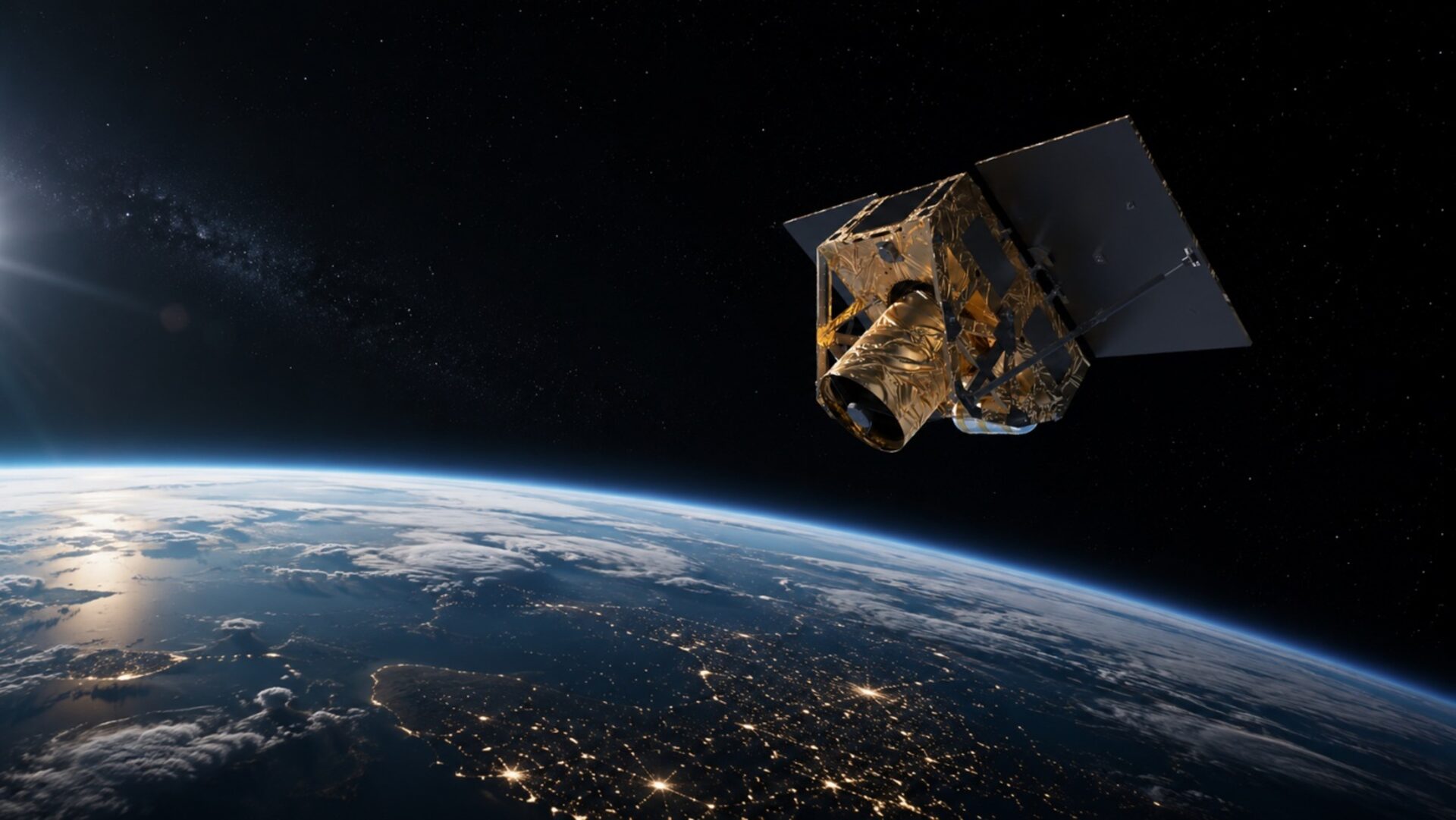
ImageSat International (ISI) from Israel is a global provider of space-based intelligence solutions. The company announced last week that it could provide a significant expansion of the capabilities of its Runner satellites. This concerns the introduction of continuous, real-time motion detection and analysis from orbit, available around the clock—day and night. S&T previously reported on the Runner system.
This new capability enables defense and intelligence agencies to obtain dynamic real-time reconnaissance information about moving objects throughout the entire operational cycle—also under nighttime conditions. This represents a unique advance in the field of persistent, space-based surveillance. Supported by advanced onboard AI and integrated processing systems, Runner autonomously detects, classifies, and characterizes movement patterns directly in orbit. Communication and evaluation with a ground station are not required.

Dynamic movement tracking also at night
This minimizes the required bandwidth, as only the intelligence results are transmitted, not raw data. The system identifies vehicles, mobile targets, and other moving objects across vast operating areas and in dense traffic—up to covering whole cities. A key unique selling point of this new feature is Runner’s ability to maintain this dynamic movement tracking even during nighttime deployments. This overcomes one of the most stubborn limitations of space-based optical reconnaissance.
This breakthrough is enabled by a novel optical system design that allows the satellite to capture sufficient photon data even under the low-light conditions of night. In combination with advanced algorithms and AI-assisted processing, this enables reliable movement detection and analysis based on night-recorded video material—a capability that from orbit on this scale had not been achievable until now.
Runner automatically analyzes images in orbit
By leveraging advanced on-board processing, Runner conducts automated image analysis directly in orbit and, on the satellite itself, converts raw visual data into actionable reconnaissance products. Since only the already processed reconnaissance results are transmitted to the user, this architecture enables rapid dissemination, efficient bandwidth usage, and the provision of actionable operational insights almost in real time.
“Runner redefines the role of satellites in operational reconnaissance,” said Noam Segal, CEO of ISI. “The ability to persistently detect and analyze movements from orbit—day and night—and to deliver actionable reconnaissance results in real time fundamentally changes the expectations that defense and intelligence agencies can place on space-based systems.” The enhanced dynamic intelligence capability of Runner further cements ISI’s leading position in next-generation space-based reconnaissance and AI-assisted satellite operations.
