
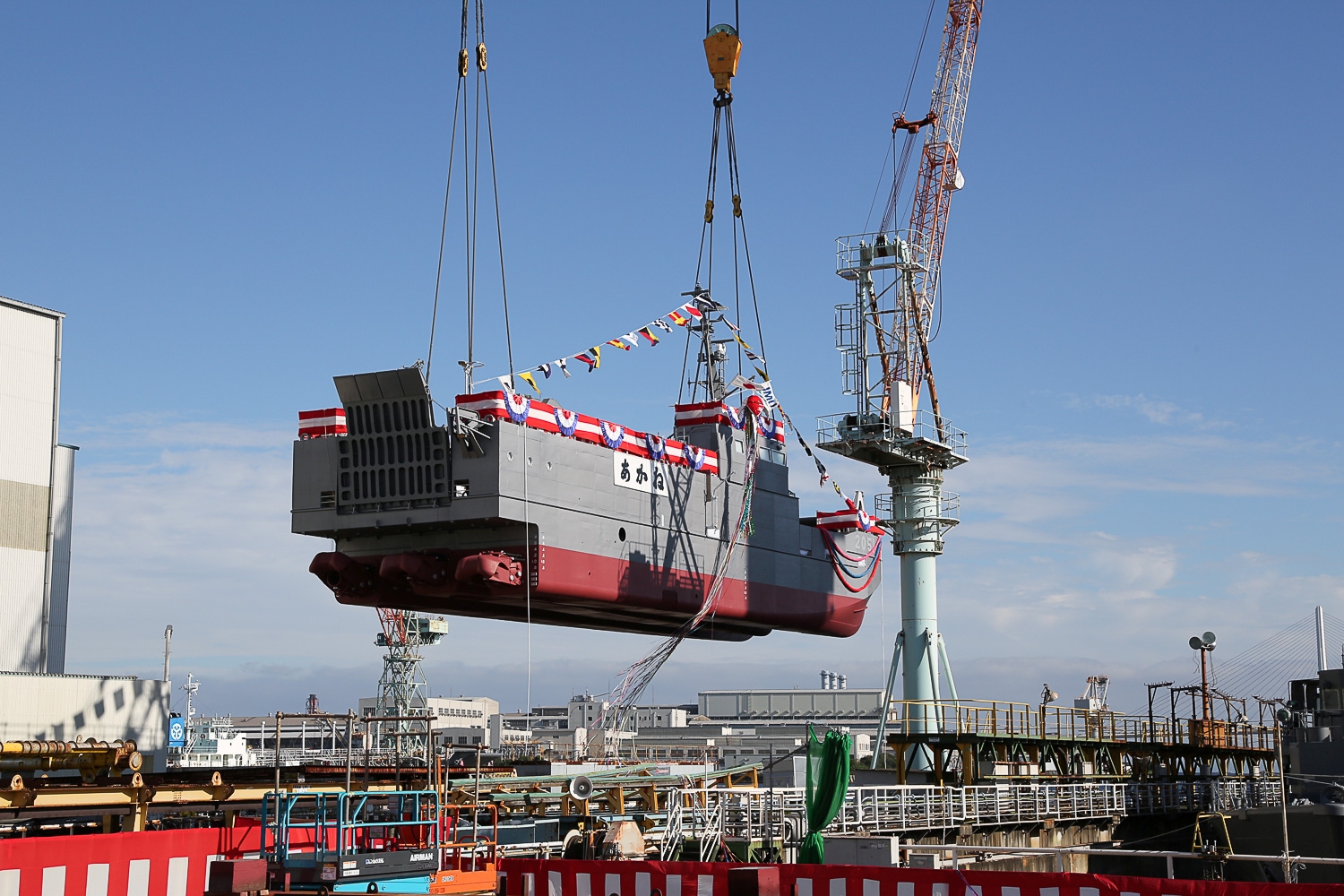
The shipyard of Japan Marine United Corporation (JMU) in Yokohama launched on September 17 the first of four fast landing crafts for the Japanese Navy’s Maneuver Support Vessel (MSV) project. The approximately 150-ton displacement craft was named Akane. The 35-meter-long and eight-meter-wide design with an aluminum hull is based on the Caimen design from the British company BMT, has a crew of ten, can transport up to 200 personnel or vehicles, and features a bow and stern ramp.
Three diesel engines with a total of 7,600 hp enable, via three waterjets, a loaded maximum speed of 18 knots (33 km/h). The handover to the Navy is planned for next March, after which Akane is to be deployed to Amami-Ōshima, the main island of the Amami Islands off Japan’s southern coast in the East China Sea. There a new naval port is currently being built, which should be completed by 2032. Akane and her three sisters, which are to be delivered in the next fiscal year, will operate from there under the Maritime Transport Group established in 2025.
General strengthening of Japan’s amphibious capabilities
Shortly after the program’s establishment, Japan’s procurement authority commissioned BMT and JMU to build the landing crafts. The procurement of a foreign design is unusual for the country’s navy and suggests a certain urgency. It fits into a general strengthening of amphibious capabilities in recent years, as Japan responds to China’s increasingly aggressive operations in its surrounding seas. Among other things, the People’s Republic also claims the Senkaku Islands administered by Japan in the East China Sea.
With Taiwan, which essentially shares this claim, Japan regards itself as an ally and also considers the possible defense of the island state, viewed by China as a renegade province, in its security considerations. In July of this year, Tokyo also confirmed discussions with Vietnam on the joint development and production of fast landing crafts. As early as 2018, Japan had, for the first time since World War II, again established an amphibious troop formation.
In 2024, the first of two amphibious support ships of the Yoko-class with 4,000 tons displacement and the first of four landing ships of the Nihonbare-class with 3,000 tons displacement were launched. These replace much smaller landing crafts of only 50 tons. The Navy also operates six LCAC-type hovercraft vehicles of the American type LCAC, deployed from the three Osumi-class amphibious dock landing ships. The latter is slated to be replaced in the future by larger amphibious helicopter carriers and new dock landing ships.
