
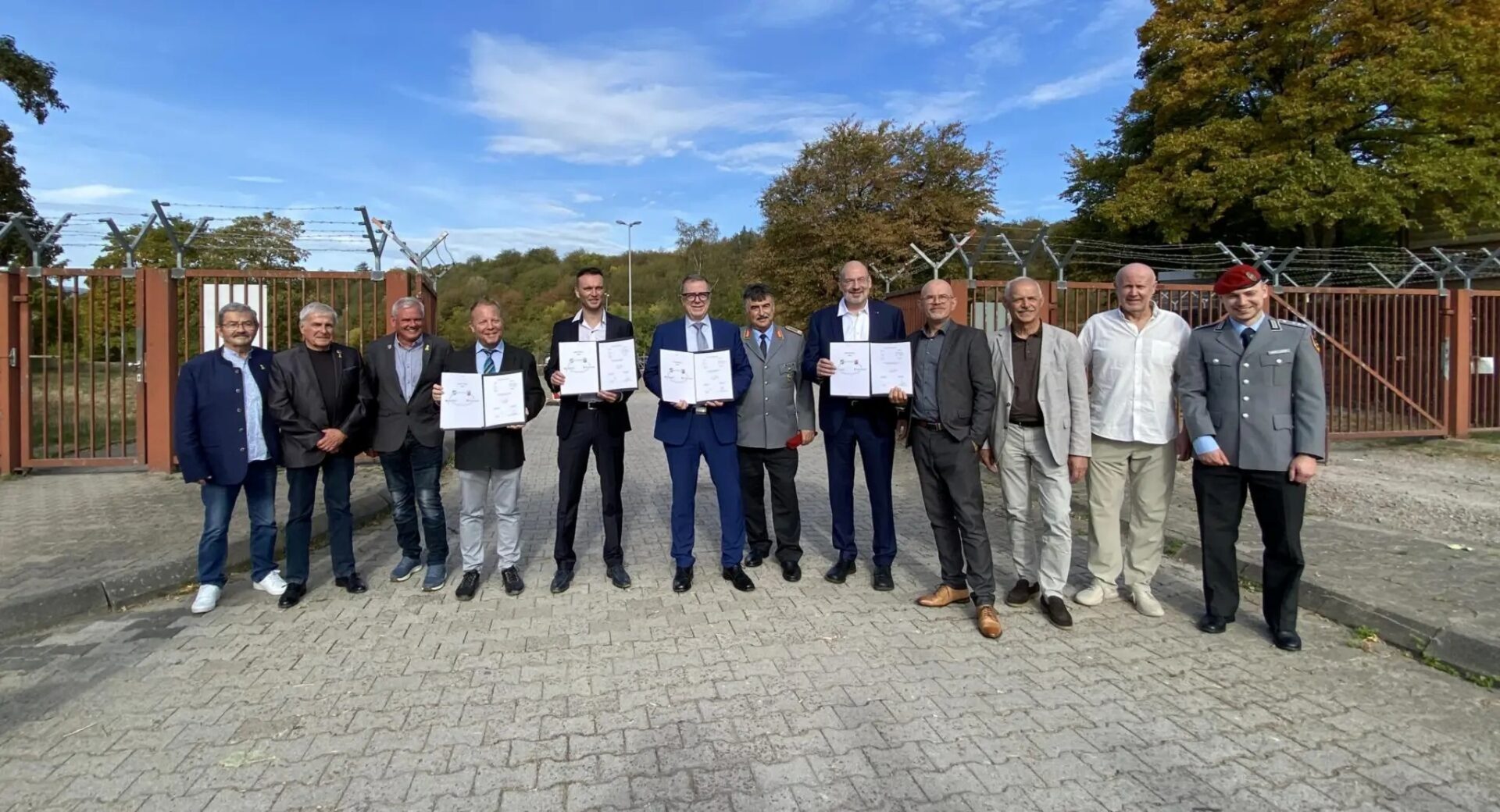
The former Unteroffizier-Krüger Barracks in Kusel could become a Bundeswehr site again. According to the Kusel district, on Wednesday, District Administrator Johannes Huber and representatives of the Federal Ministry of Defence (BMVg), the Bundeswehr, the Federal Agency for Real Estate Tasks (BIMA), the state of Rhineland-Palatinate and the affected municipalities signed a Letter of Intent (LoI). According to reports from several regional media, this declaration of intent is not legally binding, but lays the foundation for further cooperation between the district and the Bundeswehr.
At the same time, it is a prerequisite for the property to be used again for military purposes. According to Brigadier General Hans-Jürgen Neubauer, the Federal Ministry of Defence’s Commissioner for Bundeswehr properties, a preliminary contingent of 20 to 40 soldiers is expected to move into the barracks as early as October. By March 2027, this number should grow to 100 to 150. In April, basic training could then begin in Kusel in a training company of the Homeland Defense Division.
In principle, more than 1,000 soldiers could be stationed in Kusel
How many soldiers will be stationed in Kusel in the medium- and long-term, according to reports, will also depend on the condition of the barracks after the move. It will be checked which buildings have to be renovated and where new buildings may be required, Brigadier General Neubauer is quoted as saying. On the available usable area of 20 to 25 hectares, more than 1,000 soldiers could in principle be accommodated. Most recently, the Artillery Training Battalion 345 was stationed in Kusel, which was relocated to Idar-Oberstein in 2014.
The 1964 barracks built for the Bundeswehr are named after the artillery non-commissioned officer Johannes Joachim Theodor Krüger, around whom a legend has grown about him being the sole surviving operator of a German artillery battery with numerous engagements against British tanks in the Battle of Cambrai during World War I. It was always occupied by artillery training facilities. After its closure in 2014, a first reception facility for asylum seekers was established here.
In early July, the BMVg announced that eight former properties of the Bundeswehr and NATO partners would be particularly well suited for the timely expansion of the armed forces with the corresponding training capacities due to their location, infrastructure, and capacities. In August, the initiation of concrete preparatory steps for five properties for the new service was ordered. In addition to Kusel, the Kurpfalz Barracks in Speyer, the Graf-Stauffenberg Barracks in Sigmaringen, the Kanaal-van-Wessem Barracks in Soest, and the Ray Barracks in Friedberg were named.
