
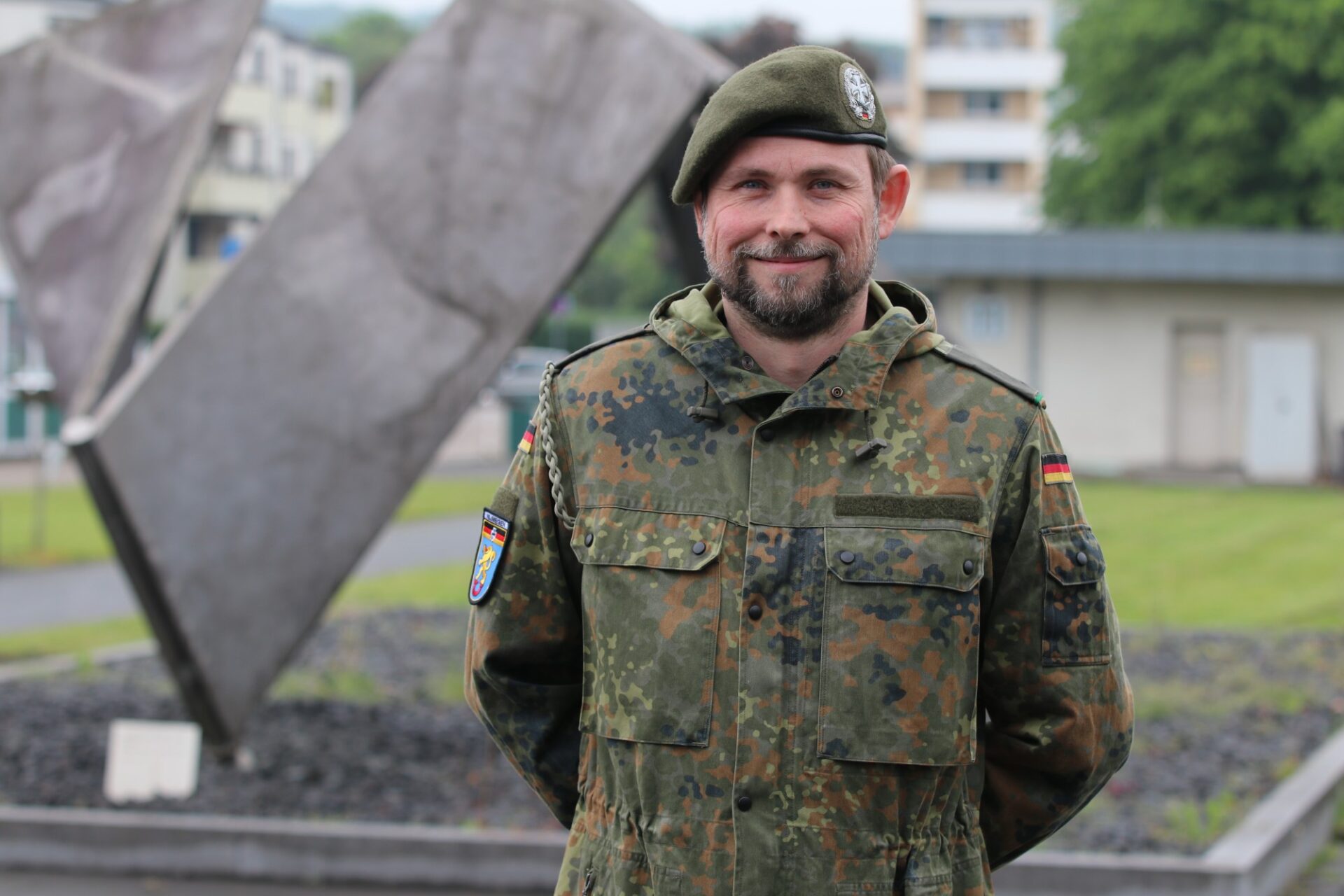
About 20 reservists participated in the initial briefing of the district and county liaison commands (BVKs and KVKs) at the State Command North Rhine-Westphalia. For most of them this is the first training phase for their future deployment in one of the five BVKs and 54 KVKs of the state. Brigadier General Hans-Dieter Müller, commander of the State Command North Rhine-Westphalia and thus responsible for more than 600 mobilized reservists in the liaison commands, emphasizes the special importance of these forces.
“These soldiers are our extended arm into the countryside. Their territorial network has often grown over many years. They maintain the on-the-ground exchange with representatives of the districts, counties and independent cities. I am pleased with every engaged reservist who strengthens our State Command in the field,” says Brigadier General Müller.
Connection between the Bundeswehr and Civil Administration
The BVKs and KVKs form the important interface between military and civilian institutions. They support their civilian counterparts, for example in crises or major damage events, and coordinate the collaboration between the Bundeswehr, municipalities and authorities. This Civil-Military Cooperation (ZMZ) is steered by the State Command North Rhine-Westphalia. In total there are 661 posts in these liaison commands alone in North Rhine-Westphalia. Almost weekly there are trainings and exercises of individual KVKs or BVKs as well.
One of the participants in the current initial briefing is Lieutenant Martin S. (41), who will be deployed in the KVK Herne in the future. The Dortmund native began his career in 2004 with the basic service in the Bundeswehr. “I wanted to get to know the Bundeswehr, form my own impression, and not just hear from others how it works,” Martin S. recalls. Today, more than two decades later, he looks back positively on that time: “I do not want to miss the basic service. It was a very nice time. Some contacts with comrades from back then still exist today.”
From Basic Military Service back into the Reserve
After his active service he returned to civilian professional life and has worked since 2007 for the City of Dortmund. There he is employed in the Audit Office and was during the COVID-19 pandemic a member of the crisis staff as well as co-organizer of the vaccination center. “I know administrative structures very well,” explains the 41-year-old — a valuable prerequisite for service in a liaison command.
However, he never really let go of the Bundeswehr: “Some say: Once in uniform, always in uniform. And I never quite finished with the Bundeswehr.” In 2013 Martin S. was initially ordered to a Homeland Security Company to refresh his former military abilities. Maps and compasses, orientation in the terrain, handling weapons and camaraderie were again part of his daily life for several weeks a year.
Multistage training for deployment in the liaison commands
Today, balancing family and work also plays an important role. “In the KVK Herne I am stationed closer to home and train about four weeks a year,” explains the father of two. “Whoever engages in a KVK or BVK takes responsibility for their region. Especially the close cooperation with cities, districts and authorities makes this service particularly valuable and practical,” says Brigadier General Müller.
The training for liaison officers and sergeants begins with the initial briefing at the State Command North Rhine-Westphalia. Subsequently, in the Lower Saxony town of Nienburg, a basic course for Civil-Military Cooperation (ZMZ) as well as a staff duties course follow. After another advanced course in Ahrweiler, an initial briefing and a regional briefing, the reservists are fully trained for their assignment in the liaison commands and very well prepared.
For their five districts and 54 county liaison commands, the State Command North Rhine-Westphalia continues to seek former NCOs with portepee as well as officers — i.e., those interested starting at the rank of sergeant (Feldwebel) and above. Interested individuals can obtain further information from the State Command North Rhine-Westphalia at the telephone number 0211 / 959 3515 or by email at [email protected].
