
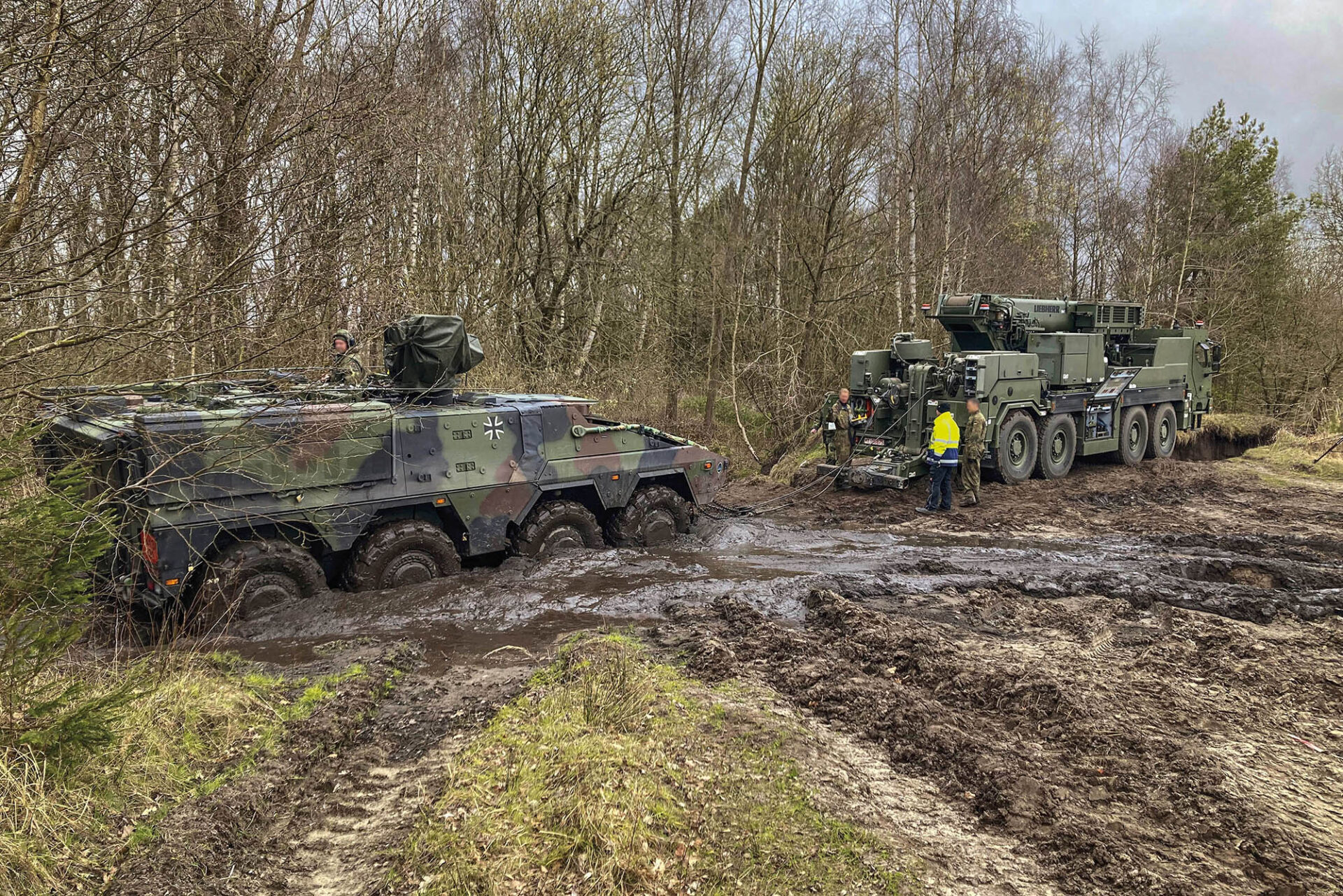
As increasingly heavily protected wheeled vehicles become more common, the requirements for their recovery also rise. The new recovery platform MLTB 1025-4.1, which Liebherr debuted for the first time at the British defense exhibition DVD 2026, was precisely designed for such requirements. It is intended to be able to recover correspondingly heavy vehicles such as the Boxer even in difficult terrain, without lagging behind in terms of tactical mobility compared with the supported unit.
Liebherr shows new recovery platform for heavy wheeled vehicles
The new recovery platform MLTB 1025-4.1 was presented at the UTAC test facility Millbrook in Bedfordshire (United Kingdom). The development was guided by modern and increasingly heavier and more complex vehicle fleets. It is not only about being able to tow an immobilized vehicle. The MLTB combines lifting, winching, recovery and towing capabilities on a single platform. At the same time, the vehicle should be off-road capable and, above all, mobile and fast enough to follow the formations whose vehicles it must recover in an emergency.
And thus the new recovery platform can of course also recover the Boxer wheeled armored vehicle and, at the same time, follow in terms of mobility the corresponding mid-range forces of the respective armed forces.
As little time as possible at the recovery site
Another requirement addressed by the new MLTB 1025-4.1 arises from operations under threat. A damaged or immobilized vehicle must not only be recovered; it must be done as quickly as possible. After all, immovable targets—including large wheeled vehicles that have become stuck, for example—are easily reconnoitered and targeted by drones and other modern systems on the battlefield. The Liebherr company therefore emphasizes especially the short assembly and recovery times. Because the faster a vehicle can be picked up or pulled out of a difficult situation, the shorter the recovery team and the recovery vehicle must remain at the site.
“Modern armed forces must maintain mobility and readiness even under difficult conditions,” says Simon Lowes, Sales Manager at Liebherr. “The MLTB 1025-4.1 is therefore designed to recover vehicles quickly, to reduce time on the operating site and thus keep capabilities available for further deployment. Not to forget that mobility today can be a significant protective factor, both for the recovery crew and for the system being recovered.”
Two winches for recovery
A central role is played by two Rotzler winches at the rear of the vehicle. They enable the crew, immediately after reaching the recovery site, to begin the actual recovery. Both winches can be operated in a coordinated manner via a synchronized remote control. This allows the pulling operations to be coordinated. Especially under threat, this is intended to help keep the time required for a recovery mission as short as possible.

In addition to the winches, the MLTB 1025-4.1 features capabilities for heavy lifting and towing. The platform is intended for both wheeled and tracked vehicles.
Recovery must be able to follow the troops
For missions off paved roads, Liebherr combines high off-road capability with a large operational reach and a robust vehicle architecture. This should enable the MLTB to operate where damaged vehicles must be recovered under difficult tactical conditions. At the same time, the platform is designed for use in mixed and multinational vehicle fleets. Liebherr therefore emphasizes as much interoperability as possible.
The discussions at DVD 2026 showed, according to the company, particular interest in higher capability, mobility, and interoperability of future recovery vehicles. Behind this lies a simple dependency: with the mobility and weight of modern combat vehicles, the capabilities of their recovery vehicles must also grow. After all, a heavy wheeled vehicle is of little use if its own recovery cannot follow in the terrain and it becomes an easy target for drones when stuck.
Technical data MLTB 1025-4.1
- Drive: 8×8, all-wheel drive and all-wheel steering
- Engine: Liebherr 6-cylinder turbo-diesel
- Power: 400 kW / 544 hp
- Max. torque: 2,516 Nm
- Transmission: automated ZF Traxon Torque 2, 12 gears
- Top speed: 85 km/h
- Gradeability: > 60 %
- Length: 11.79 m
- Width: 2.75 m
- Height: 3.74 m
- Gross axle load: 44 t
- Tire type: 445/95 R 25 with run-flat elements
- Tire pressure: 4–9 bar
- Fording depth: up to 1,000 mm
- Telescopic boom: 7–20.9 m
- Max. crane load: 22.8 t
- Pick-and-Carry: up to 15 t
- Undercarriage lift: up to 16 t
- Main recovery winch: Rotzler TR 200, 200 kN traction, 75 m rope length
- Second recovery winch: Rotzler TR 80, 80 kN traction, 49 m rope length
- Fuel tank capacity: 580 l
Author: Dorothee Frank, Online Editor-in-Chief
