
Rheinmetall and the South Korean LIG Defense & Aerospace (LIG D&A) have agreed on a strategic partnership. Together the partners aim, according to a press release issued on Monday, to provide air defense systems for European and NATO territory. The short-term goal of the cooperation is the establishment of a joint venture in which Rheinmetall will hold the majority stake. As part of the partnership, the companies will localize, further develop and market LIG D&A’s air defense missile systems of medium and long range in Europe.
This should be done in close connection with Rheinmetall’s short-range air defense (VSHORAD). In addition, according to the press release, both partners have agreed to jointly develop new missiles and capabilities for air defense in the short-range area (SHORAD). The goal is to close existing gaps in this segment and to offer comprehensive solutions across all layers of air defense. This combination of capabilities will broaden and strengthen the product portfolios of both companies. It will also enable turnkey solutions to be offered from a single source.
South Korean M-SAM Deployed in the Iran War
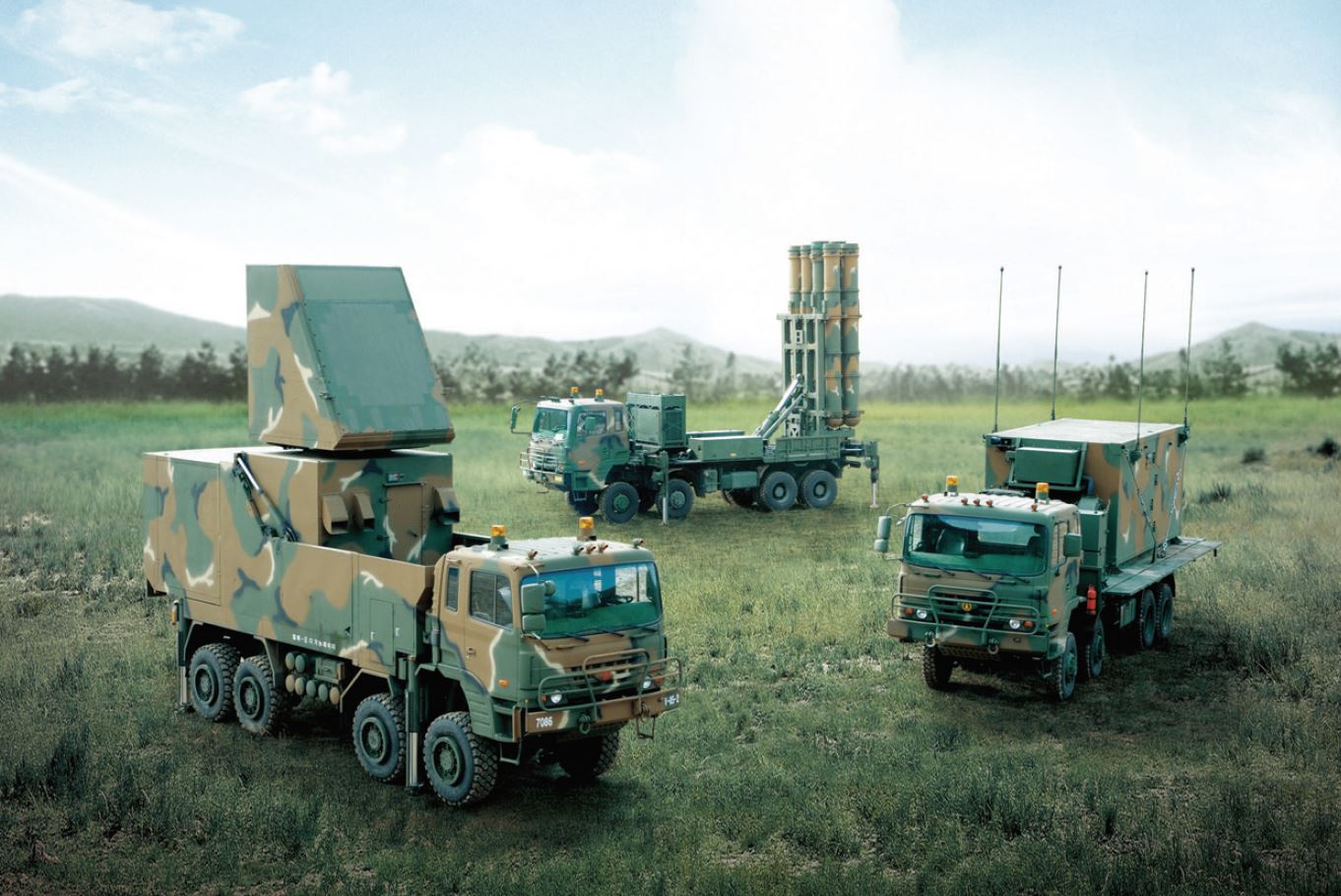
Among the mid- and long-range systems mentioned are presumably the South Korean types M-SAM and L-SAM, whose development involved LIG together with the Russian Almaz, Samsung Thales and the Doosan Group on one side as well as Hanwha and the national Agency for Defense Development on the other. The 400-kilogram M-SAM handles the medium range in South Korea’s air- and missile-defense system with a range of 40 to 50 kilometers and an altitude of up to 15 kilometers.
The radar of the battery, consisting of four to six eight-launchers, is based on the Russian S-400. The South Korean Air Force currently has 19 of 25 ordered batteries in service, the United Arab Emirates two of twelve. During the Iran War, the latter reportedly fired 60 projectiles with a hit rate of 96 percent. Saudi Arabia and Iraq have also ordered ten and eight batteries, with interest also shown in Indonesia and Morocco.
Air and Missile Defense System L-SAM
L-SAM is a long-range system also intended to defend against ballistic missiles, and is compared with the American THAAD and the Israeli Arrow family. Block 1 has a range of 150 kilometers and an engagement altitude of 60 kilometers, Block 2 is to reach 450 and 180 kilometers, respectively. The system uses on the one hand a projectile against air-breathing targets; the three-stage ballistic-defense intercept missile reaches Mach 9 and uses an infrared seeker to achieve hit-to-kill.
In 2022/23, Block 1 achieved three of four inbound missiles in tests. Production began in 2025, with introduction planned for 2028. The battery consists of two six-pack launchers with both flight- and missile-defense interceptors on trucks, a multifunction radar, a command and fire-control station. The short-range segment is covered in South Korea by K-SAM (Pegasus), based on the French Crotale.

New Opportunities for Rheinmetall and LIG
For South Korea, an international collaboration for a newly developed short-range system thus makes sense. In addition, the country’s industry can also expand its presence on the European market through the successful systems already in service here, such as Hanwha’s K2 Black Panther main battle tank and the K9 Thunder self-propelled howitzer, as well as the K239 Chunmoo rocket artillery system, which are already in service with several NATO states.
Rheinmetall currently offers mostly cannon-based systems in the air defense field from its Oerlikon division, which are also used in the Skyranger turret. After the group recently expanded into the maritime sector by acquiring Lürssen’s naval division, the cooperation with LIG offers the opportunity to also provide long-range missile systems. This places the company in competition with Diehl’s IRIS-T family, but also with other European and Israeli providers in this segment.
The partners also benefit from the existing, but the Iran War has further exacerbated, shortage of American systems such as Patriot missiles. In their press release they point out that the latest conflicts in Ukraine and the Middle East have shown that independent, rapid and reliable supply and deployment chains are essential for sustainability and success. Both companies contribute to these efforts to meet the high demand for multi-layer air defense systems, missiles and munitions.
