
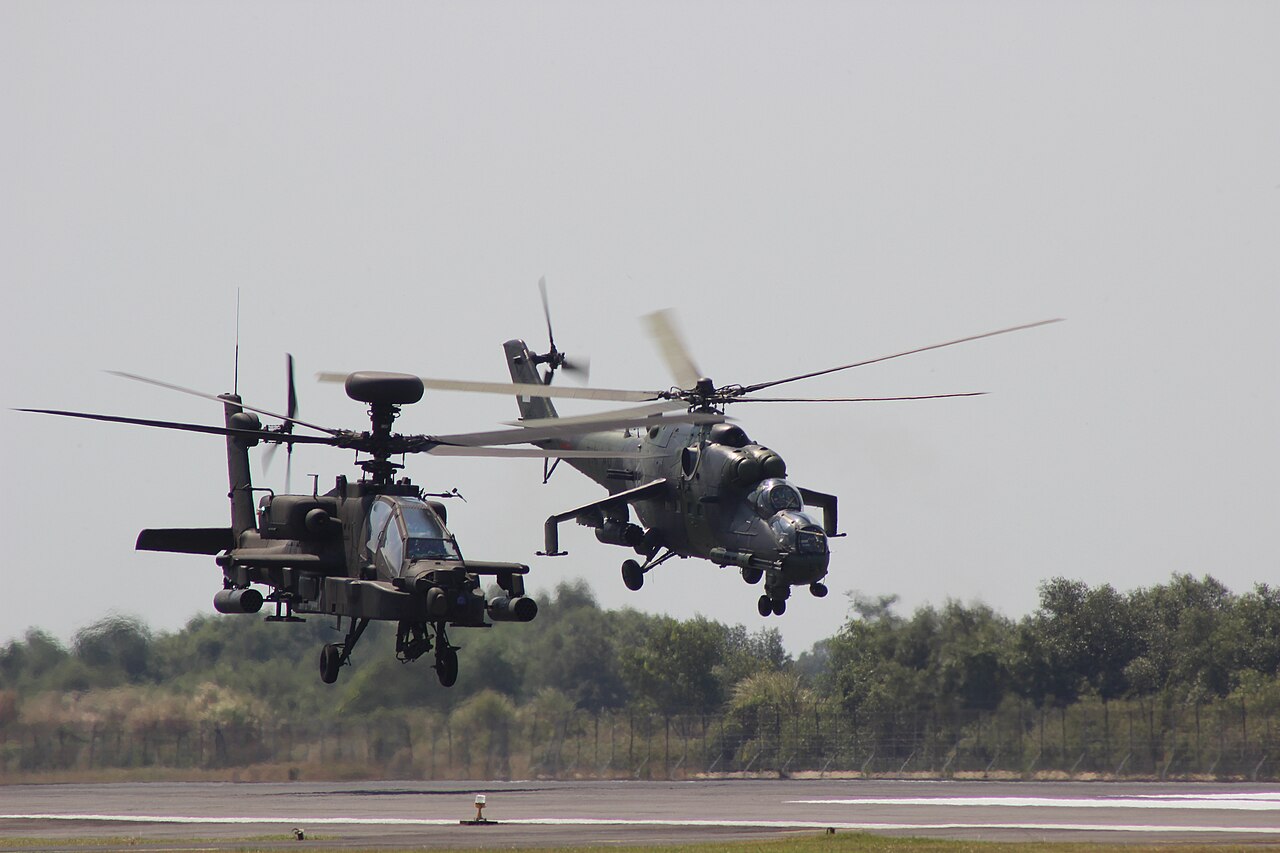
The Indonesian Army Aviation Corps received two new Mil Mi-35M attack helicopters from Russia in early September. They complement the existing fleet of seven older Mi-35P, the export version of the Mi-24P. Of this, the night-capable M model stands out in particular for its upgraded avionics and sensors as well as a modified armament. Thus it features night vision devices, satellite navigation, the electro-optical fire-control system GOES-342, robust secure communications equipment and electronic multifunction displays in the cockpit.
Instead of the rigidly mounted twin cannon GSh-30K in 30 x 165 mm caliber, a swiveling NPPU-23 turret is used with the either the dual-barreled GSh-23L or the water-cooled GSh-23V with 450 rounds in 23 x 115 mm caliber. In addition, there are various structural and aerodynamic modifications, including more powerful engines of the Klimov VK-2500-02 type, main rotor blades made of composite material and an X-shaped tail rotor similar to that of the Mi-28. In Russia, the Mi-35P has been in service since 2011 with more than 60 examples.
Mi-35 exported to numerous countries
The original Mi-35 was the export version of the Mi-24V from the 1970s, NATO designation Hind-E, and the most-produced model of the Mi-24 family. The type has been exported in total with more than 180 units to eleven countries, including the Mi-35M2 version for Venezuela and the Mi-35M4 with Israeli avionics for Brazil. Czechia delivered its modernized examples to Ukraine in 2023, where the model has been used by both sides in the war with Russia. In the same year, Belarus also received 25 aircraft.
The Indonesian helicopters are stationed at the Army Aviation Center in Semarang on the island of Java. They are also used for transport tasks in inaccessible areas of the vast country. Like all members of the Mi-24 family since the Hind-D, the model combines the typical tandem cockpit of a combat helicopter with a cabin for up to eight soldiers or corresponding cargo, which has led to the designation “flying armored personnel carrier.”
