
Already on July 10 of this year, the army chiefs of Australia and New Zealand signed an update to the ANZAC Plan, the defense agreement concluded in 2023. Named after the traditional Australian and New Zealand Corps from World War I, the plan is intended to strengthen military cooperation and interoperability for joint operations in light of new challenges in the region. In the upcoming “Talisman Sabre” exercise next year, the two South Pacific neighbours now aim to elevate their already close military cooperation to a new level.
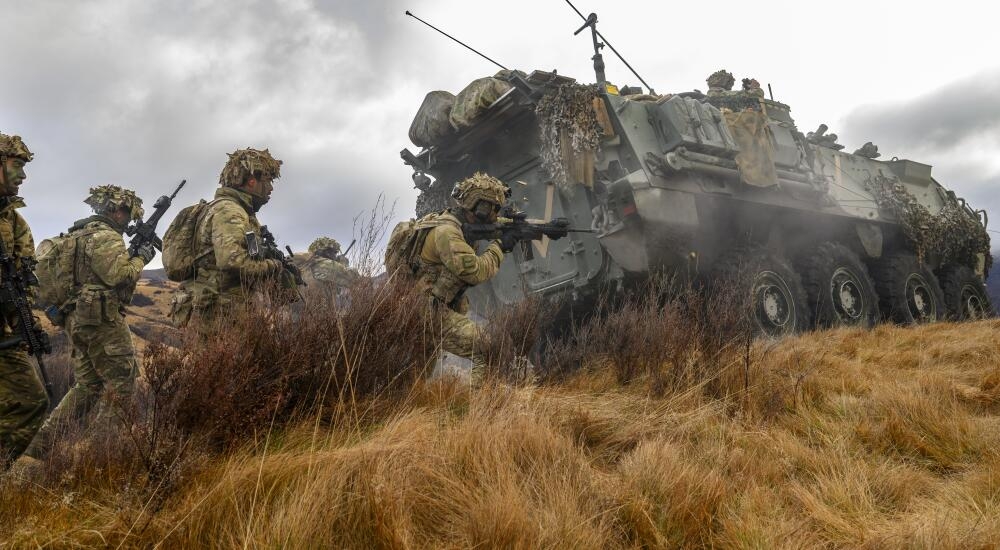
At the end of August, for this purpose, the New Zealand Motorised Infantry Battle Group (MIBG) trains for 16 days at the Hill 60 exercise for its first overseas deployment. Hill 60 refers to the last battle on the Gallipoli Peninsula in 1916, where ANZAC suffered heavy losses but ultimately failed to establish the foothold needed to secure access to the Black Sea for the Entente powers. April 25, as the anniversary of the Gallipoli landing in 1915, has since been observed as ANZAC Day in both countries as well as the island kingdom of Tonga in memory of the victims.
Plan ANZAC Envisions Alignment of Equipment and Training
The MIBG is a battalion-sized battle group with a strength of around 1,000 soldiers, which amounts to roughly a quarter of the small country’s active land forces, essentially consisting of the 1st New Zealand Brigade. Important weapon systems include the New Zealand variant of the armored 8×8 vehicle LAV III (NZLAV), the protected 4×4 Bushmaster, and the 105-mm gun L119. At Talisman Sabre 2027, the integration of the formation into the Australian 7th Brigade with headquarters in Brisbane is to be practiced.
This brigade is primarily intended for operations in the Pacific region, while the 1st Brigade based in Darwin focuses on the offshore seas north of Australia and the 3rd Brigade based in Townsville concentrates on mechanized warfare. The New Zealand Defence Forces have previously worked with the 7th Brigade, but not at the level now planned. Plan ANZAC calls for aligning equipment and training with Australia’s neighbors, which is also explicitly stated in New Zealand’s Defence Capabilities Plan of April 2025.
Response to Growing China’s Influence in the Pacific Region
Even earlier, for example, the procurement of Australian Bushmaster vehicles—initially five units for the New Zealand Special Air Service (NZSAS) from 2018, and then 43 more for the Army from 2020—was a sign of the neighboring ties. On the other hand, since 2015 the forces have replaced the Steyr AUG, known among neighbors as the F88, with the LMT MARS-L. With Plan ANZAC, both countries are responding not least to the growing influence of China in the Pacific region. New Zealand also plans to modernize and expand its artillery capabilities, among others.
Thus, the 105-mm guns are to be replaced by longer-range systems. Australia has already procured the American rocket artillery system HIMARS. Recently it received the second delivery, and that two years ahead of schedule. By September 2025, eight of the initial order of 42 had been delivered; shortly thereafter, the U.S. State Department also approved a further order for 48 more systems. HIMARS will be used by the newly established 14th Regiment, Royal Australian Artillery.
