
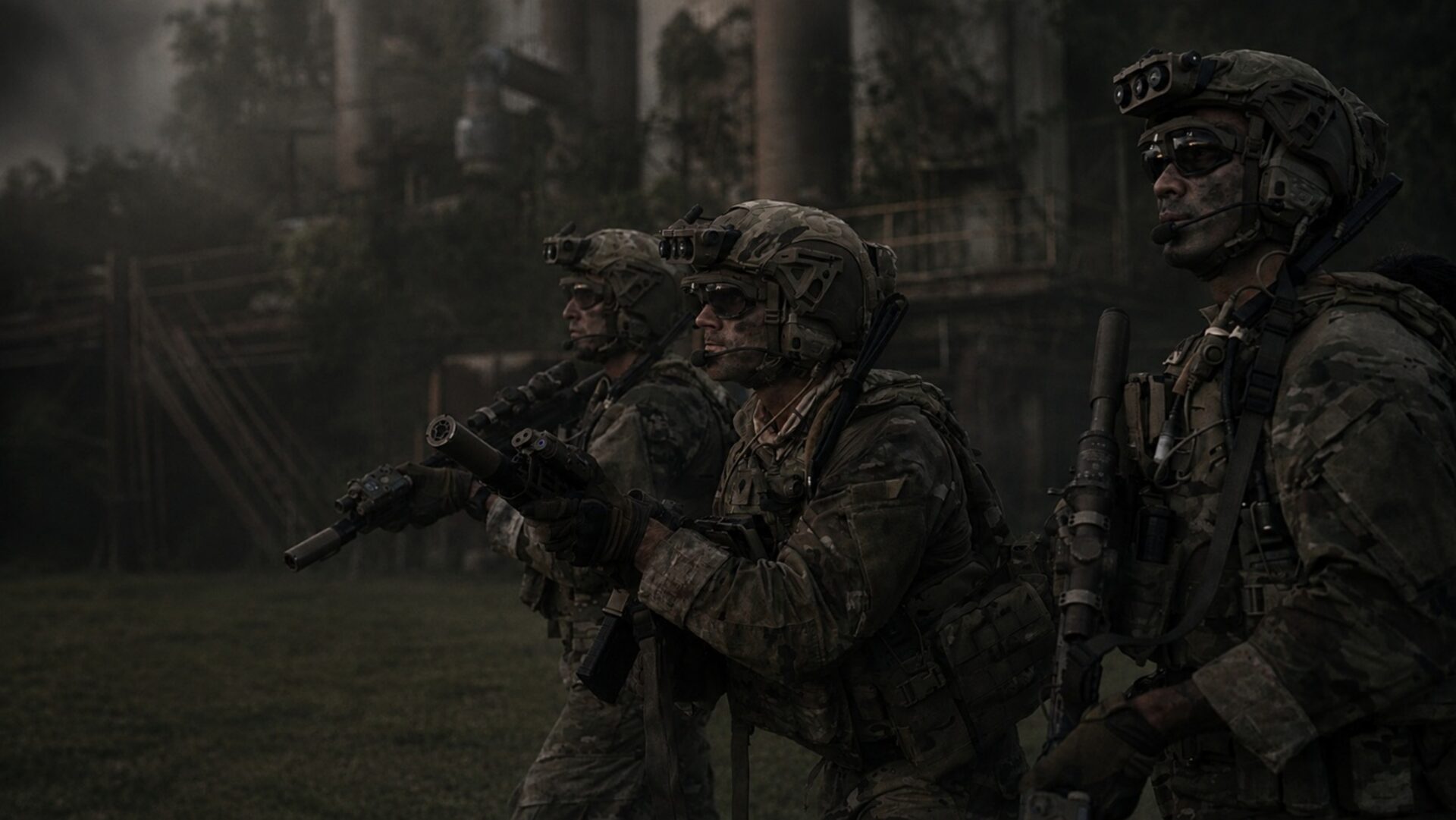
Twenty-Six Defense presented at the AUSA Annual Meeting & Exposition 2026 in Washington, D.C., a range of technologies to support military personnel, particularly the U.S. Army’s ground forces.
With this, the company aims to showcase solutions that align with the U.S. Army’s priorities regarding modernization, large-scale combat operations, and multi-domain readiness. These solutions enhance situational awareness, protection, lethality, and speed of today’s forces, the company stated during the presentation.
Twenty-Six Defense at AUSA
Twenty-Six Defense is the US division of the Israeli company Elbit Systems, and has recently been renamed—a new name intended to emphasize the focus on the subsidiary’s products manufactured in the United States.
Primex
At the show, “Primex” makes its premiere. The next-generation system for perception support for soldiers. Primex offers integrated multispectral sensing, secure access, and seamless connectivity to battlefield data streams and edge computing resources—enabling faster and more informed decision-making. The solution is a lightweight, soldier-centered wearable system designed for operational flexibility day and night and for mission success.
Primex is intended primarily to contribute to fused and multispectral perception, thereby addressing the speed of instinct. Primex enables digital perception with extremely low latency through close integration of low-light sensors, thermal imaging, and real-time processing. Soldiers can perceive their surroundings and respond instinctively—even in limited visibility.
And Primex is said to offer excellent, soldier-centered ergonomics. The solution, according to the manufacturer, is designed for prolonged use. The system is characterized by the lightest head-mounted weight and a near-neutral center of gravity. The balanced construction and intuitive user interfaces enable soldiers to maintain situational awareness without distraction or cognitive overload.
And the modular architecture is intended to future-proof the system. Thanks to the modular hardware and software architecture, various sensors, data sources, and command systems can be integrated. Flexible configuration options allow the capabilities to evolve without requiring a complete redesign.
It remains unclear at this time whether Primex is US-only or can also be offered internationally.
Enhanced Night Vision
Also at AUSA is shown the AN/PSQ-44 Enhanced Night Vision Goggle – Binocular (enhanced-capability binocular night vision device). The AN/PSQ-44 provides the warfighter a decisive advantage through a system that combines a direct situational awareness view in the field of view (heads-up situational awareness) with unmatched capabilities to master the networked battlefield, according to the manufacturer. The wireless link to the rifle-mounted thermal sight enables rapid target acquisition, augmented reality features (via the Smart Battery Pack) and the integration with the Nett Warrior system to give the soldier the necessary lethality for close combat.
The system uses Gen 3 image intensifier tubes with white phosphor and enhanced performance. It is also a fusion system that combines image intensification with thermal imaging. The manufacturer cites an optimal display resolution of 1280 x 1024 with a top thermal resolution of 640 x 480 (10-micron technology). And a detection range of 500 meters (presumably for personnel).
Loitering Munition
The SkyStriker B4E system is expected to deliver precise, autonomous effects, both in ISR/reconnaissance and combat missions. The system offers operators direct control, operates in contested environments, and can be scaled from single launches to mass use (swarm). Ready for action when needed. Developed to overwhelm the opponent, according to the manufacturer.
The SkyStriker B4E conducts autonomous operations designed specifically for contested deployment environments. It uses computer-assisted target recognition as well as terminal guidance to engage stationary or up to approximately 50 mph (about 80 km/h) moving targets. Its autonomy enables mission planning across multiple platforms and coordinated execution by multiple units, delivering a coordinated effect across widely dispersed formations. The system performs passive RF detection and localization, remains functional even if the radio link fails, and has demonstrated navigation capability without GPS support in 150 missions of the “Block 3” version—from launch to target strike—according to the manufacturer.

And it is designed for deadly effect, with a CEP of 1 meter against moving targets at speeds of up to 55 mph (about 88 km/h). Precision on arrival at the target at the exact moment.
According to the manufacturer, the system is ready for series production, as U.S. manufacturing lines are active. They guarantee rapid delivery at operational tempo. And it is said to have already seen combat testing. According to the manufacturer, the system has already completed hundreds of deployments under real combat conditions.
GPS-denied navigation is also possible, and a swarm capability enabled by coordinating multiple units, including real-time ATR (automatic target recognition). The modularity for diverse missions allows easy and rapid payload adaptation (33 lbs / about 15 kg), whether kinetic, ISR, or multi-effect.
Twenty-Six Defense will also feature the mobile 120-mm mortar system XM1168, the autonomous relocatable surveillance turret, and SkyStriker Block 4E at the center—solutions that ensure troop protection, capabilities to counter unmanned aerial systems (Counter-UAS), and precision effects.
“Twenty-Six Defense has made it its mission to provide capabilities that give our soldiers decisive advantages on the battlefield,” said Luke Savoie, President and CEO.
With more than 30 years of experience supporting the U.S. military, Twenty-Six Defense’s 3,300 American employees are expanding domestic development and manufacturing capabilities—at a time when the country is calling for greater industrial speed and resilience.
“Our mission is simple,” Savoie said. “Advance the forces. Develop agilely. Deliver enduring reliability.” Visitors to AUSA 2026 can explore these technologies at Booth 625 and meet the experts behind them; there, Twenty-Six Defense will show how its US-led innovations contribute to modernizing the armed forces for future battles.
Author: Andre Forkert, Defense Editor
