
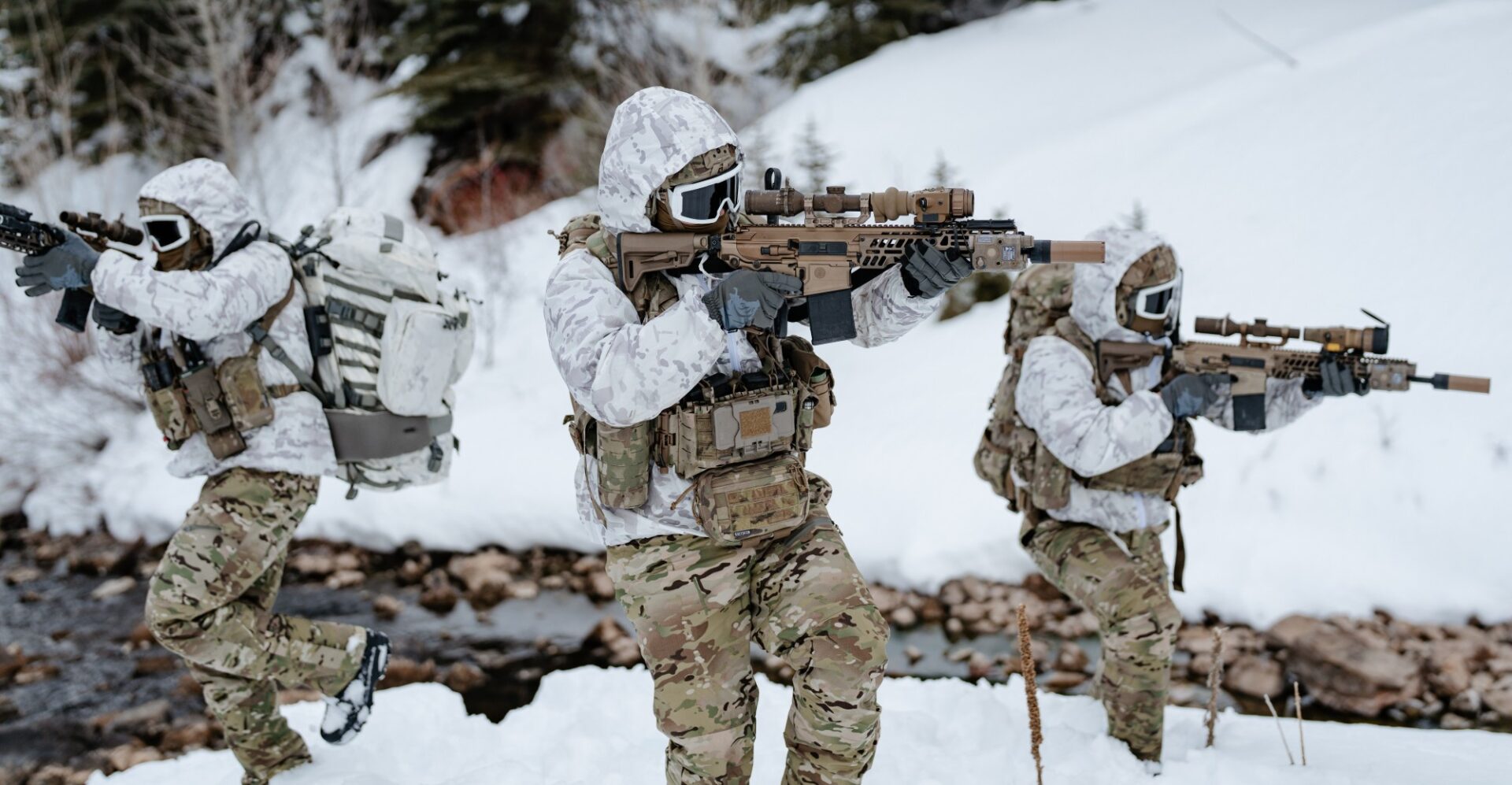
Leonardo DRS, Inc. announced at AUSA that the company has secured a production contract from the U.S. Army valued at $63 million for the next-generation thermal imaging targeting system—the “Family of Weapon Sights – Individual” (FWS-I). The contract was awarded under the Army’s existing IDIQ (Indefinite-Delivery/Indefinite-Quantity) contract for advanced, battlefield-proven thermal imaging targeting systems to support infantry-equipped soldiers.
The Leonardo Thermal Imaging Targeting System
The FWS-I is a lightweight, uncooled thermal imaging targeting system designed for wireless integration into soldier-worn sighting systems, including the Enhanced Night Vision Goggle–Binocular (ENVG-B) and the Integrated Visual Augmentation System (IVAS). This wireless connection allows soldiers to view the thermal image of the target device on their helmet-mounted display. This enables rapid target acquisition without bringing the weapon to bear. Maintaining situational awareness provides a decisive advantage in complex operating environments with high threat levels.
“Modernization in the direct-combat arena means providing soldiers with the information they need without adding unnecessary complexity,” said John Baylouny, President and CEO of Leonardo DRS. “The FWS-I production contract reflects the Army’s ongoing focus on advanced sensing, networked soldier systems and mission-ready capabilities. DRS is proud to support this mission by delivering field-proven technologies that help soldiers identify threats, make faster decisions, and prevail in combat — in line with the motto ‘Own the Edge™’.”
As adversaries increasingly employ highly advanced camouflage techniques and operate under poor visibility conditions, thermal imaging targeting systems help soldiers identify and assess potential threats across a range of operating scenarios—whether in urban terrain, dense foliage, smoke, fog, or darkness, as well as at short and long ranges. The FWS-I uses infrared imaging to assist soldiers in detecting heat signatures—particularly under conditions where camouflage, lighting, or weather reduce the effectiveness of conventional optical observation methods.
“This cutting-edge technology ensures that soldiers on today’s battlefield have access to the most advanced targeting optics,” explained Jerry Hathaway, Senior Vice President and General Manager of Leonardo DRS Electro-Optical Infrared Systems. “The FWS-I combines modern uncooled thermal imaging with a helmet-integrated display to improve target acquisition and situational awareness for dismounted soldiers. We are proud that the U.S. Army continues to rely on DRS to deliver this critical capability that enhances survivability and mission effectiveness across operations in multiple domains (Multi-Domain Operations).”
The FWS-I is based on uncooled infrared technology, enabling robust thermal imaging performance without cryogenic cooling. Thanks to its clip-on design, it is flexible on a range of weapon systems. The wireless connection to the soldier-worn systems ensures speed, precision and situational awareness without limiting mobility.
This contract builds on DRS’s long-standing collaboration with the U.S. Army and the company’s experience in electro-optical and infrared technologies (EO/IR). In addition to the FWS-I, DRS provides a broad spectrum of EO/IR technologies to support mounted and dismounted operations as well as for airborne platforms and to enhance aircraft survivability.
This contract is notable because Leonardo can now offer a better solution. With higher resolution, a field of view better tuned for long distances, and a more capable electronic core.
Notably, the contract also underscores that Leonardo can now offer an evolved solution with higher resolution, a field of view more tuned to longer distances, and a more capable electronic core. This is likely to prompt the U.S. Army to consider when the next generation of target optics will enter procurement. The current production contract thus secures the continued introduction of the FWS-I for now, while technologically the transition to more capable successor solutions is already being prepared. For Leonardo, this also opens the opportunity to base future modernization steps on a system family already fielded by the U.S. Army.
Author: Andre Forkert, Defense Forces Editor
