
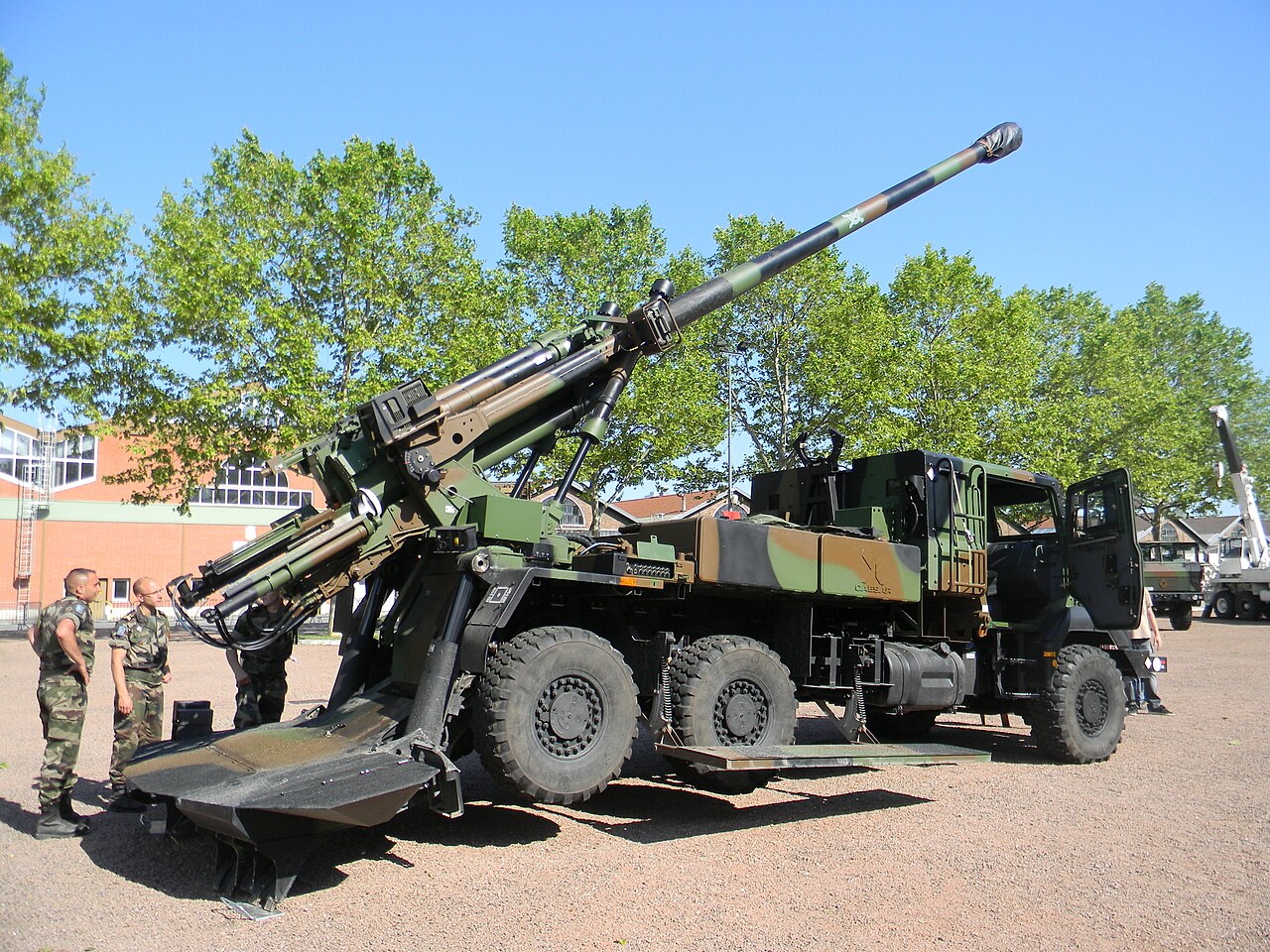
In response to the comprehensive threat posed by reconnaissance and combat drones as seen in the Ukraine conflict, the French armed forces continue to search for new organizational forms for deploying conventional weapon systems. Thus the 7e Brigade blindée, with its headquarters in Besançon in eastern France, is testing various deployment formats intended to balance combat power with the danger of being attacked as a “worthy target.” During the Orion 2026 exercise this year, the brigade practiced operating in half-platoons, each consisting of two Leclerc main battle tanks and two VBL reconnaissance vehicles.
Corresponding experiments are also taking place in artillery. Thus the 68e Régiment d’artillerie d’Afrique (RAA), belonging to the 7e Brigade, reorganized its firing batteries with 155-mm wheeled self-propelled Caesar howitzers from two platoons, each consisting of four guns in groups of three, with two guns per group. In addition, it has established its own sub-unit for the preparation of firing positions and the deployment of decoy targets. This organization was also tested during Orion 2026 and earlier this year during a live-fire exercise at Camp de Canjeurs.

Prepared Fire Positions and “Opaque Bubbles”
At the same site, last October the 35e Régiment d’artillerie parachutiste (RAP) had already conducted tests with more camouflage, decoy targets, jammers, and defensive weapons against the drone threat. To reduce danger for the operators, ammunition was no longer carried on the guns but prepositioned at the firing positions. The 68e RAA is now also adjusting its own structure to regain the ability to maneuver dynamically. In doing so, it also draws on earlier organizations with regiment-owned reconnaissance platoons, whose forces were most recently distributed among the individual gun detachments.
The two platoons of a battery were thereby capable of independent maneuvering. The new support sub-unit consolidates this with additional capabilities and is responsible for identifying and preparing all firing positions by stocking ammunition, setting up drone-protection cages, and deploying decoy targets. The guns wait for a firing order in “opaque bubbles,” in which they should be largely protected from reconnaissance and engagement by camouflage and radio silence. They then move in a coordinated manner to the positions, reposition into the prepared protective cages, and carry out the mission.
New Drone-Defense Systems
The coordination is through the artillery command system Atlas, which is compatible with brigade-level command systems such as SitaWare. According to regimental commander Colonel Rémy Jaillet, the division of into two-gun platoons not only increases survivability but also the availability of artillery fire for the supported brigade. While he is satisfied with the equipment of the 68e RAA, including Thales’ ground-surveillance radar Murin and the Delair DT64 reconnaissance drone, the networking of sensors and effectors on the battlefield still needs to improve overall.
The regiment’s first Caesar battery will permanently adopt the new structure next year. However, according to Jaillet, this should not be viewed as the standard for the entire French Army. The 68e RAA is one of six artillery regiments that are equipped with the Caesar system. Their current organization comprises two batteries of eight Caesars each, plus one with eight automatic 120-mm MEPAC mortars on a Griffon 6×6 chassis, which since 2025 has replaced the towed Mo-120-RT-61. In addition there are a staff and logistics, a fire-control, an aviation and drone-defense, and a reserve battery.
Because of the reorganization, there will in the future likely be four firing batteries with the same total number of guns. The air-defense battery is, among other things, equipped with the surface-to-air Mistral missile system; for its test last October the 35e RAP also received, as the first unit, six mobile drone-defense systems Proteus as well as the handheld interference device Nerod. Proteus was assembled within four months from old 20-mm anti-aircraft guns and trucks, in conjunction with thermal imaging devices and a fire-control computer. An improved version is expected to feature a newer Scania platform and artificial intelligence for target acquisition.
