
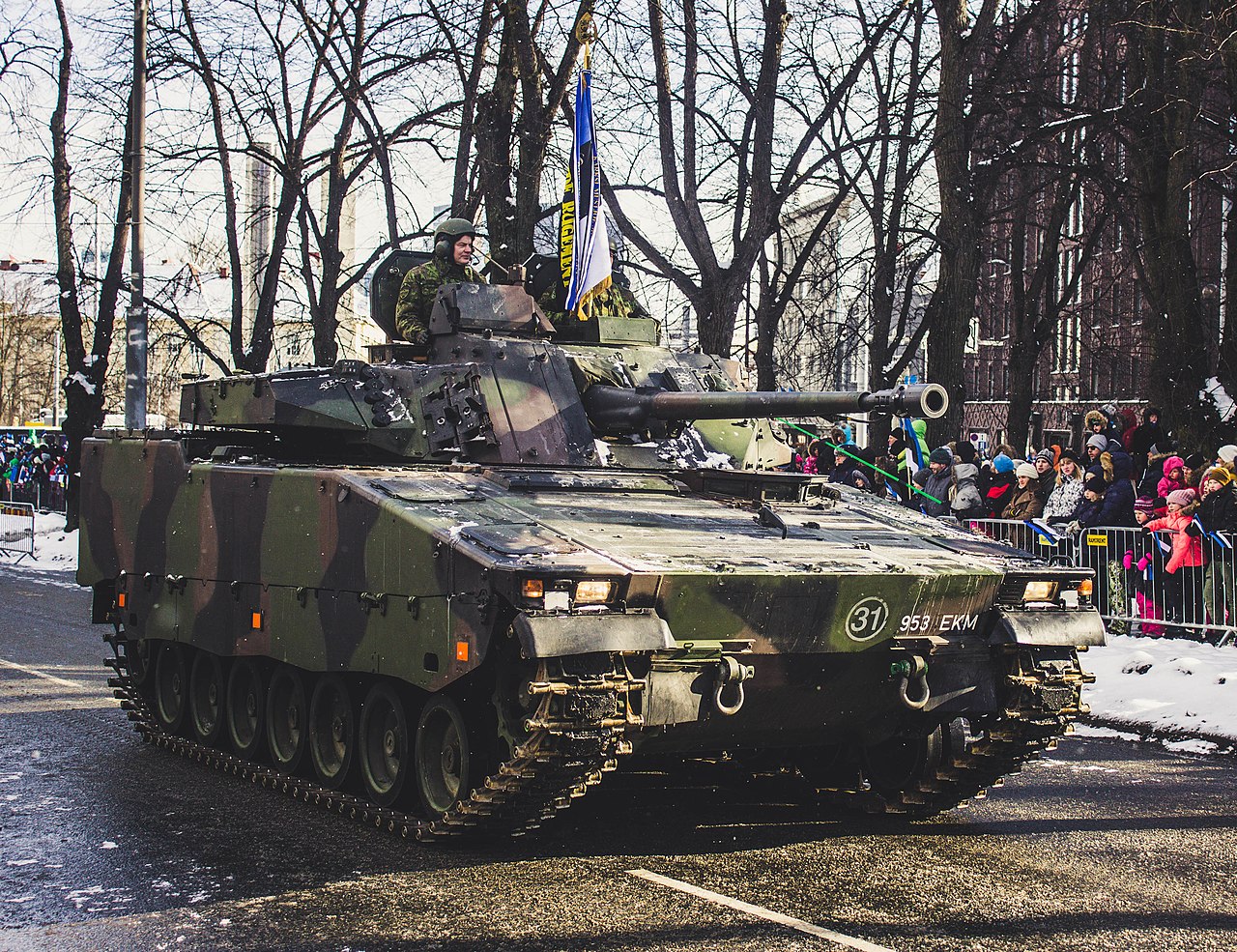
The two Baltic states, Estonia and Lithuania, have stationed portions of their armed forces closer to their respective border with Russia, with different reasons given. Estonia permanently relocated the headquarters of its 1st Infantry Brigade this week from Tapa in the north of the country to Johvi, about 40 kilometers from the border town Narva. In Narva itself, a base is being established for up to 1,000 soldiers.
The reason is a shift to a forward-defence strategy, as Brigade Commander Colonel Tarmo Kundla told the British Financial Times on Monday. Until now, the NATO member had relied on delaying an enemy assault until reinforcement from allies arrives. In light of the Ukraine war’s course and the possibility that Russia could view the border region around Narva with its large Russian-speaking population as a lucrative target for occupation by means of hybrid and conventional warfare, this apparently no longer seems appropriate from Estonia’s point of view.
The German-Dutch Corps is now responsible for Estonia
Estonia currently has one active and one partially active infantry brigade under a division headquarters, supplemented by four defence districts of the volunteer Home Guard Kaitseliit at the regimental level. The country’s total troop strength is about 3,500 active soldiers and about 30,000 reservists. The air force is concentrated with one squadron each of light transport aircraft and jet trainers, as well as two IRIS-T SLM surface-to-air missile batteries at the Amari air base, while the navy has one minesweeper, one patrol boat, and a coastal defense squadron in Tallinn.
NATO’s presence in Estonia consists, besides rotating air force units for Baltic Air Policing in Amari, mainly of the eFP Battle Group Estonia stationed in Tapa and led by the British, with about 1,000 to 1,200 personnel. In the medium term, this is to be expanded into a brigade. Since mid-2026, the 1st German-Dutch Corps (1GNC) is planned as the tactical headquarters for the defense of Estonia and neighboring Latvia. NATO has recently also emphasized the principle of forward defence.
Russian Neighbors Fear Increasing Border Crossings
Meanwhile, Lithuania sent about 100 soldiers to its border with the Russian exclave Kaliningrad for initially two weeks to bolster border guard forces. Interior Minister Martynas Katelynas cited a continuing burden on border protection due to irregular migration — also in light of a recent incident on the Latvia-Russia border, where a group of about 20 people, escorted by masked armed individuals, attempted to cross — as well as a possible further wave of mobilization in Russia.
Russians who wanted to avoid being drafted for the Ukraine war could then try to flee across the border and seek asylum, according to Katelynas. Given Russia’s personnel problems, there is the possibility that President Vladimir Putin could order another mobilization of reservists in October. According to a current report by Finnish television, the border guard there already records an increasing number of crossings by men who were seeking to flee conscription into military service or recruitment for the Ukraine war.
