Even before the first Heavy Weapons Carrier Infantry are regularly added to the force, their future crews can begin training. Rheinmetall has now completed the Factory Acceptance Test for the new Firing and Combat Training Simulator for Heavy Weapons Carrier Infantry (AGSW). This marks a key building block for training on a weapon system that is set to become a core element of the German Army’s Medium Forces.
Training on the Heavy Weapons Carrier Infantry Begins Ahead of Influx
During the Factory Acceptance Test (FAT) at the Rheinmetall site in Bremen, the training device “Firing and Combat Training for Heavy Weapons Carrier Infantry”, abbreviated AGSW, was inspected by representatives of the Army Development Office, the Federal Office for Equipment, Information Technology and Utilization of the Bundeswehr (BAAINBw), as well as soldiers of the Jägers and the Infantry School. As Rheinmetall announced today, the responsible project manager at the BAAINBw had already confirmed in July 2026 the successful completion of the test.
Thus the training program reaches an important milestone: The Bundeswehr can begin training via simulation before the introduction of the new weapon system. For this, in 2022 the Bundeswehr and industry agreed to provide training resources as early as possible, preferably before the larger influx of the first Heavy Weapons Carrier Infantry.
Four Virtual Combat Rooms
The AGSW forms the heart of this training. The firing and combat simulator consists of four combat rooms as well as a station for leadership, control and evaluation. The crews are not only supposed to learn how to operate the vehicle there. The interior, system logic, aiming behavior, driving dynamics and ballistics are simulated, among other things. This allows the training to be increased step by step: first individual crew members can train their respective tasks, then the crews together. In addition, tactical exercises up to more complex scenarios at the platoon level are possible.
The development of the training facility began after the contract was signed in early 2024 and was completed in July of this year. Rheinmetall had already worked with the Infantry School and the Army Development Office during the concept phase, so that experiences and requirements of the later users could be incorporated into the development.
Training Has Already Begun
In fact, the Jägers already have the first part of the training system. Between September 2025 and April 2026, Rheinmetall delivered so-called action trainers to the Jäger battalions. They are based on the same simulation software and control logic as the larger AGSW and serve as an entry into training. In the autumn, the first AGSW is to be handed over to the Infantry School. In total, five systems are planned to arrive with the users by mid-2027.
Both simulator variants also allow soldiers to create their own virtual training areas or adjust existing ones. This allows, for example, to model rooms of a possible future mission. March routes, positions and tactical procedures can be tested virtually, before the crews drive through them with the real vehicle.
Vehicle and Dismounted Infantry
Another step is the networking of various simulators. The AGSW is prepared to be connected with so-called Infantry Desktop Trainers. This will enable not only vehicle crews to train with each other in the future, but also the interaction of the Heavy Weapons Carrier Infantry with the dismounted infantry to be depicted in a joint simulation.
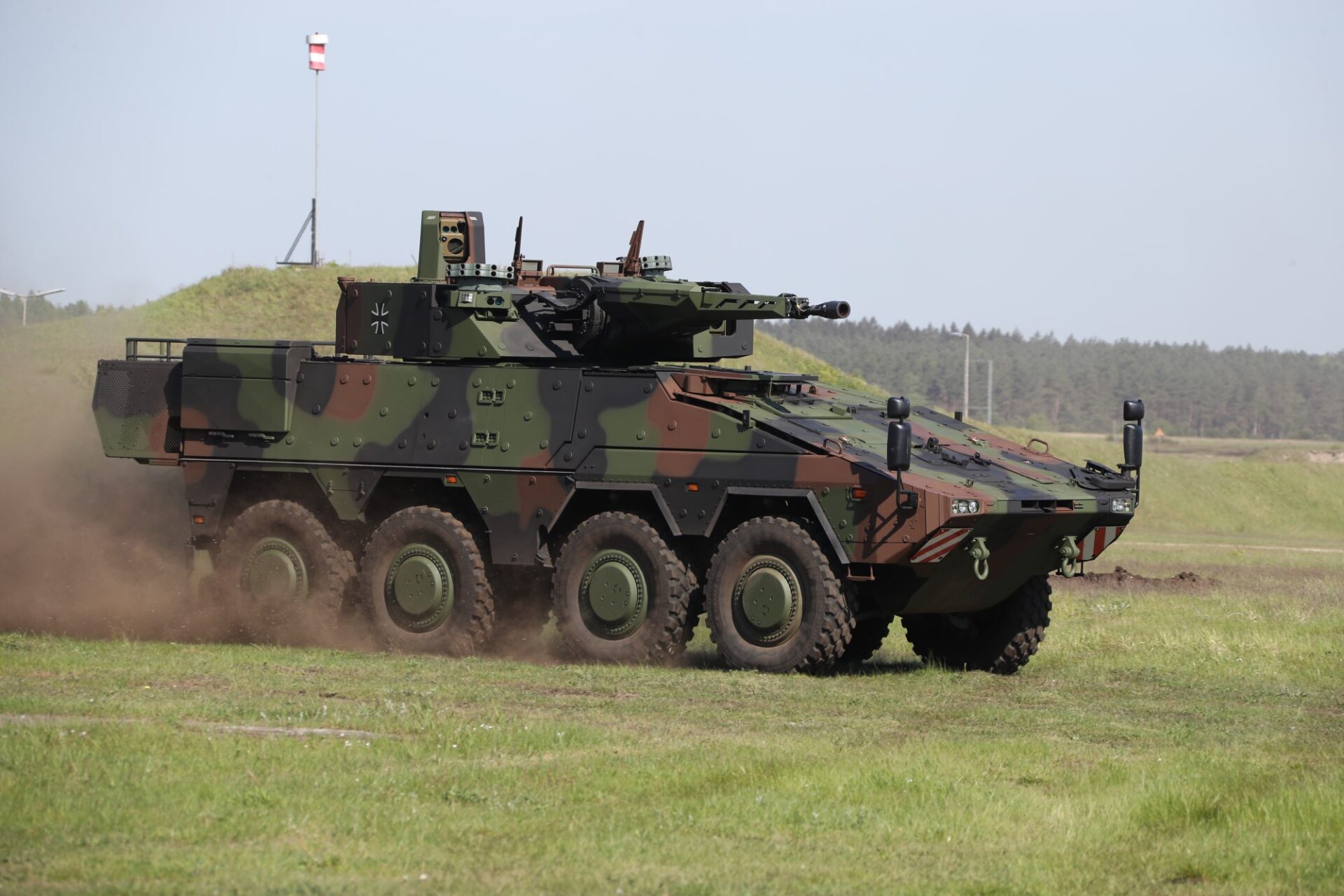
This corresponds to the task of the real vehicle. The Heavy Weapons Carrier Infantry is based on the Australian Boxer Combat Reconnaissance Vehicle and combines the Boxer’s 8×8 drive module with a Lance two-person turret. It is armed with the MK30-2 ABM machine cannon, which is also used on the Puma Infantry Fighting Vehicle. The wheeled armoured vehicle is intended to replace the Wiesel 1 and provide direct fire support as well as anti-tank capabilities for the infantry.
Germany procures a total of 123 Heavy Weapons Carrier Infantry under a government contract with Australia. The Bundeswehr sees the system in particular for the Army’s Medium Forces. With the vehicle, the Jäger battalions are to obtain their fire support on a wheeled, road-mobile platform and thus become fully road-mobile. The ability to redeploy on its own axles within Europe is, after all, one of the essential considerations behind the Medium Forces concept.
From Puma to Heavy Weapons Carrier Infantry
Technologically, Rheinmetall does not start training from zero. The AGSW builds on the concept of the training device Shooting and Combat Training for Infantry Fighting Vehicle Puma (AGSP), also developed by the company. This achieved an important development milestone in 2025 and is now in serial production. The underlying technology is intended to be used for training systems of other Bundeswehr vehicles. Prospectively, this will allow Jägers, mechanized infantry and Army reconnaissance troops at their respective locations to have their own training opportunities.
After the delivery of the five AGSWs and their acceptance at the respective locations, another step remains: the software of both the action trainers and the large simulators will be brought to the final design state of the Heavy Weapons Carrier Infantry. Subsequently, a uniform software state will be rolled out for both training systems.
Thus, vehicle and training do not run sequentially, but largely in parallel into the troops. For a new weapon system, this is of considerable importance: when the first Heavy Weapons Carrier Infantry arrive at their formations, their crews will not have to start with the basics. A substantial portion of their training will already have been completed on the virtual vehicle.
Author: Dorothee Frank, Online Editor-in-Chief
