
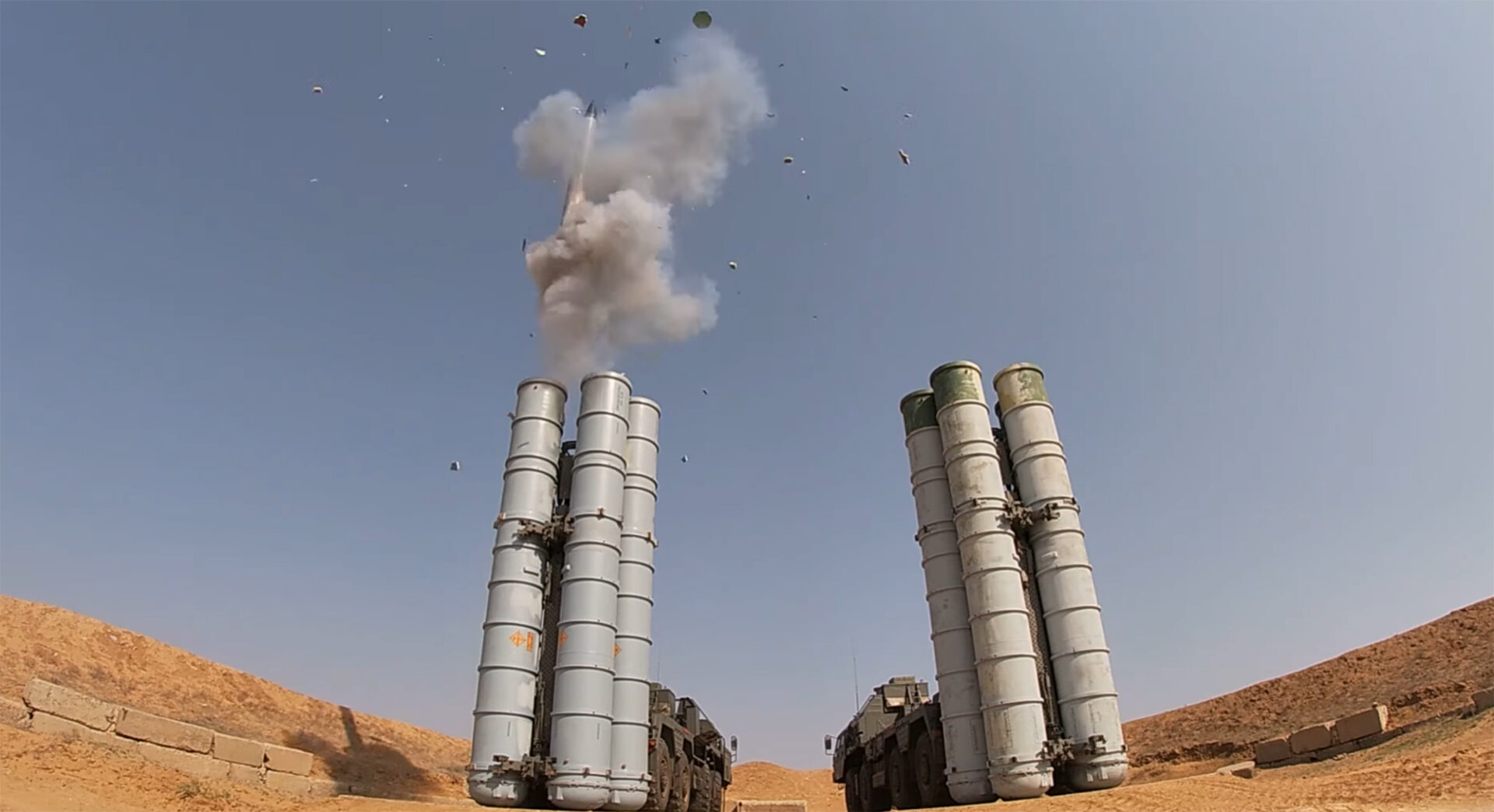
Russia apparently uses modified components of its air defense systems S-300 and S-400 to attack ground targets in Ukraine. According to Ukrainian intelligence services, up to 17 S-400 launchers have been modified for this purpose. According to Israeli analysts who spoke to the author, older air defense and training missiles are among those used, fired on ballistic trajectories against ground targets. The improvised weapons are clearly less accurate than Iskander or other ballistic ground-to-ground missiles – but they serve several purposes for Russia.
Russia turns S-400 into ballistic ground weapons
In principle, the Russian S-400 system was developed for long-range air defense. Its missiles are intended to counter, among other things, combat aircraft, cruise missiles, and other aerial targets. In the war against Ukraine, Russia is now reportedly using parts of the system for a task for which they were not originally intended: attacks on ground targets.
According to Israeli analysts who monitor the war in Ukraine, Russia has modified S-400 launchers for this purpose. These can fire, among other things, retrofitted RM-48U missiles on a fast ballistic trajectory against ground targets.
The RM-48U is a missile used for training and testing purposes. Russia can thus assign older or decommissioned stocks to a new use.
According to Ukrainian intelligence, as many as 17 S-400 launchers have now been modified for ground attacks. Such systems are reportedly stationed in the Russian regions of Bryansk and Rostov.
Attacks also against Kyiv
The modified systems are said to have already been used to strike Ukrainian targets, including the capital Kyiv. According to the Israeli analysts, Ukrainian forces recently destroyed a modified Russian S-400 launcher in the Bryansk region. This unit is said to have previously been used for ground attacks against Kyiv.
The missiles reach their targets on a fast ballistic trajectory. However, their accuracy is considerably lower than that of a ballistic missile designed for ground attacks. Available information indicates that the missiles can miss their intended target by approximately 300 meters. Against individual point targets, such a weapon is therefore only marginally suitable. Its effectiveness may look different against larger area targets – or if the attack is intended to fulfill another purpose beyond immediate destruction, such as saturating the enemy’s air defenses or plain terror against the Ukrainian civilian population.
Old missiles instead of expensive Iskander
From the Russian perspective, the modification offers several advantages according to Israeli analysts. Russia reportedly has large stocks of older air defense and training missiles, some of which are nearing the end of their service life. Rather than decommissioning these stocks, they can still be used to attack Ukrainian targets.
At the same time, this approach can save newer and much more valuable precision weapons. High-value systems like Iskander or Zircon can be held back for strategically more important attacks – for example for the soon-to-be-expected large-scale strikes against Ukraine’s energy infrastructure in winter.
Thus, the modified S-300 and S-400 missiles essentially take on the role of a long-range, relatively inexpensive supplement to Russia’s actual ballistic weapons.
Another factor, according to the analysts, is that international sanctions hinder Russia’s rapid production of large quantities of modern precision missiles. The use of existing stockpiles partially reduces the need for newly produced ground-to-ground weapons.
Russia compels Ukraine to deploy
However, the calculation goes beyond the cost of the Russian attack missile. Even a comparatively old and inaccurate missile poses a threat on its ballistic trajectory that Ukrainian air defenses must respond to. If it is fired at a populated area or critical infrastructure, it cannot be ignored. Therefore, according to Israeli analysts, Russia may be trying to force Ukraine to deploy its limited and sometimes very expensive interceptors.
Even if the Russian attack missile comes from old stock and has only a limited military value, engaging it on the Ukrainian side can consume valuable interceptors. In larger attack waves this further strains Ukraine’s air defense.
The effectiveness of air defense missiles
Technically, using an air defense missile against a ground target is possible, but according to Israeli experts speaking to the author, it is neither particularly efficient nor easy. Some modern Soviet/Russian air defense systems, such as the S-300 and S-400, have rudimentary or secondary capabilities in their fire control software to engage ground targets.
The fundamental problem lies in the original design of the weapons. Anti-air missiles and their fire-control systems are optimized to detect, track, and engage targets in open air. For a ground target, conditions change fundamentally. Terrain, buildings, and other structures generate numerous radar echoes. Add terrain shading and the lack of clear separation of the target from the background. Without suitable coordinates and corresponding adjustments to the fire control, precise engagement becomes significantly more difficult.
Warhead for other tasks
Another problem is the warhead. Anti-air missiles typically carry fragmentation warheads designed to destroy fast aerial targets. The detonation often occurs via an proximity fuze: The missile does not need to hit the enemy aircraft directly, but detonates nearby and creates a cloud of high-energy fragments. For attacks on fortified ground targets, this principle is only partly suitable. Anti-air missiles generally do not have heavy penetration warheads or the large explosive effect that specially developed ballistic missiles or cruise missiles can deploy against certain ground targets.
The Russian use of old air defense and training missiles thus reflects less an attempt to turn them into fully fledged substitutes for Iskander or other precision missiles. Rather, Russia can still use existing stocks militarily, save its own high-value missiles, and at the same time apply additional pressure to Ukrainian air defenses. These modified systems thus serve as a cost-effective artillery supplement with a long range, to preserve inventories of high-value ballistic missiles like Iskander, while simultaneously challenging Ukraine’s air-defense interceptors. From this, one cannot yet deduce a real shortage in Russian stockpiles.
Author: Arie Egozi, Israel Correspondent
