
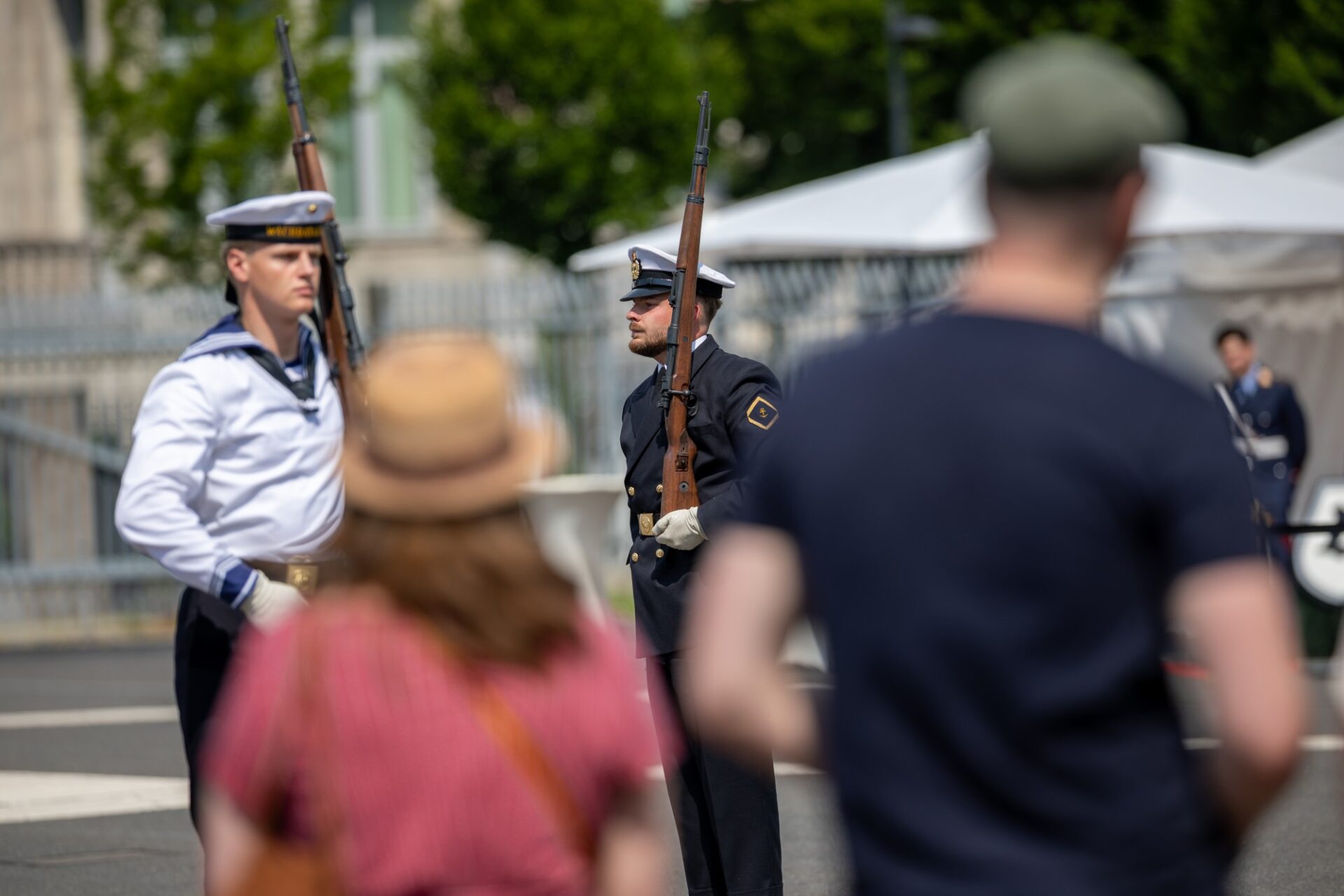
With the representative population survey 2026, the Center for Military History and Social Sciences of the German Armed Forces (ZMSBw) again comprehensively examined the society’s willingness to defend. For this, in April and May 2026, more than 2,200 randomly selected citizens were surveyed. According to the empirical data, according to ZMSBw, one can conclude: no one should underestimate Germany’s willingness to defend.
The basis of societal willingness to defend is the strongly expressed perception across all parts of the population of Russia as a threat to Germany’s security. Only the AfD’s electorate views Russia as a majority non-threat. With this threat perception, public support for strengthening national defense capabilities (increasing defense spending, personnel growth of the German Armed Forces, and acceptance of the New Military Service) as well as Germany’s military engagement to protect the NATO eastern flank and to militarily support Ukraine in its defense against Russia depends on it.
Strong support for Zeitenwende and the German Armed Forces
Given the ongoing threat from Russia, the survey shows that a clear majority continues to call for financial and personnel strengthening of the German Armed Forces (58 percent and 64 percent, respectively). The New Military Service, introduced at the beginning of 2026, also encounters broad societal acceptance, higher than the previous year (59 percent, +6 percentage points) – including among younger people.
Public support for the German Armed Forces remains very high and steadfast. Regardless of the security policy situation, for a quarter of a century at least three quarters of the population have reported a positive attitude toward the German Armed Forces. Currently, it is over 80 percent. The claim that the population harbors a critical attitude toward the German Armed Forces is an old claim, for which no empirical evidence exists, according to ZMSBw.
International Security: Strong Commitment, Decreasing Engagement
The majority of citizens holds a realistic foreign and security policy outlook and supports an active German foreign policy. Pacifist, isolationist, and militarist positions are held by only minority groups in the German population. Compared with the previous year, general support for an active German foreign policy has fallen, which is also reflected in the lower approval ratings for nearly all tools of foreign policy as well as for Germany’s overseas deployments by the German Armed Forces.
This development leads to a growing gap between the principled commitment to Germany’s responsibility for international security and public support for concrete (military) engagement to defend that security—within the EU, NATO, and the United Nations. Despite this development, a majority of 55 percent of respondents advocate that Germany should use military force to defend an eastern NATO member state if it were militarily attacked by Russia; a quarter (26 percent) are undecided and a minority (14 percent) oppose it.
Millions would defend Germany—with and without a weapon
In the event of a military attack on Germany, large parts of the population would be willing to engage in civil protection, in the medical sector, in defense-relevant economic sectors, or also in the armed forces. Men are more inclined to engage in technical or military roles, while women are more likely to envision service in the medical sector.
Significantly more men (53 percent) than women (15 percent) would fundamentally be ready to defend Germany with a weapon in the event of a military attack. The concrete interest in the New Military Service is also clearly higher among young men (34 percent) than among young women (17 percent). The same applies to the soldier profession: 20 percent of young men and 5 percent of young women can imagine becoming a soldier.
Personal willingness to defend remains high
What are the approval values for personal willingness to defend with a weapon and for interest in service in the armed forces? In the group of 20- to 40-year-olds alone, 50 percent of men and 16 percent of women declare themselves willing to take part in armed combat. In absolute numbers, this would amount to five million men and slightly less than two million women, according to the census.
Additionally, every fifth man aged 16 to 29 can imagine a professional activity as a soldier in the German Armed Forces. In absolute numbers, this would be more than one million men according to the census. And the 16- to 29-year-olds who express a moderate to very strong interest in the New Military Service would correspond to about two million men and around one million women in absolute numbers. Beyond the group of 18-year-old men, there is therefore further potential among interested candidates for the New Military Service.
Conclusion
No one should underestimate the willingness to defend among the German population, because the empirical findings show, according to ZMSBw: the acute threat from Russia is recognized, current defense policy is supported, and personal willingness to defend is sufficiently strong. For the German Armed Forces, the challenge is to harness the existing defense potential in the population in such a way that Germany’s defense capability is strengthened as quickly as possible and sustainably at the same time.
