
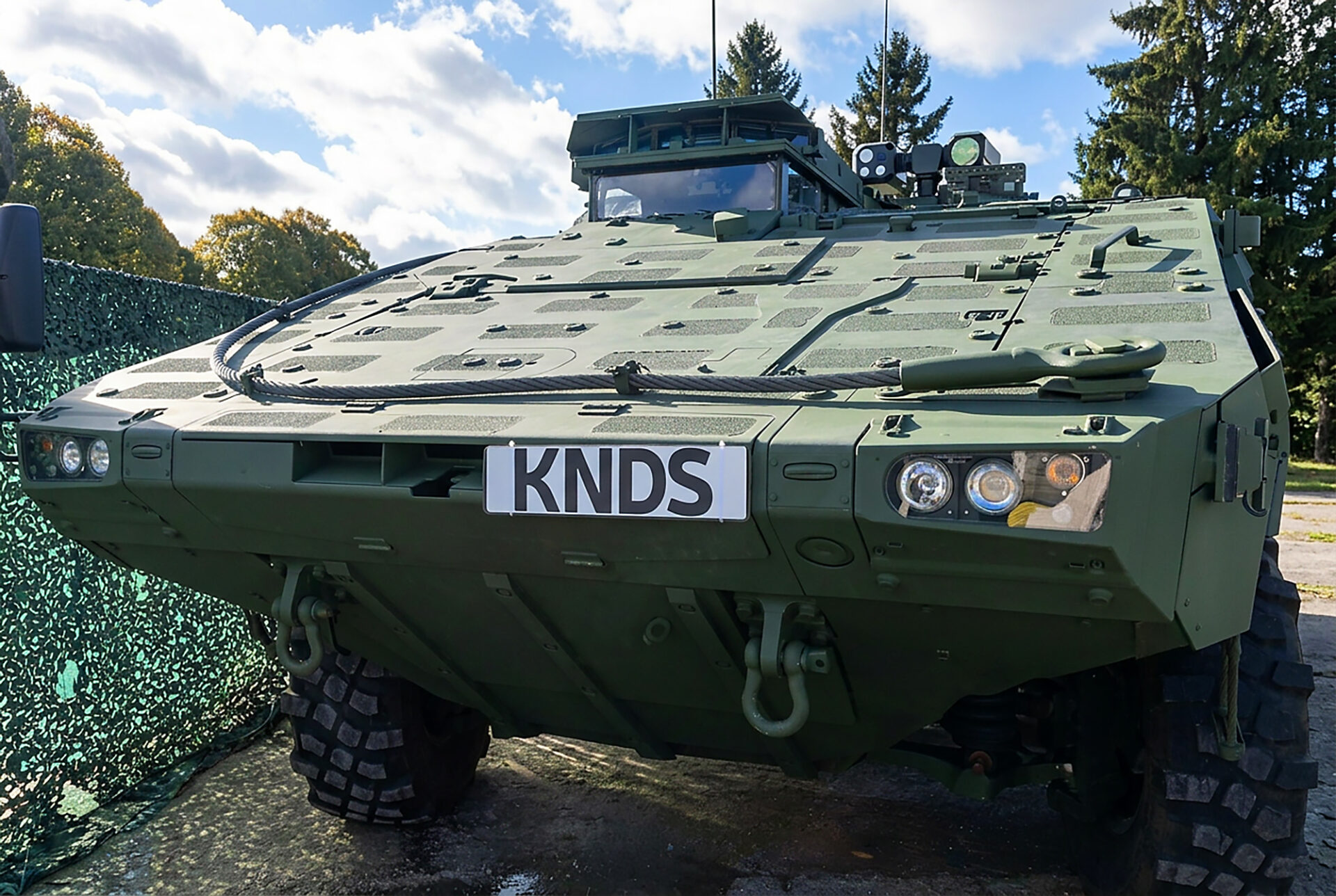
At yesterday’s Defence TechDay in Erding, KNDS Deutschland showcased a Boxer equipped with a laser weapon. The notable fact: it has already proven its effectiveness in tests. There exists currently a laser-based drone defense solution, and the system demonstrated in Erding also features additional peculiarities for operating unmanned systems. What from the outside at first glance seemed only modest is, in truth, a genuine novelty based on the Boxer platform — tested and proven.
New Drone Defense from Germany
For the laser Boxer, KNDS Deutschland and the startup Ground A merged their capabilities to realize a high-tech drone defense. The use of lasers offers significant advantages, especially against the defense of small and inexpensive drones, compared with conventional air defense systems. While countering with kinetic effects consumes ammunition for each target, a laser weapon only needs electrical energy. As a result, the costs and effort per shot-down drone are greatly reduced. After all, ammunition, including its logistical provisioning and production, is eliminated. As long as sufficient energy is available and the system remains operational, a laser weapon thus has an almost unlimited engagement potential.
However, lasers depend on environmental conditions. Fog, rain, and also dust can significantly limit range and effectiveness. In addition, the laser requires a direct line of sight to the target. Laser weapons are therefore not a complete replacement for existing air defense systems, but they can complement them meaningfully, especially in the near range. After all, the major advantage of lasers lies in the cost-effective engagement of smaller drones.
Boxer with a Laser as an Engagement Means
Another major advantage lies in precision. The laser can selectively damage individual components of a drone, such as sensors, propulsion elements, or other vulnerable parts. Especially for small drones, often made of plastic, this can be enough to render the aircraft inoperable within a short time. New developments are increasingly relying on artificial intelligence to identify particularly sensitive areas of the drone and to aim the laser beam accordingly.
The real technical challenge, however, lies less in generating the laser beam than in reliable target acquisition and tracking. Unlike a projectile, the laser must concentrate its energy over a small area of a potentially fast-moving target for a certain period of time. Even small deviations can significantly reduce effectiveness. Therefore, powerful sensors, precise beam steering, and fast tracking are crucial for the overall system’s effectiveness.
Ground A and Its GA 1000 Laser Weapon
The Ground A laser demonstrated its effectiveness in the Boxer setup shown at Defence TechDay already in live-fire tests during the past week. The energy comes from batteries, whose footprint inside the Boxer remains manageable. At most one workspace would be lost inside due to the batteries, the author was told. Temperature is also not a problem, as the laser operates in the low kilowatt range. That it remains effective against drones despite this modest power is due to the strong concentration of the beam on a point about the size of a euro coin.
This, of course, requires a powerful ability to track and follow the beam onto the opposing target, and precisely this is the outstanding feature of Ground A’s GA 1000 laser weapon: The system automatically detects and tracks the target, and the laser beam remains stable until it has its effect on the point.
The target spectrum is primarily the typical 10-inch drones, which also fly at around 100 km/h, explained company representatives. That these statements are based on credible information rather than PowerPoint promises was demonstrated by the laser Boxer from KNDS and Ground A again during tests in the past week. In real firing tests. For the mid-level forces, the Bundeswehr could therefore procure a Boxer drone-defense module with a laser weapon relatively soon to close the existing capability gap.
And exactly such insights were also the aim of the Defence TechDay in Erding, organized by TechHUB Security and Defense (SVI): to show what exists. What the industry possesses. What can be procured. This claim was more than fulfilled by yesterday’s event. There, in Erding, cutting-edge high-tech was on display, most of which could be procured on short notice. Like the laser Boxer for drone defense by KNDS and Ground A.
Author: Dorothee Frank, Online Editor-in-Chief
