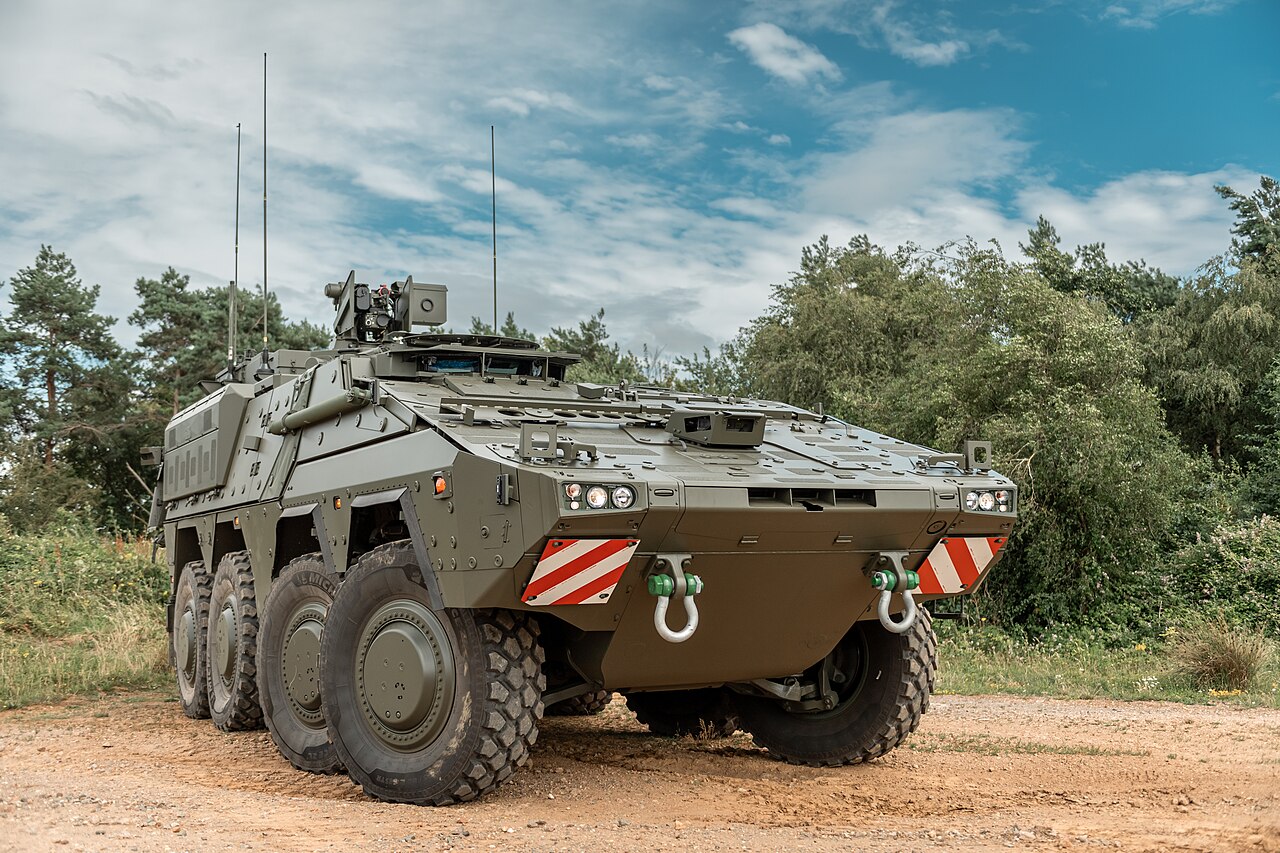
Britain has scrapped several versions of the GTK Boxer from the Mechanised Infantry Vehicle program and will not use the platform in the armoured cavalry role either. This was stated last week by Luke Pollard, Parliamentary State Secretary for Defence Readiness and Industry in the Ministry of Defence, in response to a parliamentary inquiry. Accordingly, the mortar carrier, the recovery version and the Mounted Close Combat Overwatch variant equipped with Brimstone missiles will no longer be pursued due to a change in priorities at the Military Strategic Headquarters.
By contrast, according to Pollard, the vehicle remains intended for command and medical tasks as well as troop transport in the 3rd (UK) Infantry Division, although these plans could still be revised. No surprise is the rejection of the cavalry role, i.e., essentially armoured reconnaissance. This should in the future be taken over by the reconnaissance vehicle Ajax. The minister did not indicate on which platform the capabilities removed from the Boxer development will be implemented instead. That they will be introduced is to be expected, particularly for a fundamental capability such as recovery and repair.
Britain’s tangled Boxer pathways
The British Boxer program has already traversed tangled paths. Britain originally joined the then German-French project as early as 1996. Both France (1999) and the UK (2003) later withdrew to develop their own vehicles, while the Netherlands (2001) joined. Unlike the French VBCI alternative, the British Future Rapid Effect System (FRES) languished in various problems and ultimately produced, through detours, the reconnaissance vehicle Ajax based on the Austrian-Spanish ASCOD infantry fighting vehicle with numerous development difficulties.
For the share of a multipurpose transport vehicle from FRES, in 2007 Boxer, VBCI and the Piranha V by General Dynamics European Land Systems were tested, but only as the basis for a version tailored to British needs. In 2008 the Piranha was selected, but for budgetary reasons no order was placed. The FRES program was subsequently restructured, but not relaunched in 2010 as planned. The reconnaissance component was instead merged with the Warrior IFV modernization project and led to Ajax, while the Warrior remained unmodernized.
Finally, Britain rejoined the Boxer program in 2018 and in 2019 awarded the manufacturer consortium ARTEC a contract for initially 523 vehicles. In 2022 this was increased by 100, bringing the total to 623, with the intended use of the type spanning ten different roles. According to recent reports, at least 96 wheeled howitzers, the RCH-155, will be added. For British production under the ARTEC license, the joint venture Rheinmetall BAE Systems Land established a production line in Telford, Shropshire. In August 2026 the British Army then took over the first vehicle from domestic production.
