During the Cold War, the issue of monitoring and opening roadblocks was ubiquitous. Afterward, it was neglected like many other skills, and mine clearance was reduced to the disposal of IEDs (Improvised Explosive Devices). Thanks to Russian aggression and the invasion of Ukraine, this capability is once again in demand. Today, however, it is certainly broader than it was at that time.
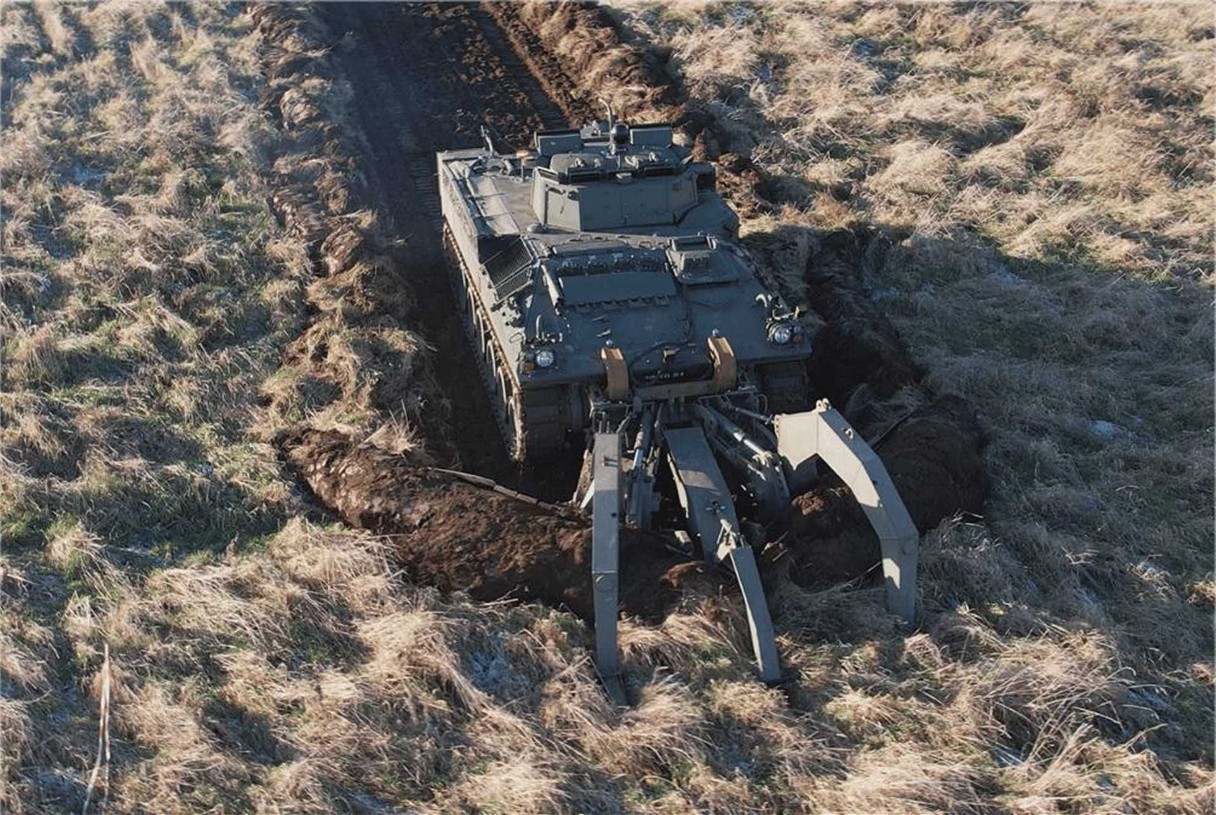
How can roadblocks be opened? Is the traditional (mine)-clearing tank—the Keiler, Rheinmetall Keiler New Generation, M1150 Assault Breacher Vehicle (ABV), VAB Génie, FFG WiSENT 1/2 MC, etc.—still the method of choice? Because today there are more options than the classic battle tank converted for mine clearance. The questions arise about manned or autonomous, wheeled or tracked, and armored or protected.

Developments in Mine Clearance
In the battles on the Western Front from 1915 to 1918, artillery fire suffocated any form of maneuver warfare at the outset. In the subsequent wars of the 20th century, mobility was the dominant factor on the battlefield. Currently, both Ukraine and Russia are constructing barriers, some with depths of up to 1,000 meters, thereby preventing the opponent from attempting to shift into maneuver warfare.
In the era of the “peace dividend,” the armed forces focused their attention on clearance safety. Milling and ram systems can meet the requirement for a clearance rate of up to 98 percent, but in practice, according to the Bundeswehr, they achieve only a clearance speed of less than 700 meters per hour and are extremely maintenance-intensive. The slower the clearance speed, the more time the opponent has to disable the vehicle early and prevent the opening of their barrier. In essence, every obstacle is monitored.
These constraints led military leadership to rethink away from milling- and ram systems toward mine-clearing ploughs and mine-clearing crawlers. In doing so, they consciously accept the lower clearance rates of both systems. The clearance plough detonates some mines but pushes others out of the clearance lane. This results in at least a theoretical possibility that these mines could slide back into the cleared lane and endanger following forces. But it also provides greater speed. Therefore, the latter systems can be deployed more readily under combat conditions, even though they remain highly vulnerable.
Hydrema 910 MCV from Denmark
One approach from Denmark is the Hydrema 910MCV (Mine Clearing Vehicle) V2 system. This is an 18-ton, highly mobile mine-clearing vehicle. It is specialized to safely neutralize both armored and anti-personnel mines and is used worldwide for military and humanitarian clearance missions. The operation of the area mine-clearing system runs in two directions: The vehicle drives on the road like a normal truck. Upon reaching the operational area, the crew turns around and backs over the area to be cleared. This creates a greater distance between the cab and the clearing tool.
 Mentioned here is: Sign up easily for a Digital Access to immediately benefit from all S&T Digital advantages. To Digital Access
Digital monthly pass
for €2.50 / month
Order
Digital annual pass
for €15 / 1 year
Order
Digital annual subscription
for €12 / 1 year
Order

Enjoy premium content and additional benefits from Soldat & Technik Digital:
- Access to all premium articles from Soldat & Technik.
- Easy payment via PayPal, direct debit, or credit card
- The subscription can be canceled at any time
- The monthly and yearly passes do not automatically renew.
